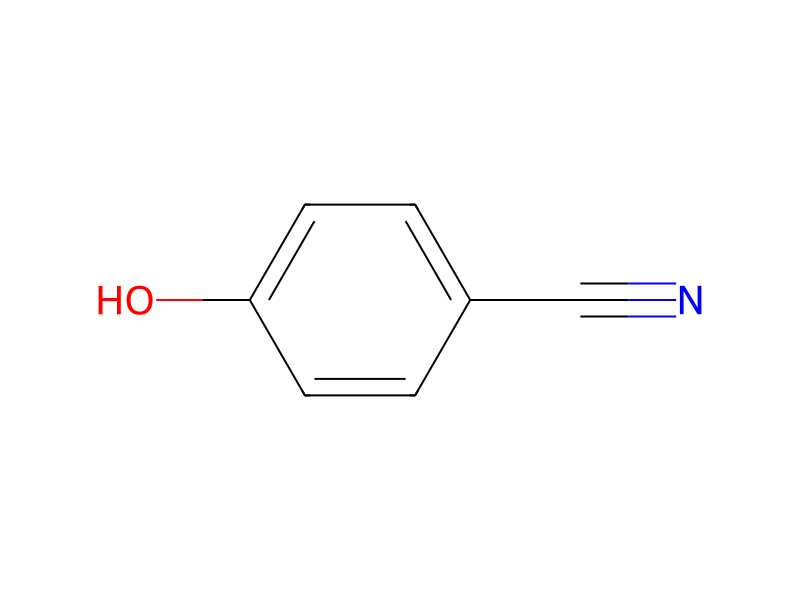
4-Cyanophenol → HCID 22388922, compound
Reaction equation

C(C1C=CC(O)=CC=1)#N.C(OC(=O)CCCCCBr)C.[CH2:21]([O:23][C:24](=[O:39])[CH2:25][CH2:26][CH2:27][CH2:28][CH2:29][O:30][C:31]1[CH:36]=[CH:35][C:34]([C:37]#[N:38])=[CH:33][CH:32]=1)[CH3:22]>>[CH2:21]([O:23][C:24](=[O:39])[CH2:25][CH2:26][CH2:27][CH2:28][CH2:29][O:30][C:31]1[CH:32]=[CH:33][C:34]([C:37]#[N:38])=[CH:35][CH:36]=1)[CH3:22].[C:37]([C:34]1[CH:35]=[CH:36][C:31]([O:30][CH2:29][CH2:28][CH2:27][CH2:26][CH2:25][C:24]([OH:39])=[O:23])=[CH:32][CH:33]=1)#[N:38]Participants
5


Procedure
That is, at first, 6-(4-cyanophenoxy)hexanoic acid ethyl ester is synthesized by Williamson reaction of 4-cyanophenol and 6-bromohexanoic acid ethyl ester. Then, the 6-(4-cyanophenoxy)hexanoic acid ethyl ester is hydrolyzed under an alkaline condition to obtain 6-(4-cyanophenoxy)hexanoic acid. Finally, the obtained 6-(4-cyanophenoxy)hexanoic acid is supplied to Pseudomonas oleovorans, which is one of PHA producing bacteria, to culture the bacterium and the product is extracted to obtain a PHA containing 3-hydroxy-6-(4-cyanophenoxy)hexanoic acid as a monomer unit.
Sources & evidence
- ORD record
- ord-2c73be1b19ba4fc889541ee412dc194d
- Source dataset
- uspto-grants-2005_03
- Patent number
- US06867023B2
Reaction notes
Loading…