Benzaldehyde → 2-Benzylidene-3-quinuclidinone
Reaction equation

[N:1]12[CH2:8][CH2:7][CH:4]([CH2:5][CH2:6]1)[C:3](=[O:9])[CH2:2]2.[CH:10](=O)[C:11]1[CH:16]=[CH:15][CH:14]=[CH:13][CH:12]=1.[OH-].[K+].O>CO>[CH:10](=[C:2]1[C:3](=[O:9])[CH:4]2[CH2:7][CH2:8][N:1]1[CH2:6][CH2:5]2)[C:11]1[CH:16]=[CH:15][CH:14]=[CH:13][CH:12]=1Participants
Reactant 4



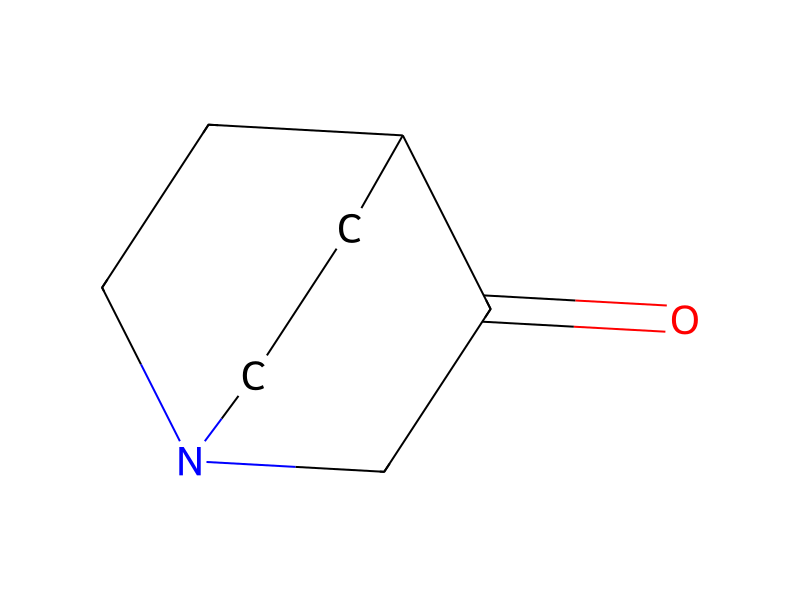
Product 1

Reagents, catalysts & solvents 1

Procedure
A mixture of 3-quinuclidinone (6.25 g, 50 mmol), benzaldehyde (5.83 g, 55 mmol) and KOH (0.84 g, 15 mmol) in 30 mL MeOH is heated under reflux for 16 h. The reaction is cooled and water is added. The mixture is extracted with CHCl3, dried (MgSO4), filtered and concentrated. The yellow solid is triturated with warm heptane, filtered and dried to provide 6.6 g (62%) of 2-benzylidene-1-azabicyclo[2.2.2]octan-3-one. A suspension of 2-benzylidene-1-azabicyclo[2.2.2]octan-3-one (6.6 g, 31 mmol) in MeOH is treated with a THF slurry of 10% Pd/C (0.38 g) in a Parr hydrogenation bottle. The bottle is charged with 40 psi of hydrogen gas and allowed to shake for 1 h. The mixture is filtered through Celite, and the solvent is removed in vacuo. The residue is purified by chromatography (Biotage 40M, 30% EtOAc/hexanes—100% EtOAc) to afford 0.48 g (7%) of 2-benzylidene-1-azabicyclo[2.2.2]octan-3-ol and 4.8 g (72%) of 2-benzylquinuclidin-3-one. MS (ESI+) for C14H17NO m/z 216.1 (M+H)+.
Workup
- temperatureis heated
- temperatureunder reflux for 16 h
- temperatureThe reaction is cooled
- extractionThe mixture is extracted with CHCl3
- dry with materialdried (MgSO4)
- filtrationfiltered
- concentrationconcentrated
- customThe yellow solid is triturated with warm heptane
- filtrationfiltered
- customdried
Sources & evidence
- ORD record
- ord-463d9a4da7b44191981eacc8f44fbb44
- Source dataset
- uspto-grants-2005_03
- Patent number
- US06869946B2
Reaction notes
Loading…