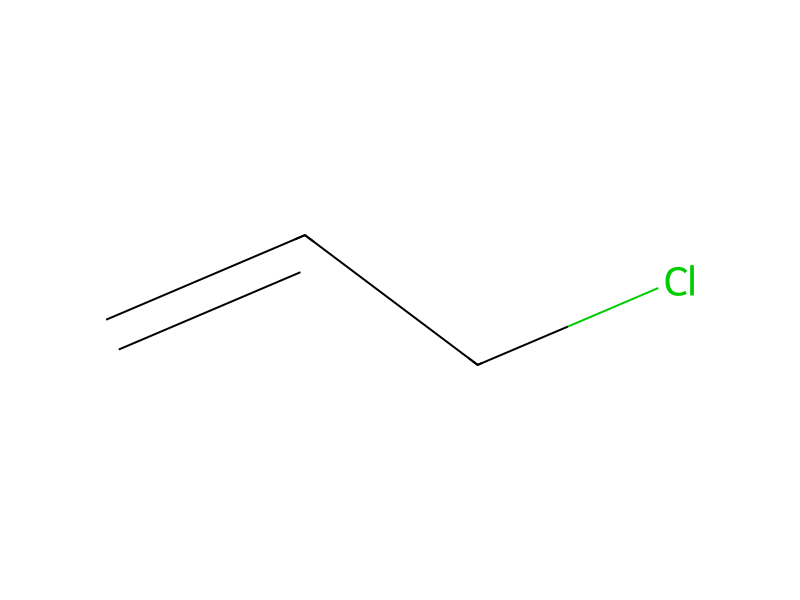
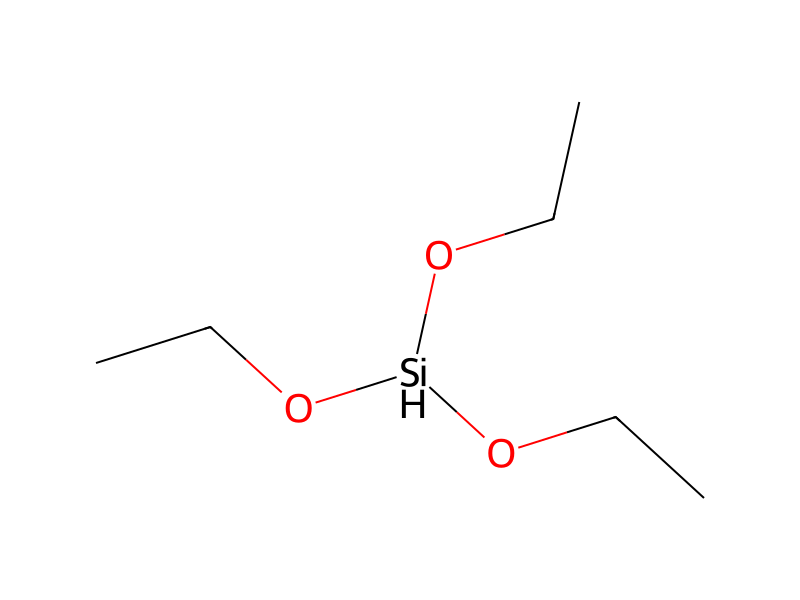
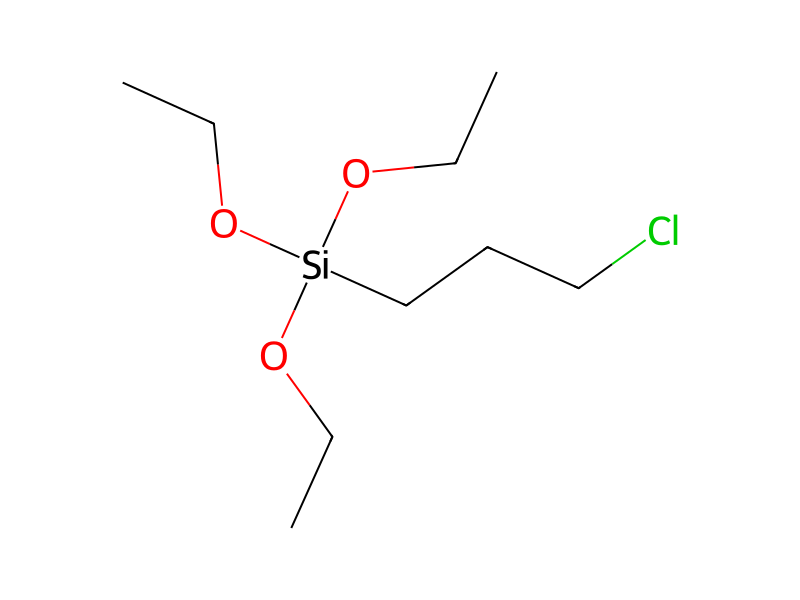
Allyl chloride → (3-Chloropropyl)triethoxysilane
Reaction equation

[CH2:1]([Cl:4])[CH:2]=[CH2:3].CO[SiH](OC)OC.[CH2:12]([O:14][SiH:15]([O:19][CH2:20][CH3:21])[O:16][CH2:17][CH3:18])[CH3:13]>[Ru]>[Cl:4][CH2:1][CH2:2][CH2:3][Si:15]([O:19][CH2:20][CH3:21])([O:16][CH2:17][CH3:18])[O:14][CH2:12][CH3:13]Participants
Reactant 3

Product 1
Reagents, catalysts & solvents 1

Procedure
Ruthenium has been reported to be a very efficient catalyst for the hydrosilation reaction of allyl chloride and trimethoxysilane. Japanese Patent No. 2,976,011 discloses the Ru-catalyzed hydrosilation reaction of triethoxysilane and allyl chloride to give chloropropyltriethoxysilane in about 41% yield. U.S. Pat. No. 5,559,264 describes the hydrosilation reaction of a methoxysilane and allyl chloride in the presence of a ruthenium catalyst and preferably in the substantial absence of solvent to provide a chloroalkylalkoxysilane. Tanaka et al., J. Mol. Catal. 1993, 81, 207-214 report the ruthenium carbonyl-catalyzed hydrosilation reaction of trimethoxysilane and allyl chloride and Japanese Patent Application No. 8[1996]-261232 describes the activation of ruthenium carbonyl for use as a hydrosilation catalyst for the same reaction.
Sources & evidence
- ORD record
- ord-9cf4cf866dfa4e5bbebde78334840aed
- Source dataset
- uspto-grants-2005_03
- Patent number
- US06872845B2
Reaction notes
Loading…