6-Aminohexanoic Acid → HCID 15992782, compound
Reaction equation

[NH2:1][CH2:2][CH2:3][CH2:4][CH2:5][CH2:6][C:7]([OH:9])=[O:8].[OH-].[Na+].C(=O)(O)[O-].[Na+].F[C:18]1[CH:23]=[CH:22][C:21]([N+:24]([O-:26])=[O:25])=[CH:20][CH:19]=1>O.C(O)C>[N+:24]([C:21]1[CH:22]=[CH:23][C:18]([NH:1][CH2:2][CH2:3][CH2:4][CH2:5][CH2:6][C:7]([OH:9])=[O:8])=[CH:19][CH:20]=1)([O-:26])=[O:25]Participants
Reactant 4

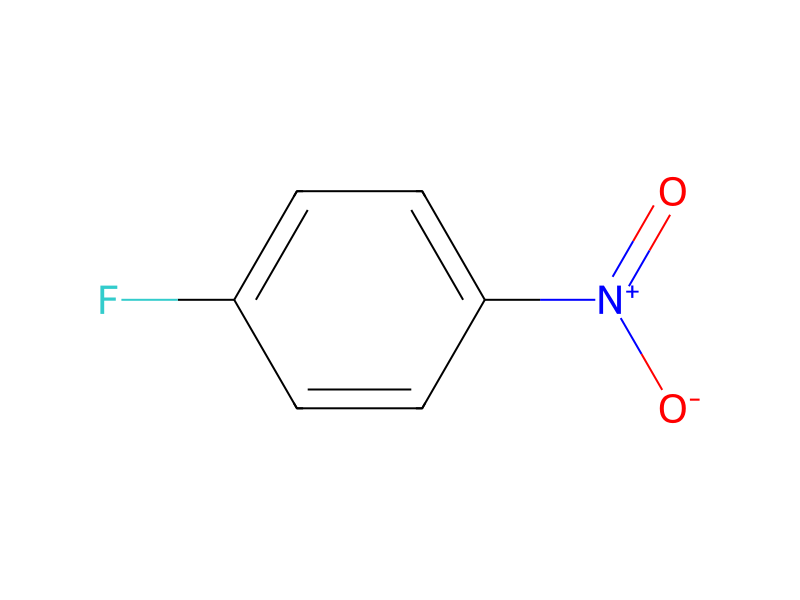


Product 1

Reagents, catalysts & solvents 2


Procedure
5 g (38.11 mmol) of 6-aminocaproic acid are dissolved in 50 ml of water in the presence of 1.5 g (1 eq) of sodium hydroxide and 4.2 g (1.3 eq) of sodium bicarbonate in a 250 ml three-necked flask equipped with a reflux condenser and a thermometer. A solution of 4.9 ml (1.2 eq) of 4-fluoronitrobenzene in 50 ml of ethanol is run into the mixture, which mixture is subsequently brought to reflux (85°-90° C.) for 48 hours. The mixture is cooled and then extracted 3 times with dichloromethane. The aqueous phase is acidified to pH˜3 with 5N hydrochloric acid. A yellow precipitate is formed; the mixture is left overnight in a refrigerator. The precipitate is pulled dry and washed with water and with acetone. After drying, 9.3 g of a yellow product are obtained, i.e. a final yield of 97%.
Workup
- customequipped with a reflux condenser
- temperatureto reflux (85°-90° C.) for 48 hours
- temperatureThe mixture is cooled
- extractionextracted 3 times with dichloromethane
- customA yellow precipitate is formed
- customThe precipitate is pulled dry
- washwashed with water and with acetone
- customAfter drying
Sources & evidence
- ORD record
- ord-731370078f1649c8b61fa6fa034e07cf
- Source dataset
- uspto-grants-2003_10
- Patent number
- US06630004B1
Reaction notes
Loading…