1-Butene → HCID 23503844, compound
Reaction equation

[CH2:1]=[CH:2][CH2:3][CH2:4][CH2:5][CH3:6].C=CCC>C1(C)C=CC=CC=1>[CH2:1]=[CH:2][CH2:3][CH3:4].[CH2:1]=[CH:2][CH2:3][CH2:4][CH2:5][CH3:6]Participants
Reactant 2
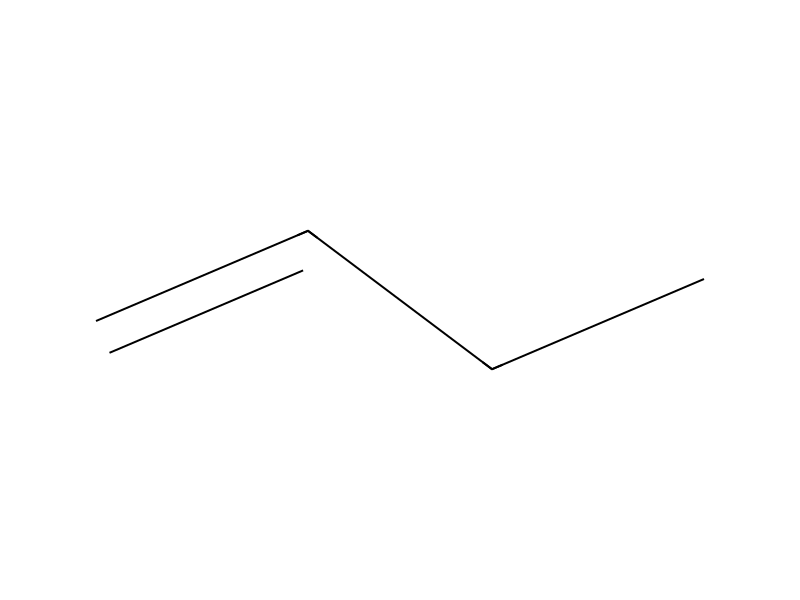

Product 1

Reagents, catalysts & solvents 1

Procedure
On the other hand, in an egg-plant type flask with an inner volume of 25 ml replaced with argon, 5 ml of purified toluene and 1.2 mg of dichloro{2,2′-thiobis[4-methyl-6-(tert-butyl)phenolato} titanium were mixed by stirring, and then charged into the autoclave. The molar ratio of [Al]/[Ti] of the catalyst solution prepared then was 8,000. After the catalyst solution was mixed by stirring at room temperature for 10 minutes, 31.5 ml of 1-hexene and 14 g of 1-butene were charged and the polymerization was carried out at 40° C. for 1 hour. Then, the polymerization was terminated by adding methanol. Further, the mixture was charged into about 10-fold acidic methanol, and the precipitated polymer was filtered to be dried at 80° C. for about 2 hours. As a result, 1.1 g of poly(1-butene/1-hexene) copolymer was obtained. Mw of the polymer obtained was 582×104, Mn was 227×104, Mw/Mn was 2.6, and no crystal fusion peak by DSC was detected. The glass transition temperature (Tg) was observed at −36° C. and the polymer was amorphous.
Workup
- additionwere mixed
- additioncharged into the autoclave
- customThe molar ratio of [Al]/[Ti] of the catalyst solution prepared
- additionAfter the catalyst solution was mixed
- stirringby stirring at room temperature for 10 minutes
- customThen, the polymerization was terminated
- additionby adding methanol
- additionFurther, the mixture was charged into about 10-fold acidic methanol
- filtrationthe precipitated polymer was filtered
- customto be dried at 80° C. for about 2 hours
Sources & evidence
- ORD record
- ord-106a28948e4f4c039f25dfa9a07942d5
- Source dataset
- uspto-grants-2003_10
- Patent number
- US06632900B2
Reaction notes
Loading…