过氧化氢 → 5-Bromo-2,3-dihydroxyethylbenzene
HRID 1069492
反应方程式
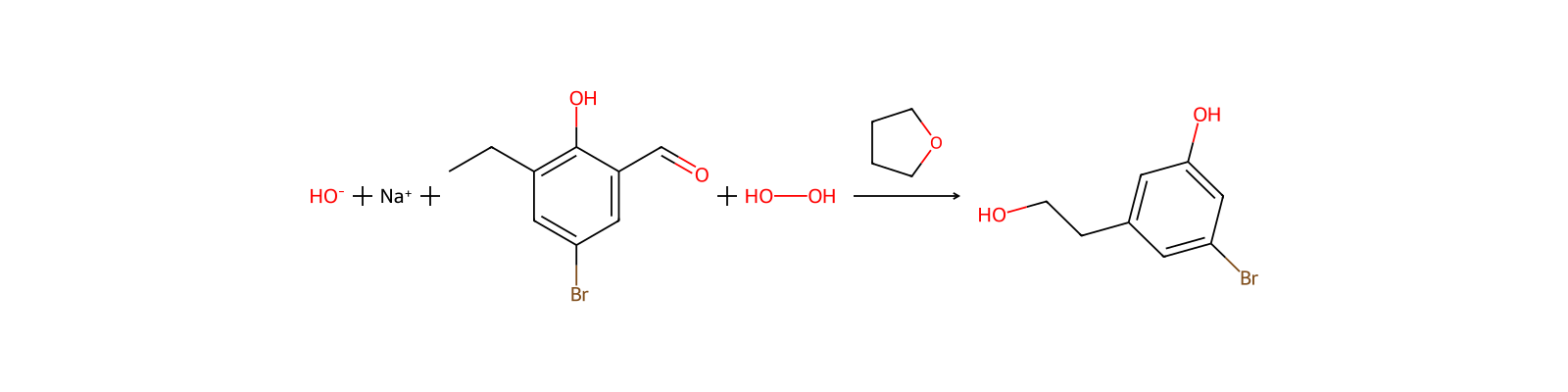
[OH-:1].[Na+].[Br:3][C:4]1[CH:11]=[C:8](C=O)[C:7](O)=[C:6]([CH2:13][CH3:14])[CH:5]=1.[OH:15]O>O1CCCC1>[Br:3][C:4]1[CH:11]=[C:8]([OH:15])[CH:7]=[C:6]([CH2:13][CH2:14][OH:1])[CH:5]=1参与物
5





实验过程
A 2L flask was charged with tetrahydrofuran (600 mL) and one normal aqueous sodium hydroxide (260 mL). To this solution was added 5-bromo-3-ethylsalicylaldehyde (58 g, 0.25 mol, prepared by the procedure described by S. A. Weerawarna et al., J. Het. Chem., 1991;28:1400). With good stirring, hydrogen peroxide (400 mL of 3% solution, 0.35 mol) was slowly added. After 30 minutes, tlc (silica plate eluted with hexane:ethyl acetate, 7:3) showed no more starting material. The reaction mixture was brought to a pH of ˜5.0 by addition of acetic acid. The tetrahydrofuran was removed under vacuum, then the aqueous mixture was extracted twice with 300 mL portions of methyl t-butyl ether. The ether solution was dried over magnesium sulfate, filtered, and concentrated to a dark oil (54.8 g). This material was not further purified, but used directly in the next reaction.