氢溴酸 → H-D-Phg-NH2.HBr
HRID 2052264
反应方程式
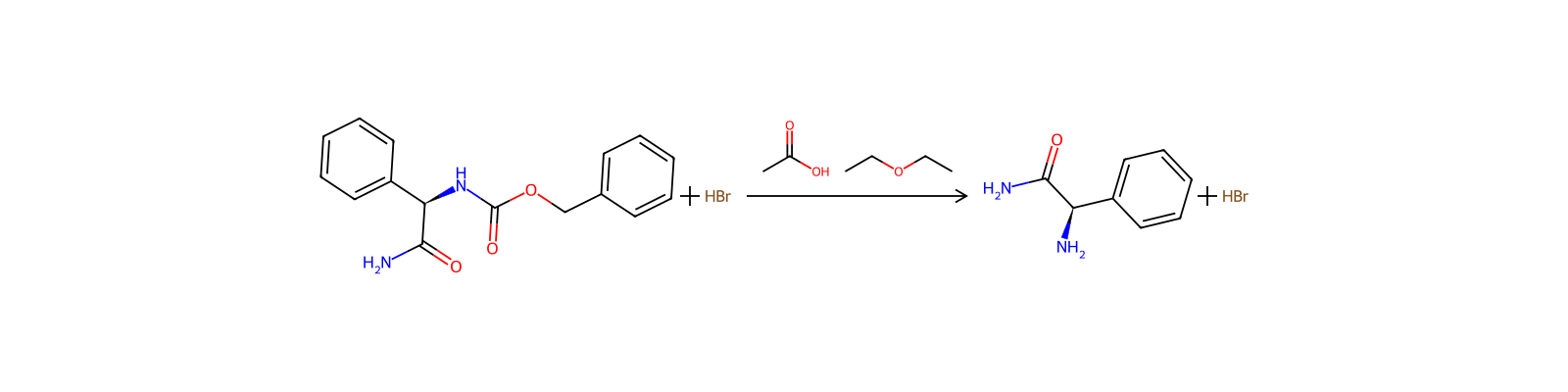
[NH:1](C(OCC1C=CC=CC=1)=O)[C@@H:2]([C:9]([NH2:11])=[O:10])[C:3]1[CH:8]=[CH:7][CH:6]=[CH:5][CH:4]=1.[BrH:22]>C(O)(=O)C.CCOCC>[NH2:1][C@@H:2]([C:9]([NH2:11])=[O:10])[C:3]1[CH:8]=[CH:7][CH:6]=[CH:5][CH:4]=1.[BrH:22]参与物
5





实验过程
20.0 g (70 mmoles) of Z-D-Phg-NH2, prepared as described in Step 1, are dissolved in 40 ml of acetic acid, and 70 ml of a 8 n HBr solution in acetic acid are poured to the solution. After 1 hour the reaction mixture is diluted with ether and the hydrobromide is filtered off. The salt, containing a great excess of HBr, is recrystallized from a tenfold amount of ethanol. 14.15 g (87.5%) of H-D-Phg-NH2.HBr are obtained; m.p.: 263.0°-263.5° C. (determined on a Koffler apparatus). Rf8 (HBr): 0.25; Rf8 base: 0.40. [α]D =-75.6° (c=1.0, in dimethyl formamide).