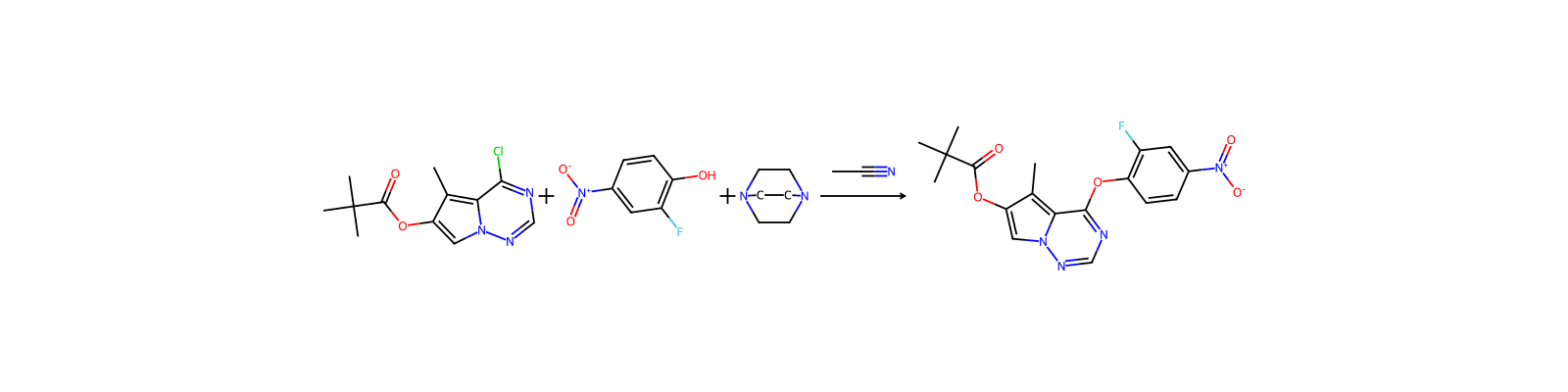
[C:1]([O:7][C:8]1[C:9]([CH3:18])=[C:10]2[N:15]([CH:16]=1)[N:14]=[CH:13][N:12]=[C:11]2Cl)(=[O:6])[C:2]([CH3:5])([CH3:4])[CH3:3].[F:19][C:20]1[CH:25]=[C:24]([N+:26]([O-:28])=[O:27])[CH:23]=[CH:22][C:21]=1[OH:29].C1N2CCN(CC2)C1>C(#N)C>[C:1]([O:7][C:8]1[C:9]([CH3:18])=[C:10]2[N:15]([CH:16]=1)[N:14]=[CH:13][N:12]=[C:11]2[O:29][C:21]1[CH:22]=[CH:23][C:24]([N+:26]([O-:28])=[O:27])=[CH:25][C:20]=1[F:19])(=[O:6])[C:2]([CH3:5])([CH3:4])[CH3:3]To a homogeneous solution of 4-chloro-5-methylpyrrolo[2,1-f][1,2,4]triazin-6-yl pivalate (1.00 g, 3.74 mmol, Compound D of Example 1) and 2-fluoro-4-nitrophenol (588 mg, 3.74 mmol) in anhydrous acetonitrile (25 mL), at room temperature under a nitrogen atmosphere, was added DABCO (462 mg, 4.12 mmol). The mixture was then heated at 50° C. for 3 h. The mixture was cooled to room temperature then partitioned between chloroform and saturated aqueous ammonium chloride. The aqueous layer was extracted twice with chloroform. The combined organic layers were washed once each with saturated aqueous ammonium chloride and saturated aqueous sodium chloride, dried over anhydrous magnesium sulfate and concentrated in vacuo to yield a pale yellow solid that was used in the next step without further purification. MS(ESI+) m/z 389.1 (M+H)+.