
HRID 5288als Edukt
Stearyltrimethylammonium chloride
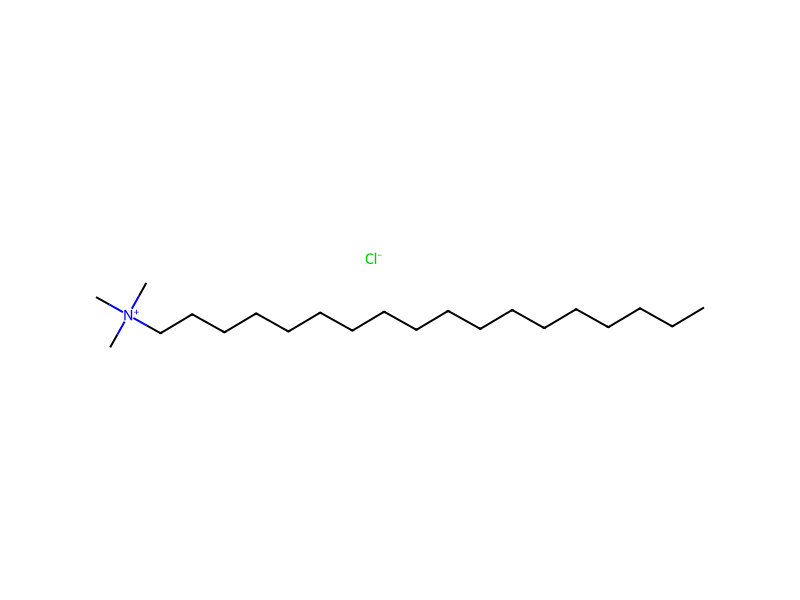
112-03-8CCCCCCCCCCCCCCCCCC[N+](C)(C)C.[Cl-]VBIIFPGSPJYLRR-UHFFFAOYSA-MStearyltrimethylammonium chloride is an organic molecular entity.
112-03-8DTXSID1026902CHEMBL118745Cosmetic ingredients (Steartrimonium Chloride) -> CIR (Cosmetic Ingredient Review)
Hair conditioning; Preservative
Sicherheitsangaben dienen nur zur Orientierung und ersetzen weder das Sicherheitsdatenblatt (SDB) des Lieferanten noch geltende Vorschriften oder eine fachliche Bewertung.
This chemical does not meet GHS hazard criteria for 3.7% (10 of 268) of reports.
Danger
H302 (88.1%): Harmful if swallowed [Warning Acute toxicity, oral]
P260, P262, P264, P264+P265, P270, P273, P280, P301+P317, P301+P330+P331, P302+P352, P302+P361+P354, P304+P340, P305+P354+P338, P316, P317, P321, P330, P361+P364, P362+P364, P363, P391, P405, and P501 (click each P-code to see the statement)
Aggregated GHS information provided per 268 reports by companies from 19 notifications to the ECHA C&L Inventory. Each notification may be associated with multiple companies.
Warning
Chemical: 1-Octadecanaminium, N,N,N-trimethyl-, chloride
1-Octadecanaminium, N,N,N-trimethyl-, chloride (1:1) is listed on the EPA's Chemical Data Reporting (CDR) system. Manufacturers and importers of 1-Octadecanaminium, N,N,N-trimethyl-, chloride (1:1) are required to report information about their production and use of this chemical to the EPA under the Toxic Substances Control Act (TSCA). (40 eCFR Part 711)
REACH registered substance: Trimethyloctadecylammonium chloride (EC: 203-929-1)
Octadecyltrimethylammonium chloride: Does not have an individual approval but may be used as a component in a product covered by a group standard. It is not approved for use as a chemical in its own right.
Acute Tox. 4 (88.1%)
Acute toxicity - category 4
Acute toxicity (Oral) - Category 4
CIR ingredient: Steartrimonium Chloride
Quaternium-10 is a quaternary ammonium salt found in numerous cosmetics. (L1890)
VerwendenEmulsion (main components are high polymeric and cyclic silicones); forms a protective film to coat split ends; conditioning agent for rinses and shampoos; glazing agent for hair.


CHEBI:81710The CIR Expert Panel concluded the following ingredients are safe in the present practices of use and concentration described in the safety assessment when formulated to be non-irritating...Steartrimonium Chloride...
Safe for use in cosmetics, with qualifications
While quaternium-10 itself is not toxic, it is a nitrosating agent. Nitrosating agents may decompose and/or react to cause nitrosamine contamination. Nitrosamines are produced from secondary amines and amides in the presence of nitrite ions and are believed to be carcinogenic. Once in the body, nitrosamines are activated by cytochrome P-450 enzymes. They are then believed to induce their carcinogenic effects by forming DNA adducts at the N- and O-atoms. (L1889, L1890, A2878, A2879, A2880)