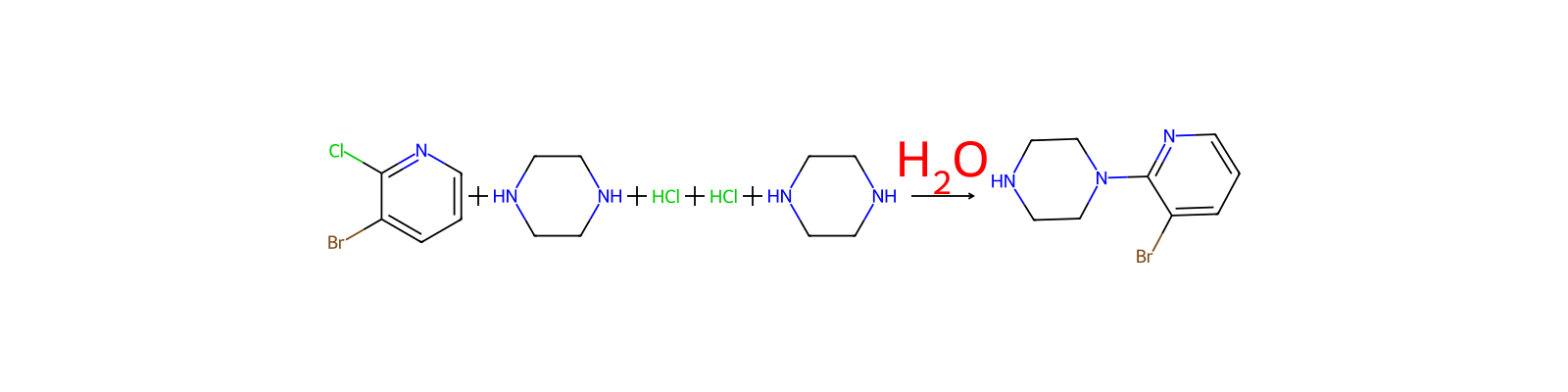
HRID 220448As reactant
Completing data — refresh the page later to see the latest
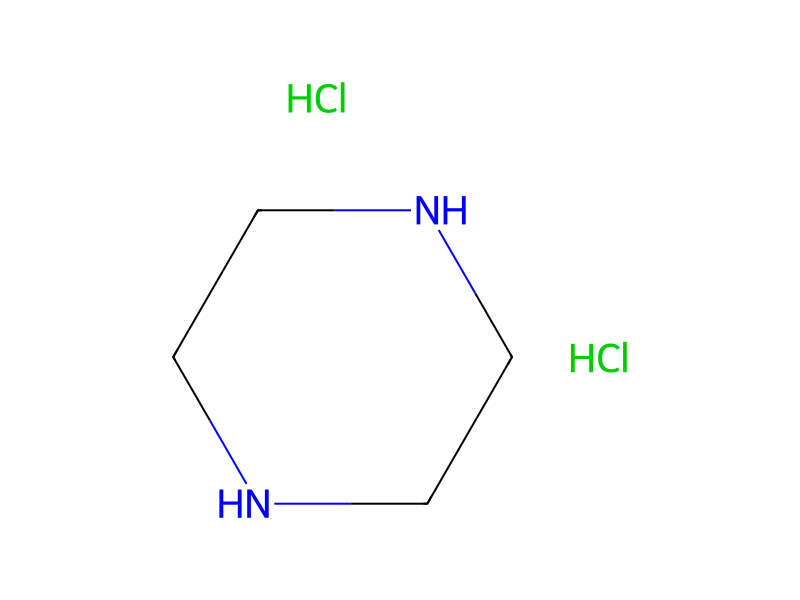
142-64-3C1CNCCN1.Cl.ClCVVIJWRCGSYCMB-UHFFFAOYSA-NPiperazine dihydrochloride appears as white to cream-colored needles or powder. Mp: 318-20 °C (with decomposition).
142-64-3、7542-23-6DTXSID4047096CHEMBL3188015CREAM COLORED CRYSTALLINE POWDER
WHITE NEEDLES
White to creamy colored needles or powder.
41 % (NIOSH, 2024)
SOLUBILITY IN WATER: 35% @ 0 °C, 41% @ 20 °C, 48% @ 50 °C; INSOL IN ORGANIC SOLVENTS
41%
635 °F (NIOSH, 2024)
635 °F
635 °F
Piperazine dihydrochloride appears as white to cream-colored needles or powder. Mp: 318-20 °C (with decomposition).
Safety information is for reference only and does not replace the supplier’s Safety Data Sheet (SDS), applicable regulations, or professional assessment.
Danger
H315: Causes skin irritation [Warning Skin corrosion/irritation]
P203, P233, P260, P261, P264, P264+P265, P271, P272, P273, P280, P284, P302+P352, P304+P340, P305+P351+P338, P318, P321, P332+P317, P333+P317, P337+P317, P342+P316, P362+P364, P403, P405, and P501 (click each P-code to see the statement)
Danger
H315 (100%): Causes skin irritation [Warning Skin corrosion/irritation]
P203, P233, P260, P261, P264, P264+P265, P271, P272, P273, P280, P284, P302+P352, P304+P340, P305+P351+P338, P318, P321, P332+P317, P333+P317, P337+P317, P342+P316, P362+P364, P403, P405, and P501 (click each P-code to see the statement)
Chemical: Piperazine, dihydrochloride
Hazard Traits - Respiratory Toxicity
Piperazine dihydrochloride: Does not have an individual approval but may be used as a component in a product covered by a group standard. It is not approved for use as a chemical in its own right.
Piperazine dihydrochloride is well tolerated as an oral medication at a dose of 150 mg/kg for several days. Skin burns, allergic contact dermatitis, and asthma have been reported after occupational exposures to piperazine dust. [ACGIH] Piperazine, CAS # 110-85-0, is corrosive to skin. [Quick CPC] Asthma reported in pharmaceutical and chemical production workers; [Malo] Allergic contact dermatitis reported in pharmaceutical, laboratory, healthcare, and veterinary workers; [Kanerva, p. 1827] See Piperazine and salts.
Used to manufacture fibers, pharmaceuticals, and insecticides; [ACGIH] Used as a veterinary anthelmintic medication and a curing agent for polychloroprene; [HSDB]
Plastic Composites Manufacturing [Category: Industry]
MEDICATION (VET)
MEDICATION
CHEM INT FOR ANTIHISTAMINES
USED IN MAKING INSECTICIDES & FIBERS
(1972) 8.3X10+8 GRAMS
(1975) 7.14X10+8 GRAMS
PIPERAZINE DIHYDROCHLORIDE 53% BASE /IS/ POPULAR IN DRY FEED OR DRINKING WATER /ANTHELMINTIC/ MEDICATION.
PIPERTAB 2: COMPOSITION: EACH TABLET CONTAINS: PIPERAZINE DIHYDROCHLORIDE EQUIVALENT TO 50 MG PIPERAZINE BASE. ... AVAILABLE IN 500 TABLET BOTTLES. PIPERTAB 10: COMPOSITION: EACH TABLET CONTAINS: PIPERAZINE DIHYDROCHLORIDE EQUIVALENT TO 250 MG PIPERAZINE BASE.





White to cream-colored needles or powder; [NIOSH]
White to cream-colored needles or powder.
White to cream-colored needles or powder.
STABLE @ TEMP TO 270 °C & IN NEUTRAL OR ACID MEDIA
Stability of piperazine can be accomplished by use of its simple salts, /including hydrochloride/, which are more stable than the piperazine base.
SLIGHTLY HYGROSCOPIC
82-83 °C /Monohydrate/
Manufacturers, packers, and distributors of drug and drug products for human use are responsible for complying with the labeling, certification, and usage requirements as prescribed by the Federal Food, Drug, and Cosmetic Act, as amended (secs 201-902, 52 Stat. 1040 et seq., as amended; 21 U.S.C. 321-392).
Skin Irrit. 2 (100%)
Eye irritation - category 2A
Acute toxicity (Oral) - Category 5
Repr. 2
Water [Note: Slightly hygroscopic (i.e., absorbs moisture from the air)].
Water [Note: Slightly hygroscopic (i.e., absorbs moisture from the air).]
Excerpt from NIOSH Pocket Guide for Piperazine dihydrochloride:
(General first aid procedures)
SRP: At the time of review, criteria for land treatment or burial (sanitary landfill) disposal practices are subject to significant revision. Prior to implementing land disposal of waste residue (including waste sludge), consult with environmental regulatory agencies for guidance on acceptable disposal practices.
If material not on fire and not involved in fire: Keep sparks, flames, and othersources of ignition away. Keep material out of water sources and sewers. Build dikes to contain flow as necessary. /Piperazine/
Personnel protection: Avoid breathing vapors. Keep upwind. ... Avoid bodily contact with the material. ... Do not handle broken packages unless wearing appropriate personal protective equipment. Wash away any material which may have contacted the body with copious amounts of water or soap and water. If contact with the material anticipated, wear appropriate chemical protective clothing. /Piperazine/
The worker should immediately wash the skin when it becomes contaminated.
Work clothing that becomes wet or significantly contaminated should be removed and replaced.
Workers whose clothing may have become contaminated should change into uncontaminated clothing before leaving the work premises.
8 hr Time Weighted Avg (TWA): 5 mg/cu m.
Excursion Limit Recommendation: Excursions in worker exposure levels may exceed 3 times the TLV-TWA for no more than a total of 30 minutes during a work day, and under no circumstances should they exceed 5 times the TLV-TWA, provided that the TLV-TWA is not exceeded.
0.03 ppm (inhalable fraction and vapor) [2011]
5 mg/m³
TWA 5 mg/m3
Excerpt from NIOSH Pocket Guide for Piperazine dihydrochloride:
Wear appropriate personal protective clothing to prevent skin contact.
Wear appropriate eye protection to prevent eye contact.
Eyewash fountains should be provided in areas where there is any possibility that workers could be exposed to the substance; this is irrespective of the recommendation involving the wearing of eye protection.
Facilities for quickly drenching the body should be provided within the immediate work area for emergency use where there is a possibility of exposure. [Note: It is intended that these facilities provide a sufficient quantity or flow of water to quickly remove the substance from any body areas likely to be exposed. The actual determination of what constitutes an adequate quick drench facility depends on the specific circumstances. In certain instances, a deluge shower should be readily available, whereas in others, the availability of water from a sink or hose could be considered adequate.]
IN ISOLATED FROG & RABBIT HEARTS PIPERAZINE PRODUCED BIPHASIC EFFECT WITH INITIAL NEG INOTROPIC ACTION FOLLOWED BY POS INOTROPIC ACTION. FORMER PHASE WAS ANTAGONIZED BY ATROPINE, HEXAMETHONIUM & DIGOXIN. DIRECT ACTION ON THE HEART IS SUGGESTED. /PIPERAZINE HYDROGEN CHLORIDE/
... SIDE EFFECTS ... INCL HEADACHES, NAUSEA, VOMITING, DIARRHEA, LETHARGY, TREMOR, INCOORDINATION, MUSCULAR WEAKNESS ... & VAGUE OCULAR DISTURBANCES. /PIPERAZINE SALTS/
LOSS OF CONSCIOUSNESS, DYSARTHRIA, APRAXIA, CLONIC SPASMS, TREMOR, MUSCULAR WEAKNESS, DROPPING OF OBJECTS, INABILITY TO THINK CLEARLY &/OR HALLUCINATIONS SEEN IN 35 YR OLD PT WITH TERMINAL RENAL FAILURE TAKING 30 MG PIPERAZINE HEXAHYDRATE/KG BODY WT/DAY FOR 10 DAYS. /PIPERAZINE HEXAHYDRATE/
SEVERE ILLNESS OCCURRED IN A 25 YR OLD WOMAN AFTER ADMIN OF PIPERAZINE ON 2 SEPARATE OCCASIONS. EVIDENCE FAVORS A HYPERSENSITIVITY MECHANISM RATHER THAN A DIRECT TOXIC EFFECT OF DRUG OR ITS METABOLITES. /PIPERAZINE/
ACUTE HUMAN EXPOSURES HAVE RESULTED IN MILD TO MODERATE SKIN BURNS & SENSITIZATION. MILD TO MODERATE ASTHMA HAS BEEN ASSOCIATED WITH INHALATION OF DUST.
EYE CONTACT, MARKED PAIN AND MODERATE EYE IRRITATION WHICH HEALS IN 2 DAYS WITH NO CORNEAL INJURY. SKIN CONTACT VERY SLIGHT IRRITATION.
VOMITING & DIARRHEA IS OCCASIONALLY REPORTED IN CATS & DOGS ESPECIALLY IF OVERDOSED. /ORAL ADMIN/
IN ISOLATED FROG & RABBIT HEARTS PIPERAZINE PRODUCED BIPHASIC EFFECT WITH INITIAL NEG INOTROPIC ACTION FOLLOWED BY POS INOTROPIC ACTION. FORMER PHASE WAS ANTAGONIZED BY ATROPINE, HEXAMETHONIUM & DIGOXIN. DIRECT ACTION ON HEART IS SUGGESTED. /PIPERAZINE/
Manufacturers, packers, and distributors of drug and drug products for human use are responsible for complying with the labeling, certification, and usage requirements as prescribed by the Federal Food, Drug, and Cosmetic Act, as amended (secs 201-902, 52 Stat. 1040 et seq., as amended; 21 U.S.C. 321-392).
52% piperazine base grades
Piperazine, hydrochloride (1:2): ACTIVE
INTRODUCED IN 1956 BY THE DOW CHEMICAL COMPANY AS A LIVESTOCK AND POULTRY ANTHELMINTIC.
UsesIt is used as a one day wormer, either in water or feed, for the control of Round worms in poultry, swine, and horses. It also controls nodular worms in swine, and small strongyles in horses.
UsesIn the manufacture of fibers, pharmarceuticals, and insecticides.
UsesPiperazine Dihydrochloride is an anthelmintic agent used in the treatment of parasitic worms in animals.
General DescriptionWhite to cream-colored needles or powder. Mp: 318-20°C (with decomposition).