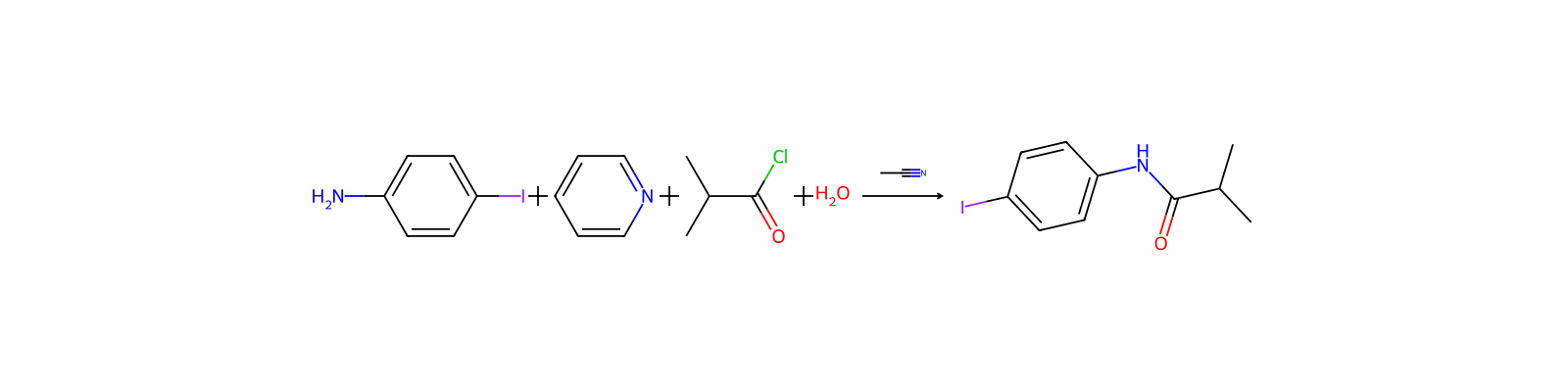
4-Iodanilin
4-Iodoaniline

Grundinformationen
- CAS
540-37-4- Standard-SMILES
Nc1ccc(I)cc1- InChIKey
VLVCDUSVTXIWGW-UHFFFAOYSA-N- Summenformel
- C6H6IN
- Durchschnittliche Molmasse
- 219,02 g/mol
- Monoisotopische Masse
- 218,95449719
Überblick
reagent
Namen und Bezeichner
- Bevorzugter Name
- 4-Iodoaniline
- IUPAC
- 4-iodoaniline
- Lokaler Name
- 4-Iodanilin
- Englischer Name
- 4-Iodoaniline
- Summenformel
- C6H6IN
- Molmasse
- 219.02
Namen und Synonyme
4-IODOANILINE540-37-4p-IodoanilineBenzenamine, 4-iodo-4-Iodobenzenamine0BMK56397BNSC-9246DTXSID9060239RefChem:858089DTXCID5041564208-743-44-iodophenylamine
Weitere Namen anzeigen
1-amino-4-iodobenzene4-IodoaniL4-LODANILINE4-iodo-anilinp-iodo-anilinp-lodoaniline
Aniline, p-iodo-Aniline, 4-iodo-p-Aminophenyl iodide4-Iodo-phenylamineMFCD000078484-iodobenzeneamine4-iodo-benzenamineCCRIS 9122
Datenbank-Bezeichner
- CAS
540-37-4- PubChem CID
- 10893
- DTXSID
DTXSID9060239- ChEMBL
CHEMBL41790- UNII
- 0BMK56397B
- EC Number
- 208-743-4
- Nikkaji
- J60.430E
Eigenschaften
Berechnete Struktureigenschaften
- XLogP
- 2,3
- Polarare Oberfläche (TPSA)
- 26 Ų
- H-Brücken-Donoren
- 1
- H-Brücken-Akzeptoren
- 1
- Frei drehbare Bindungen
- 0
- Schwere Atome
- 8
- Formalladung
- 0
- Komplexität
- 66,9
Experimentelle und physikochemische Eigenschaften
Chemical ClassesNitrogen Compounds -> Amines, Aromatic
SpringerMaterials Properties13C nuclear magnetic resonance spectrum
LogP2.34
Vapor Pressure0.00767 [mmHg]
Physical DescriptionWhite solid; [Merck Index] Light brown crystalline powder; [Alfa Aesar MSDS]
Physikochemische Eigenschaften
- Schmelzpunkt
- 61 · 61-63 °C(lit.)
- Siedepunkt
- 268.7 · 268.7±23.0 °C(Predicted)
- Dichte
- 1.8155 · 1.8155 (estimate)
- storage temp.
- Keep in dark place,Sealed in dry,Room Temperature
- Löslichkeit
- 2 O: · H2O: slightly soluble
- Aggregatzustand
- Crystalline Powder or Needles
- pka
Sicherheit und Regulatorisches
Sicherheitsangaben dienen nur zur Orientierung und ersetzen weder das Sicherheitsdatenblatt (SDB) des Lieferanten noch geltende Vorschriften oder eine fachliche Bewertung.
GHS-Klassifizierung
GHS Classification
Warning
H302 (98.4%): Harmful if swallowed [Warning Acute toxicity, oral]
P261, P264, P264+P265, P270, P271, P280, P301+P317, P302+P352, P304+P340, P305+P351+P338, P317, P319, P321, P330, P332+P317, P337+P317, P362+P364, P403+P233, P405, and P501 (click each P-code to see the statement)
Aggregated GHS information provided per 63 reports by companies from 11 notifications to the ECHA C&L Inventory. Each notification may be associated with multiple companies.
Gefahrenhinweise
Regulatory Information
Chemical: Benzenamine, 4-iodo-
4-Iodoaniline: Does not have an individual approval but may be used under an appropriate group standard
Hazards Summary
Causes degenerative spinal cord changes, structural changes in peripheral nerve or sheath, dyspnea, cyanosis, and weight loss in acute oral studies of rats; [RTECS] A skin and strong eye irritant; May induce methemoglobinemia; Harmful by inhalation; Toxic by ingestion and skin absorption; [Alfa Aesar MSDS]
Hazard Classes and CategoriesAcute Tox. 4 (98.4%)
Toxikologische Informationen
Adverse EffectsMethemoglobinemia - The presence of increased methemoglobin in the blood; the compound is classified as secondary toxic effect
Sicherheitsdaten
- F
- 8
- wgk
Chemie und Industrie
Verwendung und Herstellung
UsesA reagent; [ChemIDplus]
General Manufacturing InformationBenzenamine, 4-iodo-: ACTIVE
Anwendungen
Verwenden4-Iodoaniline is a iodine substituted aniline that is widely used as chemical intermediates in the manufacturing of pesticides, dyes and drugs. 4-Iodoaniline was shown to be a more potent nephrotoxica nt in vitro than other anilines.
Darstellung
synthetische4-Iodoaniline is obtained by the reaction of aniline and iodine in the presence of sodium bicarbonate. Add aniline and sodium bicarbonate to water and slowly add crushed iodine in stages with vigorous stirring. If the reaction solution is yellow, add a little sodium bisulfite to make it discolor, then filter and get the crude product. Then the product is recrystallized by ethanol to obtain 4-Iodoaniline.
Vor- und nachgelagerte Produkte
Vorgelagerte Rohstoffe
Nachgelagerte Produkte
Zugehörige Reaktionen
321


Notizen zur Verbindung
Wird geladen…