
3-Chinolylamin
3-Aminoquinoline
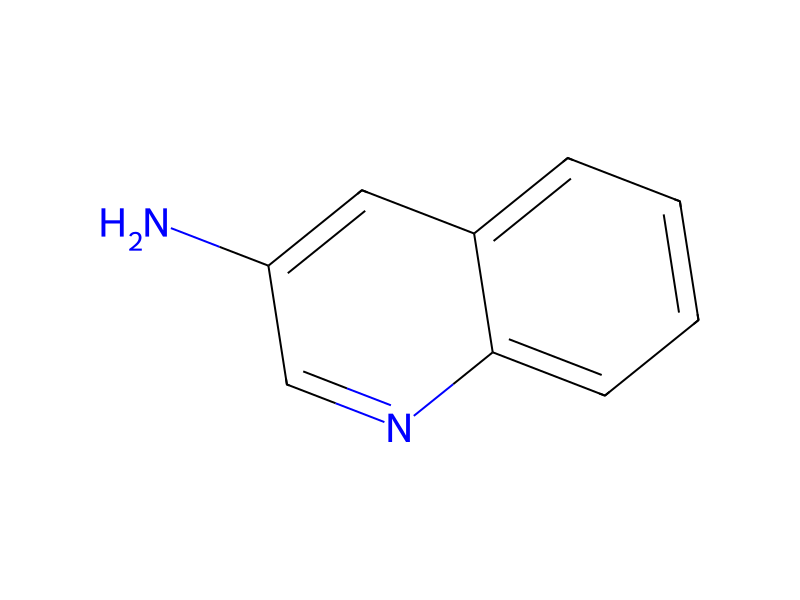
Grundinformationen
- CAS
580-17-6- Standard-SMILES
Nc1cnc2ccccc2c1- InChIKey
SVNCRRZKBNSMIV-UHFFFAOYSA-N- Summenformel
- C9H8N2
- Durchschnittliche Molmasse
- 144,17 g/mol
- Monoisotopische Masse
- 144,06874826
Überblick
3-Aminoquinoline is an aminoquinoline.
Namen und Bezeichner
- Bevorzugter Name
- 3-Aminoquinoline
- IUPAC
- quinolin-3-amine
- Lokaler Name
- 3-Chinolylamin
- Englischer Name
- 3-Aminoquinoline
- Summenformel
- C9H8N2
- Molmasse
- 144.17
Namen und Synonyme
3-AMINOQUINOLINEquinolin-3-amine3-Quinolinamine3-QuinolylamineQuinoline, 3-amino-3-Quinolineamine(Quinolin-3-yl)amineCCRIS 1678NSC 7934EINECS 209-455-1UNII-98OVL5K3R4BRN 0113317
Weitere Namen anzeigen
3-AQ3-AminoquinoL3-amino-quinolin6-Amine-quinolineQUINOLIN-3-YLAMINE
98OVL5K3R4NSC-7934AMINOQUINOLINE, 3-DTXSID80603795-22-10-00233 (Beilstein Handbook Reference)RefChem:93006DTXCID5042295InChI=1/C9H8N2/c10-8-5-7-3-1-2-4-9(7)11-6-8/h1-6H,10H
Datenbank-Bezeichner
- CAS
580-17-6- PubChem CID
- 11375
- DTXSID
DTXSID8060379- ChEMBL
CHEMBL80298- ChEBI
CHEBI:166512- UNII
- 98OVL5K3R4
- EC Number
- 209-455-1
- Nikkaji
- J48.195E
Eigenschaften
Berechnete Struktureigenschaften
- XLogP
- 1,6
- Polarare Oberfläche (TPSA)
- 38,9 Ų
- H-Brücken-Donoren
- 1
- H-Brücken-Akzeptoren
- 2
- Frei drehbare Bindungen
- 0
- Schwere Atome
- 11
- Formalladung
- 0
- Komplexität
- 136
Experimentelle und physikochemische Eigenschaften
SpringerMaterials PropertiesChemical shift
LogP1.63
Physikochemische Eigenschaften
- Schmelzpunkt
- 91 · 91-92 °C(lit.)
- Siedepunkt
- 137 °C · 137 °C / 1mmHg
- Dichte
- 1.1148 · 1.1148 (estimate)
- Brechungsindex
- 1.708 · 1.7080 (estimate)
- storage temp.
- 30 °C · Store below +30°C.
- Löslichkeit
- 0.1 g/mL, · methanol: 0.1 g/mL, clear
- pka
- 4.91 · 4.91(at 20℃)
- Aggregatzustand
- Crystalline Powder or Crystals
- Farbe
- White to beige
- Wasserlöslichkeit
- slightly soluble in hot water
- BRN
- 113317 · 113317
- InChI
Sicherheit und Regulatorisches
Sicherheitsangaben dienen nur zur Orientierung und ersetzen weder das Sicherheitsdatenblatt (SDB) des Lieferanten noch geltende Vorschriften oder eine fachliche Bewertung.
GHS-Klassifizierung
GHS Classification
Warning
H302 (10.9%): Harmful if swallowed [Warning Acute toxicity, oral]
P261, P264, P264+P265, P270, P271, P280, P301+P317, P302+P352, P304+P340, P305+P351+P338, P317, P319, P321, P330, P332+P317, P337+P317, P362+P364, P403+P233, P405, and P501 (click each P-code to see the statement)
Aggregated GHS information provided per 46 reports by companies from 5 notifications to the ECHA C&L Inventory. Each notification may be associated with multiple companies.
Gefahrenhinweise
Hazard Classes and CategoriesAcute Tox. 4 (10.9%)
CSL Reaction Information
CSL00129
3-AMINOQUINOLINE + SODIUM ETHYLXANTHATE
I was attempting to prepare 3-[ethoxy(thiocarbonyl)thio]quinoline by reacting the diazonium salt of 3-aminoquinine with potassium ethyl xanthate when an explosion occurred. Thankfully, the injury I received was minor. I was following the procedure described in the Journal of the Chemical Society, Part III [3, 2384 (1959)] on twice their scale. Jerry March's book "Advanced Organic Chemistry: Reactions, Mechanisms, Structure" (New York: John Wiley & Sons, 1992, 4th edition, page 670) lists the procedure as a customary route for the desired aryl xanthate ester and a convenient method for producing thiophenols. The same procedure is also described in "Organic Syntheses, Collective Volume III" (New York: John Wiley & Sons, page 809), which contains a cautionary note about a reported explosion, although the editors found no unusual reactivity. Since diazo esters were present, the explosion most likely resulted from the diazo ester's tendency to decompose explosively. It is unclear whether the diazo ester is a precursor of the desired product or whether the diazo ester forms through a competitive reaction. The reaction proceeded without event. But unlike the literature preparations, precipitation occurred during product extraction with diethyl ether and was isolated by filtration. A 1H NMR of the wet cake was consistent with the desired structure. The solid was air-dried overnight and weighed 17 g. The detonation occurred when a metal spatula was inserted into the solid. Related work in Tetrahedron Letters [26, 6365 (1985)] successfully demonstrated the safe preparation of diaryl sulfides. However, this was done at 25 ºC (mine at 45 ºC) with care taken to avoid heat, since a reference is cited of an explosion at 60 ºC. Also, the disappearance of the suspected diazo sulfide was monitored by thin layer chromatography, and sluggish reactions were not pushed to conversion. Instead, chromatography was used to remove any intermediates.
Chemie und Industrie
Verwendung und Herstellung
UsesSynthetic Polymer MALDI Matrix Compounds
General Manufacturing Information3-Quinolinamine: INACTIVE
Anwendungen
Verwenden3-Aminoquinoline was used:in liquid matrix for matrix-assisted laser desorption/ionization mass spectrometry (MALDI-MS) for glycopeptides, carbohydrates and phosphopeptidesin liquid matrix during novel glycan-labeling method for quantitative profiling of N-glycan by MALDI-MS analysisas derivatizing reagent for MALDI-MS analysis of oligosachharides
Vor- und nachgelagerte Produkte
Vorgelagerte Rohstoffe
Nachgelagerte Produkte
Zugehörige Reaktionen
143





Notizen zur Verbindung
Wird geladen…