
Grundinformationen
- Standard-SMILES
O=C1CCC(=O)N1I- InChIKey
LQZMLBORDGWNPD-UHFFFAOYSA-N- Summenformel
- C4H4INO2
- Durchschnittliche Molmasse
- 224,98 g/mol
- Monoisotopische Masse
- 224,92868
Namen und Bezeichner
- Bevorzugter Name
- N-Iodosuccinimide
- IUPAC
- 1-iodopyrrolidine-2,5-dione
- Lokaler Name
- 1-Iodpyrrolidin-2,5-dion
- Englischer Name
- N-Iodosuccinimide
- Summenformel
- C4H4INO2
- Molmasse
- 224.98
Namen und Synonyme
N-Iodosuccinimide516-12-11-Iodopyrrolidine-2,5-dioneSucciniodimide2,5-Pyrrolidinedione, 1-iodo-1-iodo-2,5-pyrrolidinedione3COS3X3N4PCHEBI:53204DTXSID10199550RefChem:163587DTXCID70122041208-221-6
Weitere Namen anzeigen
IodosuccinimideN-lodosuccinimide1-iodo-5-pyrrolidinedioneN-iododiimideN-Iodouccinimide
N-Iodosuccinimide (NIS)C4H4INO2MFCD00005512Succinimide, N-iodo-NISUNII-3COS3X3N4PEINECS 208-221-62,5-Dioxo-1-iodopyrrolidine
Datenbank-Bezeichner
- CAS
516-12-1- PubChem CID
- 120273
- DTXSID
DTXSID10199550- ChEBI
CHEBI:53204- UNII
- 3COS3X3N4P
- EC Number
- 208-221-6
- Nikkaji
- J6.303G
Eigenschaften
Berechnete Struktureigenschaften
- XLogP
- -0,2
- Polarare Oberfläche (TPSA)
- 37,4 Ų
- H-Brücken-Donoren
- 0
- H-Brücken-Akzeptoren
- 2
- Frei drehbare Bindungen
- 0
- Schwere Atome
- 8
- Formalladung
- 0
- Komplexität
- 129
Physikochemische Eigenschaften
- Schmelzpunkt
- 202 · 202-206 °C(lit.)
- Siedepunkt
- 249.6 · 249.6±23.0 °C(Predicted)
- Dichte
- 2 · 2,245 g/cm3
- storage temp.
- 2 · 2-8°C
- Löslichkeit
- Soluble in dioxane, tetrahydrfuran and acetonitrile. Insoluble in ether and carbon tetrachloride.
- pka
- -2.57 · -2.57±0.20(Predicted)
- Aggregatzustand
- Crystalline Powder
- Farbe
- White-yellow to brown
- Wasserlöslichkeit
- decomposes
- Merck
- 14 · 14,5045
- BRN
- 113917 · 113917
- Stabilität
- Moisture Sensitive
- InChI
- 1S/C4H4INO2/c5-6-3(7)1-2-4(6)8/h1-2H2
- InChIKey
- LQZMLBORDGWNPD-UHFFFAOYSA-N
- SMILES
- IN1C(=O)CCC1=O
- CAS Datenbank
- 516 · 516-12-1(CAS DataBase Reference)
Sicherheit und Regulatorisches
GHS-Klassifizierung
GHS Classification
This chemical does not meet GHS hazard criteria for 8% (7 of 87) of reports.
Warning
H302 (85.1%): Harmful if swallowed [Warning Acute toxicity, oral];H315 (90.8%): Causes skin irritation [Warning Skin corrosion/irritation];H319 (90.8%): Causes serious eye irritation [Warning Serious eye damage/eye irritation];H335 (87.4%): May cause respiratory irritation [Warning Specific target organ toxicity, single exposure; Respiratory tract irritation]
P261, P264, P264+P265, P270, P271, P280, P301+P317, P302+P352, P304+P340, P305+P351+P338, P319, P321, P330, P332+P317, P337+P317, P362+P364, P403+P233, P405, and P501 (click each P-code to see the statement)
Aggregated GHS information provided per 87 reports by companies from 18 notifications to the ECHA C&L Inventory. Each notification may be associated with multiple companies.;Reported as not meeting GHS hazard criteria per 7 of 87 reports by companies.;There are 17 notifications provided by 80 of 87 reports by companies with hazard statement code(s).;Information may vary between notifications depending on impurities, additives, and other factors. The percentage value in parenthesis indicates the notified classification ratio from companies that provide hazard codes. Only hazard codes with percentage values above 10% are shown. For more detailed information, please visit ECHA C&L website.
Gefahrenhinweise
Regulatory Information
Status: Active Update: 17-02-2023 https://echa.europa.eu/registration-dossier/-/registered-dossier/25034
2,5-Pyrrolidinedione, 1-iodo-: Does not have an individual approval but may be used under an appropriate group standard
Hazard Classes and CategoriesAcute Tox. 4 (85.1%);Skin Irrit. 2 (90.8%);Eye Irrit. 2 (90.8%);STOT SE 3 (87.4%)
Regulatorische Informationen
Regulatory Information
Status: Active Update: 17-02-2023 https://echa.europa.eu/registration-dossier/-/registered-dossier/25034
2,5-Pyrrolidinedione, 1-iodo-: Does not have an individual approval but may be used under an appropriate group standard
Sicherheitsdaten
- F
- 8-9
- wgk
- 3
- tsca
- No
- hs_code
- 29251995
- RTECS-Nr.
- WN2817000
- risk_code
- 22-36/37/38
- hazard_code
- Xn,Xi
- hazard_note
- Harmful/Keep Cold/Moisture Sensitive
- safety_code
- 26-36-37/39
- hazard_class
- IRRITANT
- Speicherklasse
- 11 - Combustible Solids
- Hazard Classifications
- Aquatic Acute 1Aquatic Chronic 1Eye Irrit. 2Muta. 2Skin Irrit. 2Skin Sens. 1B
Chemie und Industrie
Anwendungen
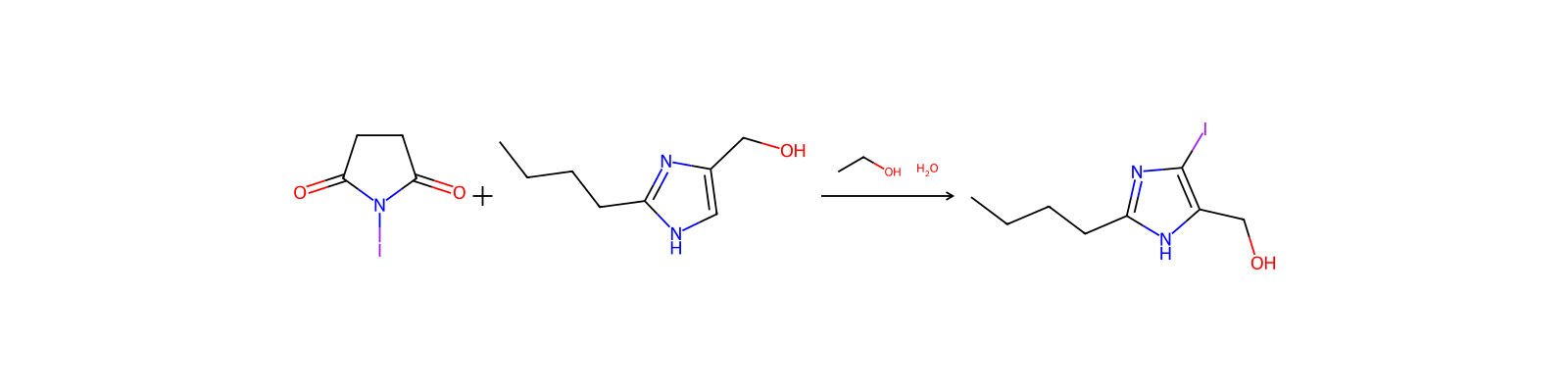
VerwendenN-Iodosuccinimide is a iodo substituted succinimide that is used as an iodinating agent in chemical synthesis.
Darstellung
synthetischeTo a solution of 39.2g of succinimide in 1200ml of boiling water was added 51.0g of freshly precipitated silver oxide, the mixture was filtered and the silver salt was allowed to crystallize. Filtration and washing with cold water furnished 45.0g of the silver salt of succinimide suitable for the iodination step. The finely powdered salt (49.5g) was added in portions with stirring to a solution of 50.8g of iodine in 300ml of acetone, the temperature being maintained at 5-10°C. After decolorization (30 min.), the silver iodide was filtered, the solvent was removed under reduced pressure at room temperature and the residue was washed with ether, yielding 43g of N-iodosuccinimide with mp 189-191°C. An analytical sample (85% recovery) was obtained by dissolving in the minimum quantity of hot dioxane and precipitating with carbon tetrachloride; colorless needles, mp 200-201°C. Ref: JACS 75, 3493 (1953)
Vor- und nachgelagerte Produkte
Vorgelagerte Rohstoffe
Nachgelagerte Produkte
Anbieter50 Anbieter
梯希爱(上海)化成工业发展有限公司021-67121386 · [email protected]
上海阿拉丁生化科技股份有限公司400-6206333 13167063860 · [email protected]
宁波君龙新材料有限公司0574 88552216 19032109277 · [email protected]
INTATRADE GmbH+49 3493/605464 · [email protected]
爱斯特(成都)生物制药股份有限公司+86-28-85122536 85324413 · [email protected]
韶远科技(上海)有限公司021-50795510 4000665055 · [email protected]
科瑞迪化学400-821-5857 021-64326257 · [email protected]
Syntechem Co.,Ltd[email protected]
上海迈瑞尔生化科技有限公司4006356688 18621169109 · [email protected]
武汉易泰科技有限公司上海分公司18930552037 · [email protected]
阿法埃莎(中国)化学有限公司400-6106006 · [email protected]
安耐吉化学&3A(安徽泽升科技股份有限公司)400-0056266 · [email protected]
石家庄斯迪亚诺精细化工有限公司0311-89250318 13582355795 · [email protected]
武汉凯威斯科技有限公司86-027-67849912 · [email protected]
芜湖诺威化学技术有限公司0553-8233716 18055326116 · [email protected]
上海柏卡化学技术有限公司400-026-1533/(021) 6478-0600 · [email protected]
上海瀚鸿科技股份有限公司021-54306202 13764082696 · [email protected]
济南德信佳生物科技有限公司0531-82375886 13001715031 · [email protected]
上海相辉医药科技有限公司13761987713 · [email protected]
上海景颜化工科技有限公司13817811078 · [email protected]
嘉兴市艾森化工有限公司0573-85285100 18627885956 · [email protected]
Pure Chemistry Scientific Inc.001-857-928-2050 or 1-888-588-9418 · [email protected]
上海隆盛化工有限公司58099637 13585536065 · [email protected]
上海攀鸿化工科技有限公司021-56491756 13512199871 · [email protected]
泰州市鑫泓川新材料有限公司18651157028 18651157028
苏州施亚生物科技有限公司86(512)5235 8471 17715136450 · [email protected]
山东西亚化学有限公司13355009207 13355009207 · [email protected]
玛雅试剂+86 (573) 82222445 (0)18006601000 452520369 · [email protected]
四川库利南科技有限公司400-1166-196 18981987031 · [email protected]
天津希恩思生化科技有限公司400 638 7771 · [email protected]
湖南汇百侍生物科技有限公司0731-85526065 13308475853 · [email protected]
南京维奥化工有限公司Please Send Email 18652950785 · [email protected]
河南多贝化工有限公司0370-2785118 17550508557 · [email protected]
斯百全化学(上海)有限公司021-021-021-67601398-809-809-809 15221380277 · [email protected]
北京泰亚杰科技有限公司021-33690831-8001 13552411790;18616022633 · [email protected]
上海源叶生物科技有限公司13636370518 · [email protected]
艾科试剂4008-755-333 18080918076 · [email protected]
上海思域化工科技有限公司86-21-34053660 · [email protected]
赛默飞世尔科技(中国)有限公司800-810-5118 · [email protected]
北京伊诺凯科技有限公司400-810-7969 010-59572699 · [email protected]
上海遐瑞医药科技有限公司+86 21 61551611
江苏艾康生物医药研发有限公司025-66113011 13913916777 · [email protected]
TCI AMERICA800-4238616 · [email protected]
TOKYO CHEMICAL INDUSTRY CO., LTD.03-36680489 · [email protected]
TCI Europe320-37350700 · [email protected]
上海贤鼎生物科技有限公司4009209199 · [email protected]
深圳康特腾科技有限公司86-0755-86635001 · [email protected]
越林试剂021-62960152 · [email protected]
无锡中坤生化科技有限公司+86 0510-85629785
上海汇凯化学科技有限公司021-61995394 18916691159 · [email protected]
Ergänzende Hinweise
DefinitionChEBI: N-iodosuccinimide is a five-membered cyclic dicarboximide compound having an iodo substituent on the nitrogen atom. It is a dicarboximide and a pyrrolidinone. It derives from a succinimide.
Zugehörige Reaktionen
2.200


Verknüpfte Notizen
Wird geladen…