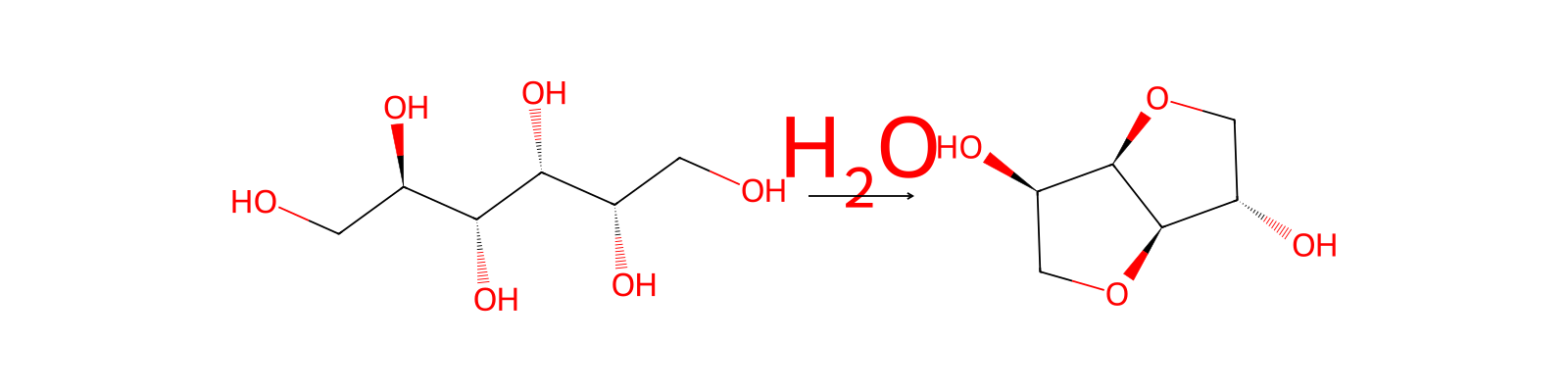
1,4:3,6-Dianhydro-D-glucitol
Isosorbide

Grundinformationen
- CAS
652-67-5- Standard-SMILES
O[C@@H]1CO[C@H]2[C@@H]1OC[C@@H]2O- InChIKey
KLDXJTOLSGUMSJ-JGWLITMVSA-N- Summenformel
- C6H10O4
- Durchschnittliche Molmasse
- 146,14 g/mol
- Monoisotopische Masse
- 146,0579088
Überblick
Isosorbide is an organic molecular entity.
Namen und Bezeichner
- Bevorzugter Name
- Isosorbide
- IUPAC
- (3S,3aR,6R,6aR)-2,3,3a,5,6,6a-hexahydrofuro[3,2-b]furan-3,6-diol
- Lokaler Name
- 1,4:3,6-Dianhydro-D-glucitol
- Englischer Name
- Isosorbide
- Summenformel
- C6H10O4
- Molmasse
- 146.14
Namen und Synonyme
isosorbide652-67-5IsobideDevicoran1,4:3,6-Dianhydro-D-glucitolHydronolIsmotic(3R,3aR,6S,6aR)-hexahydrofuro[3,2-b]furan-3,6-diol(+)-D-IsosorbideD-Glucitol, 1,4:3,6-dianhydro-1,4:3,6-Dianhydrosorbitol1,4:3,6-Dianhydro-D-sorbitol
Weitere Namen anzeigen
at101Isosorbide (75% solution, 1 g)ucitoLIsosorbidNSC 40725
DTXSID5046196NSC-40725Glucitol, 1,4:3,6-dianhydro-, D-WXR179L51SNSC40725DTXCID3026196(3R,3aR,6S,6aR)-hexahydrofuro(3,2-b)furan-3,6-diolRefChem:55420
Datenbank-Bezeichner
- CAS
652-67-5- PubChem CID
- 12597
- DTXSID
DTXSID5046196- ChEMBL
CHEMBL1200660- ChEBI
CHEBI:6060- UNII
- WXR179L51S
- EC Number
- 211-492-3
- Nikkaji
- J7.077G
Eigenschaften
Berechnete Struktureigenschaften
- XLogP
- -1,4
- Polarare Oberfläche (TPSA)
- 58,9 Ų
- H-Brücken-Donoren
- 2
- H-Brücken-Akzeptoren
- 4
- Frei drehbare Bindungen
- 0
- Schwere Atome
- 10
- Formalladung
- 0
- Komplexität
- 122
Experimentelle und physikochemische Eigenschaften
DrugsPharmaceuticals -> Listed in ZINC15
Color/FormCRYSTALS
Human Drugs
FDA approved drugs -> Active ingredient
FDA approved drugs -> Active ingredient
Melting Point
60-63
61-64 °C
Food Contact SubstancesFCS -> FDA Cumulative Estimated Daily Intake (CEDI)
Optical RotationSPECIFIC OPTICAL ROTATION: +44 DEG/D
Physical DescriptionLiquid; Dry Powder; Liquid
Physikochemische Eigenschaften
- Schmelzpunkt
- 60 · 60-63 °C (lit.)
- Siedepunkt
- 175 °C/2mmHg · 175°C/2mmHg(lit.)
- Dichte
- 1.0945 · 1.0945 (rough estimate)
- Dampfdruck
- 0.007 Pa · 0.007Pa at 20℃
- Brechungsindex
- 45 ° · 45 ° (C=5, H2O)
- storage temp.
- Inert atmosphere,Room Temperature
- Löslichkeit
- DMSO (Slightly), Methanol (Slightly), Water (Slightly)
- Aggregatzustand
- Crystals, Crystalline Solid or Mass
- pka
- 13.17 · 13.17±0.40(Predicted)
- Farbe
- Off-white to light yellow or beige
- Wasserlöslichkeit
- Soluble in alcohols, water and ketones.
- Merck
- 14 · 14,5224
- BRN
- 80510 · 80510
- Kosmetik-Inhaltsstoffe Funktionen
- SKIN CONDITIONINGHUMECTANT
- InChI
- 1S/C6H10O4/c7-3-1-9-6-4(8)2-10-5(3)6/h3-8H,1-2H2/t3-,4+,5-,6-/m1/s1
- InChIKey
- KLDXJTOLSGUMSJ-JGWLITMVSA-N
- SMILES
- O[C@H]1CO[C@@H]2[C@H](O)CO[C@H]12
- LogP
- -1.39 at · -1.39 at 20℃
- CAS Datenbank
- 652 · 652-67-5(CAS DataBase Reference)
- EPA chemische Informationen
- 1 · D-Glucitol, 1,4:3,6-dianhydro- (652-67-5)
Sicherheit und Regulatorisches
Sicherheitsangaben dienen nur zur Orientierung und ersetzen weder das Sicherheitsdatenblatt (SDB) des Lieferanten noch geltende Vorschriften oder eine fachliche Bewertung.
GHS-Klassifizierung
GHS Classification
This chemical does not meet GHS hazard criteria for 99.3% (145 of 146) of all reports.
Not Classified
Aggregated GHS information provided per 146 reports by companies from 2 notifications to the ECHA C&L Inventory.
Gefahrenhinweise
Regulatory Information
Chemical: D-Glucitol, 1,4:3,6-dianhydro-
Regulation (EC) No 1935/2004 (amended)
D-Glucitol, 1,4:3,6-dianhydro- is listed on the EPA's Chemical Data Reporting (CDR) system. Manufacturers and importers of D-Glucitol, 1,4:3,6-dianhydro- are required to report information about their production and use of this chemical to the EPA under the Toxic Substances Control Act (TSCA). (40 eCFR Part 711)
PMN - indicates a commenced PMN (Pre-Manufacture Notices) substance.
REACH registered substance: 1,4:3,6-dianhydro-D-glucitol (EC: 211-492-3)
D-Glucitol, 1,4:3,6-dianhydro-: Does not have an individual approval but may be used under an appropriate group standard
Hazard Classes and CategoriesNot Classified
Toxikologische Informationen
Adverse Effects
The adverse effects of isosorbide are due to the vasodilation of the venous capacitance vessels and the arterioles. The venodilation results in peripheral pooling of blood and arteriolar dilation, lowering systemic vascular resistance (afterload) and lowering blood pressure. Other adverse effects can be due to the reflex activity of the sympathetic nervous system due to vasodilation.
Toxicity Summary
IDENTIFICATION: Isosorbide dinitrate is a vasodilator, anti-anginal drug. Isosorbide dinitrate is a fine white to ivory-white odorless crystalline solid. It is sparingly soluble in water; freely soluble in acetone, chloroform, alcohol and ether. Indications: Isosorbide dinitrate is used principally in the management of patients with ischemic heart disease. It reduces the number, duration and severity of episodes of angina pectoris. Exercise tolerance is increased and the requirements for nitroglycerin are reduced. It is effective in all forms of angina, (stable effort angina, mixed angina, unstable angina and vasospastic or variant angina). It is used in acute myocardial infarction in control of ischemic pain, reduction of elevated blood pressure and in the treatment of pulmonary edema and congestive cardiac failure. It is also useful in the treatment of severe hypertension. The iv infusion can be used for precise control of blood pressure. It is used to control blood pressure during general anesthesia when precise control of blood pressure is important. It may also be used in esophageal spasm. HUMAN EXPOSURE: Main risks and target organs: Vasodilatation and hypotension (with their accompanying complications) are the main risks with overdose of isosorbide dinitrate. Heart and blood vessels are the target organs. Methemoglobinemia can occur. Summary of clinical effects: Features of poisoning may appear within few minutes to one hour or more after exposure. Tachycardia, hypotension followed by bradycardia and collapse, throbbing headache, dizziness, restlessness, syncope, convulsions and coma could occur. Some of the other features that can be seen include vomiting, diarrhea, cyanosis and methemoglobinemia. Respiratory failure may occur in severe cases. Clinical diagnosis is based on the history of exposure, and signs and symptoms observed: tachycardia, hypotension, throbbing headache, flushing of the face. Contraindications: Hypersensitivity to isosorbide dinitrate. Pre-existing methemoglobinemia. Marked anemia, head trauma or cerebral hemorrhage. Routes of entry: Oral: Oral entry and absorption through gastro-intestinal tract is the most frequent route of intoxication. Absorption can occur sublingually. Dermal: A preliminary report of experience with isosorbide dinitrate cream is available. Parenteral: Intoxication may occur in patients treated with intravenous isosorbide dinitrate. Absorption by route of exposure: Oral: Isosorbide dinitrate is readily absorbed from the oral mucosa and has a short duration of action. Following oral administration it is well absorbed from the gastrointestinal tract. In view of its first pass effect and short plasma half life, slow release formulations are available. Sublingual administration produces maximal concentration of the drug in plasma within 6 minutes. Dermal: Isosorbide dinitrate is also absorbed through the skin from an ointment base. The bioavailability of isosorbide dinitrate is about 29% following oral or sublingual dosing. Distribution by route of exposure: No data available. Biological half-life by route of exposure: The terminal elimination half-life of isosorbide dinitrate is 54.7 minutes, 48.8 minutes and 47.7 minutes respectively following IV injection, sublingual and oral administration. Metabolism: The major route of metabolism of isosorbide dinitrate in man is by enzymatic denitration followed by formation of glucuronides. The primary initial metabolites, isosorbide-2-mononitrate and isosorbide-5-mononitrate have longer half-lives (2-5 hours) and are presumed to be responsible, at least in part, for the therapeutic efficacy of isosorbide dinitrate. A substantial amount of drug can be metabolized due to the "first pass" effect. Elimination by route of exposure: Largely excreted in urine as isosorbide glucuronide. Mode of action: Toxicodynamics: Isosorbide dinitrate has dilator properties on vascular smooth muscle in virtually all vascular beds. Nitrates dilate veins, arteries, and, in high concentrations, arterioles. The beneficial effects in therapeutic doses and the effects seen with overdose are attributable to the physiologic consequences of systemic venous and arteriolar vasodilation. Cardiac preload, systemic blood pressure and systemic vascular resistance all show a progressive decrease. A state of hypotension, circulatory collapse and shock may result. Methemoglobinemia may occur following overdose of isosorbide dinitrate or during therapy. Pharmacodynamics: Organic nitrates can activate guanylate cyclase and increase the synthesis of guanosine 3', 5' - monophosphate (cyclic GMP) in smooth muscle and other tissues. The reactive free radical nitric oxide (NO) is formed which interacts with and activates guanylate cyclase. Interactions: Several important interactions may occur with other cardiovascular drugs. Severe postural hypotension has been observed in patients given isosorbide dinitrate and hydralazine for chronic cardiac failure.Undue dizziness and faintness may occur with sublingual nitrates and beta-adrenoceptor blocking drugs. Complete AV block has been reported after use of sublingual nitrates in patients receiving lignocaine by infusion. Even cardiac asystole may occur. Disopyramide, tricyclic antidepressants and other drugs with anticholinergic effects may prevent dissolution of sublingual isosorbide dinitrate tablets by causing dry mouth. The effects of acetylcholine, epinephrine and histamine can be antagonized by isosorbide dinitrate. An enhanced hypotensive effect may be seen with alcohol. Main adverse effects: The toxic effects of the nitrates are unaffected by the chemical form or by the route of administration and all the nitrates have a common profile of adverse effects. Hypotension, reflex tachycardia and palpitations may occur. Postural hypotension and syncope are seen, especially in elderly patients. Rarely severe bradycardia has been reported. Throbbing headache is quite common. This symptom is likely to recede as tolerance develops. Peripheral edema is also frequently seen. Transient hypoxaemia with precipitation of angina is seen occasionally. Transient cerebral ischemic episodes unrelated to changes in blood pressure are rarely seen. It is therefore advisable to initiate treatment with small doses in patients with cerebrovascular disease. Methemoglobinemia may be seen after therapeutic doses. Weakness, transient dizziness, restlessness and collapse may occur. Cutaneous flushing, perspiration and exfoliative dermatitis have all been reported. Nausea and vomiting are not frequent. Although tolerance has long been associated with nitrates, its clinical implications are not clear. Tolerance is best defined as a decreasing pharmacological effect over time, often with a need for an increasing dose to achieve a given action. Tolerance may be partial or complete and may occur with one type of nitrate therapy and not with others; disappearance of the throbbing headache is a useful sign. However, due to an attenuation of the antihypertensive effect, these agents are not useful in the long term management of hypertension. The part played by the arterial and venous sides of the circulation pertaining to the development of tolerance is not clear. By providing a long (approximately 8 hours) nitrate-free interval, the development of tolerance may be avoided or reduced. Decreasing the number of daily doses of isosorbide dinitrate also helps to achieve this effect. Sustained release preparations are more likely to produce tolerance than the short acting preparations. /Isosorbide dinitrate/
Human Toxicity Excerpts
UNTOWARD EFFECTS ARE...SIMILAR /TO GLYCERIN/, ALTHOUGH ISOSORBIDE DOES NOT ADVERSELY AFFECT BLOOD GLUCOSE LEVELS & MAY CAUSE LESS NAUSEA & VOMITING /ORAL ADMIN/.
USE OF ISOSORBIDE STUDIED IN 23 CHILDREN WITH MYELODYSPLASIA & HYDROCEPHALUS. REVERSIBLE MILD TOXICITY INCLUDED LOOSE STOOLS, PALLOR, IRRITABILITY, HYPERNATREMIA, & DOUGHY SKIN.
ISOSORBIDE ADMIN ORALLY IN DAILY DOSES AVG 10 G/KG FOR A MEAN DURATION OF 4 DAYS NOTED ELEVATED SERUM SODIUM OR BLOOD UREA NITROGEN LEVELS, AS OBSERVED IN 26 TRIALS. TOXICITY WAS ALWAYS REVERSED BY DOSAGE ADJUSTMENTS.
Drug Induced Liver Injury
Drug-Induced Liver Injury Severity and Toxicity (DILIst)
Isosorbide
DILI Positive
DOI:10.1016/j.drudis.2019.09.022
Sicherheitsdaten
- wgk
- 2
- tsca
- TSCA listed
- hs_code
- 2934999090
- RTECS-Nr.
- LZ4380000
- risk_code
- 22
- safety_code
- 24/25
- Speicherklasse
- 11 - Combustible Solids
- Giftige Stoffe Daten
- 652-67-5(Hazardous Substances Data)
Chemie und Industrie
Pharmakologische Informationen
PharmacodynamicsIsosorbide reduces intraocular pressure through its effects on ocular blood vessels. While in the blood, isosorbide promotes redistribution of water toward the circulation, promoting the excretion of urine.
Mechanism of ActionIsosorbide causes vascular relaxation, reducing systolic ophthalmic artery pressure (SOAP), systolic ocular perfusion pressure (SOPP).
Biological Half-Life
TEN NORMAL MALES RECEIVED 0.25-1.5 G/KG ISOSORBIDE. DOSE RESPONSE EFFECTS ON WATER & OSMOLAR EXCRETION STATISTICALLY SIGNIFICANT. IN 9 VOLUNTEERS, ORALLY ADMIN ISOSORBIDE APPEARED RAPIDLY IN PLASMA & EXCRETED IN URINE WITH MEAN DISAPPEARANCE HALF-LIFE OF 8 HR.
ISOSORBIDE WAS RAPIDLY ABSORBED BY HUMANS FOLLOWING ORAL ADMIN & WAS EXCRETED UNCHANGED VIA KIDNEY WITH A MEAN DISAPPEARANCE T/2 OF APPROX 7 HR. IT INCREASED URINE VOLUME, CREATININE CLEARANCE, & SODIUM & CHLORIDE EXCRETION.
RABBITS GIVEN ORAL DOSES OF 2 G/KG FOR 1-7 DAYS HAD EST EXCRETION T/2 OF LESS THAN 6 HR IN ALL EYE TISSUE. PEAK LEVEL & EXCRETION T/2 WAS SIMILAR IN DAMAGED & UNDAMAGED EYE TISSUE, EXCEPT IN LENS OF DAMAGED EYES IN WHICH EXCRETION T/2 WAS SHORTER THAN OF NORMAL EYES.
MeSH Pharmacological ClassificationCompounds that increase urine volume by increasing the amount of osmotically active solute in the urine. Osmotic diuretics also increase the osmolarity of plasma.
Absorption, Distribution and Excretion
Isosorbide is rapidly absorbed after oral administration. Refer to [isosorbide mononitrate] for detailed absorption information.
IN DOGS, 5.5 MILLIMOLES/KG IV CAUSED LESS SOLUTE EXCRETION THAN AN EQUIMOLAR DOSE OF MANNITOL. THE DISTRIBUTION SPACE OF LABELED ISOSORBIDE WAS 54% OF BODY WT IN INTACT & NEPHRECTOMIZED DOGS. PROXIMAL TUBULAR REABSORPTION OF ISOSORBIDE WAS PROBABLY PASSIVE.
Verwendung und Herstellung
Uses
MEDICATION
MEDICATION (VET)
U.S. Production2023: 80,993 lb
Consumer UsesNot Known or Reasonably Ascertainable
Industry UsesLubricating agent
Methods of ManufacturingPREPARED BY ACID DEHYDRATION OF D-GLUCITOL: HAWORTH, WIGGINS, BRITISH PATENT 600,870 (1948). PURIFICATION: HARTMANN, US PATENT 3,160,641 (1964 TO ATLAS CHEM INDUSTRIES).
Formulations/PreparationsISMOTIC (ALCON), ORAL AS 45% SOLUTION.
General Manufacturing Information
Plastics Material and Resin Manufacturing
D-Glucitol, 1,4:3,6-dianhydro-: ACTIVE
A POLYOL WITH HYDROXYL GROUP ATTACHED TO EACH OF TWO CIS-ORIENTED SATURATED FURAN RINGS.
Anwendungen
VerwendenIsosorbide is a reagent widely used to prepare detergents, cleansers, cosmetics, agrochemicals and vasodilators.
Vor- und nachgelagerte Produkte
Vorgelagerte Rohstoffe
Nachgelagerte Produkte
Ergänzende Hinweise
DefinitionA polyol with a hydroxyl group attached to each of two cis-oriented saturated furan rings. Intermediate for pharmaceuticals. Combustible.
Zugehörige Reaktionen
36


Notizen zur Verbindung
Wird geladen…