
HRID 7334als Edukt
Sodium metaborate
Daten werden ergänzt – lade die Seite später neu, um den aktuellen Stand zu sehen
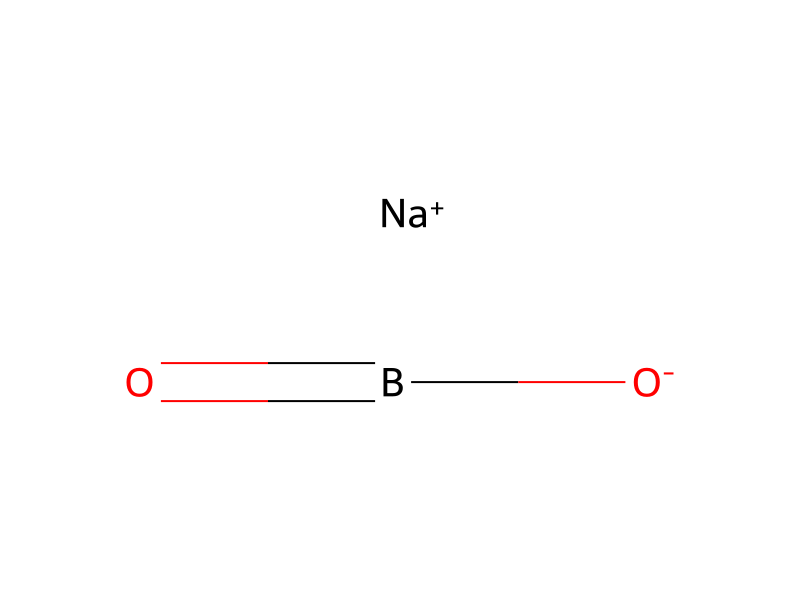
7775-19-1O=B[O-].[Na+]NVIFVTYDZMXWGX-UHFFFAOYSA-NSodium metaborate is an inorganic sodium salt having metaborate as the counterion. It is an inorganic sodium salt and a member of borate salts.
7775-19-1、98536-58-4DTXSID2034386CHEBI:752272.46 g/cu cm
2.36 @25 °C
White pieces or powder
White hexagonal crystals
In water, 2.0X10+5 mg/L at 20 °C
36 g/100 g water at 35 °C
1434 °C
1434 °C @760 [mm Hg]
966 °C
966 °C
Sicherheitsangaben dienen nur zur Orientierung und ersetzen weder das Sicherheitsdatenblatt (SDB) des Lieferanten noch geltende Vorschriften oder eine fachliche Bewertung.
This chemical does not meet GHS hazard criteria for 0.2% (2 of 1044) of reports.
Warning
H315 (10.3%): Causes skin irritation [Warning Skin corrosion/irritation]
P203, P264, P264+P265, P280, P302+P352, P305+P351+P338, P318, P321, P332+P317, P337+P317, P362+P364, P405, and P501 (click each P-code to see the statement)
Aggregated GHS information provided per 1044 reports by companies from 20 notifications to the ECHA C&L Inventory. Each notification may be associated with multiple companies.
Danger
Chemical: Boric acid (HBO2), sodium salt
Boric acid (HBO2), sodium salt (1:1) is listed on the EPA's Chemical Data Reporting (CDR) system. Manufacturers and importers of Boric acid (HBO2), sodium salt (1:1) are required to report information about their production and use of this chemical to the EPA under the Toxic Substances Control Act (TSCA). (40 eCFR Part 711)
REACH registered substance: Sodium metaborate, anhydrous (EC: 231-891-6)
Sodium metaborate: Does not have an individual approval but may be used as a component in a product covered by a group standard. It is not approved for use as a chemical in its own right.
A skin irritant; Toxic by ingestion; Oral LD50 (rat) = 2330 mg/kg; [HSDB] Also found commercially as octa- and tetrahydrate; [Hawley] No published studies on reproductive effects; See boric acid; [REPROTOX] A strong oxidizing agent; An irritant; [MSDSonline] See Boric acid.
As the federal pesticide law FIFRA directs, EPA is conducting a comprehensive review of older pesticides to consider their health and environmental effects and make decisions about their future use. Under this pesticide reregistration program, EPA examines health and safety data for pesticide active ingredients initially registered before November 1, 1984, and determines whether they are eligible for reregistration. In addition, all pesticides must meet the new safety standard of the Food Quality Protection Act of 1996. Borax is found on List A, which contains most food use pesticides and consists of the 194 chemical cases (or 350 individual active ingredients) for which EPA issued registration standards prior to FIFRA '88. Case No: 0024; Pesticide type: insecticide, fungicide herbicide; Registration Standard Date: 11/01/85; Case Status: RED Approved 9/93; OPP has made a decision that some/all uses of the pesticide are eligible for reregistration, as reflected in a Reregistration Eligibility Decision (RED) document .; Active ingredient (AI): soidum metaborate; Data Call-in (DCI) Date(s): 2/16/94; AI Status: OPP has completed a Reregistration Eligibility Decision (RED) for the case/AI.
Based on the reviews of the generic data for the active ingredients of boric acid and its sodium salts, the Agency has sufficient information on the health effects of boric acid and its sodium salts and their potential for causing adverse effects in fish and wildlife and the environment. Therefore, the Agency concludes that products containing boric acid and its sodium salts for all uses are eligible for reregistration. The Agency has determined that boric acid and its sodium salts, labeled and used as specified in the RED document, will not pose unreasonable risks or adverse effects to humans or the environment.
An exemption from the requirement of a tolerance is established for residues of the pesticidal chemical boric acid and its salts, borax (sodium borate decahydrate), disodium octaborate tetrahydrate, boric oxide (boric anhydride), sodium borate and sodium metaborate, in or on raw agricultural commodities when used as an active ingredient in insecticides, herbicides, or fungicides preharvest or postharvest in accordance with good agricultural practices.
Residues of the following chemical substances are exempted from the requirement of a tolerance when used in accordance with good manufacturing practice as ingredients in an antimicrobial pesticide formulation, provided that the substance is applied on a semi-permanent or permanent food-contact surface (other than being applied on food packaging) with adequate draining before contact with food. ... (c) The following chemical substances when used as ingredients in an antimicrobial pesticide formulation may be applied to: Food-processing equipment and utensils. Sodium metaborate is included on this list.
Skin Irrit. 2 (10.3%)
Reproductive toxicity - category 1B
(CA) CALIFORNIA 1000 ug/L /Boron/
(NH) NEW HAMPSHIRE 630 ug/L /Boron/
(ME) MAINE 1,400 ug/L /Boron/
(MN) MINNESOTA 1,000 ug/L /Boron/
(WI) WISCONSIN 960 ug/L /Boron/
Moderate skin irritant /Tetrahydrate/
... May produce irritation of the nasal mucous membranes, the respiratory tract, and eyes. /Boron compounds/
SRP: The most favorable course of action is to use an alternative chemical product with less inherent propensity for occupational exposure or environmental contamination. Recycle any unused portion of the material for its approved use or return it to the manufacturer or supplier. Ultimate disposal of the chemical must consider: the material's impact on air quality; potential migration in soil or water; effects on animal, aquatic, and plant life; and conformance with environmental and public health regulations.
Formulated products, Danger: Keep Out of Reach of Children, Corrosive. ... Avoid contact with skin. Wash thoroughly after handling. /Tetrahydrate/
SRP: The scientific literature for the use of contact lenses in industry is conflicting. The benefit or detrimental effects of wearing contact lenses depend not only upon the substance, but also on factors including the form of the substance, characteristics and duration of the exposure, the uses of other eye protection equipment, and the hygiene of the lenses. However, there may be individual substances whose irritating or corrosive properties are such that the wearing of contact lenses would be harmful to the eye. In those specific cases, contact lenses should not be worn. In any event, the usual eye protection equipment should be worn even when contact lenses are in place.
An exemption from the requirement of a tolerance is established for residues of the pesticidal chemical boric acid and its salts, borax (sodium borate decahydrate), disodium octaborate tetrahydrate, boric oxide (boric anhydride), sodium borate and sodium metaborate, in or on raw agricultural commodities when used as an active ingredient in insecticides, herbicides, or fungicides preharvest or postharvest in accordance with good agricultural practices.
Residues of the following chemical substances are exempted from the requirement of a tolerance when used in accordance with good manufacturing practice as ingredients in an antimicrobial pesticide formulation, provided that the substance is applied on a semi-permanent or permanent food-contact surface (other than being applied on food packaging) with adequate draining before contact with food. ... (c) The following chemical substances when used as ingredients in an antimicrobial pesticide formulation may be applied to: Food-processing equipment and utensils. Sodium metaborate is included on this list.
8 hr Time Weighted Avg (TWA): 2 mg/cu m (Inhalable fraction);15 min Short Term Exposure Limit (STEL): 6 mg/cu m (Inhalable fraction). /Borate compounds, Inorganic/
A4; Not classifiable as a human carcinogen. /Borate compounds, Inorganic/
7.0 [mg/m3]
77 [mg/m3]
460 [mg/m3]
1-5 mg/cu m (USSR) /Borates/
Limit for livestock is 5 ug/ml boron in water. /Boron/
0.5 mg/L maximum (USSR) /Boron in drinking water/
LC50 Onchornynchus kisutch, (Under yearling Coho salmon), 113 ug/mL/283 hr (95% confidence limits 104-123 ug/mL) (fresh water)
LC50 Onchornynchus kisutch, (Under yearling Coho salmon), 12.2 ug/mL/283 hr (95% confidence limits 10.89 to 14.56 ug/mL) (sea water)
LC50 Lepomis macrochirus (Bluegill) >100 ppm/96 hr; static /formulated product/
/HUMAN EXPOSURE STUDIES/ This study (1) charted chemosensory feel, denoted chemesthesis here, to dusts of calcium oxide (1 to 5 mg/cu m), sodium tetraborate pentahydrate [sodium borate] (5 to 40 mg/cu m), and calcium sulfate (10 to 40 mg/cu m); (2) examined correlates of the chemesthetic sensations; and (3) sought to illuminate the basis for potency. Twelve screened men exercised against a light load while they breathed air in a dome fed with controlled levels of dust for 20 min. Measured parameters included nasal resistance, nasal secretion, minute ventilation, heart rate, blood oxygenation, mucociliary transport time, and chemesthetic magnitude, calibrated to pungency of carbon dioxide. Subjects registered time-dependent feel from exposures principally in the nose, secondarily in the throat, and hardly in the eyes. Calcium oxide had the greatest potency, followed by sodium borate, with calcium sulfate a distant third. Of the physiological parameters, amount of secretion showed the best association with chemesthetic potency. That measure, as well as mucociliary transport time and minute ventilation, went into calculation of mass of dust dissolved into mucus. The calculations indicated that the two alkaline dusts increased in equal molar amounts with time. At equal molar concentrations, they had, to a first approximation, equal chemesthetic magnitude. On the basis of mass concentration in air or dissolved into mucus, calcium oxide and sodium borate differed in potency by a factor just above five, equal to the difference in their molecular weights.
/SIGNS AND SYMPTOMS/ Symptoms of poisoning: Nausea, diarrhea, rashes, depression, and coma. /Tetrahydrate/
/SIGNS AND SYMPTOMS/ This study examined work-related chronic abnormality in pulmonary function and work-related acute irritant symptoms associated with exposure to borate dust in mining and processing operations. Chronic effects were examined by pulmonary function at the beginning and end of a 7-year interval. Time-specific estimates of sodium borate particulate exposures were used to estimate cumulative exposure during the study interval. Change in pulmonary function over the 7 years was found unrelated to the estimate of cumulative exposure during that interval. Exposure-response associations also were examined with respect to short-term peak exposures and incidence of five symptoms of acute respiratory irritation /including eye, nose, and throat irritation; sneezing; nose bleeds; coughing; and breathlessness/. Hourly measures of health outcome and continuous measures of particulate exposure were made on each subject throughout the day. Whenever a subject reported one of the irritant symptoms, a symptom intensity score was also recorded along with the approximate time of onset. The findings indicated that exposure-response relationships were present for each of the specific symptoms at several symptom intensity levels. The associations were present when exposure was estimated by both day-long and short-term (15-min) time-weighted average exposures. Associations persisted after taking account of smoking, age, and the presence of a common cold. No significant difference in response rate was found between workers exposed to different types of sodium borate dusts.
/EPIDEMIOLOGY STUDIES/ An investigation was begun into the potential reproductive effects of sodium borates on men working in a sodium-borate mining and production factory in the Mojave Desert, California. The study group included 542 men, 72% of those eligible to participate. There were 529 births fathered by the study participants when only 466.6 were expected. The men were divided into five groups based on the exposure level to sodium-borate. There were minor differences in the groups, but none was significant. The number of births among the older men who had worked at the facility longest was very near the expected level. No adverse effects on fertility could be linked with the periods of high exposure. Of all offspring among the exposed men, 52.7% were female. The usual ratio is 51.2% male and 48.8% female; the excess of female offspring was not significant. Primarily female offspring were fathered by the employees in the RESR area, pilot facility. Those who chose not to participate in the study were not demographically different from the participants. The authors conclude that there did not appear to be any hazards to reproductive efforts resulting from exposure to sodium-borate. /Sodium Borate/
ACCUMULATES IN PLANTS. /SODIUM METABORATE TETRAHYDRATE/
SOCKEYE SALMON (ONCHORHYNCHUS NERKA) & JUVENILE OYSTERS (CRASSOSTREA GIGAS) EXPOSED TO SUBLETHAL DOSES OF BORON (SODIUM METABORATE) TAKE UP BORON ROUGHLY IN RELATION TO ITS AVAILABILITY. OYSTERS SHOW NO BIOACCUMULATIVE POTENTIAL OR PROLONGED RETENTION FOLLOWING CESSATION OF DOSAGE. FIELD SURVEYS CONDUCTED BEFORE & AFTER INDUSTRIAL BORATE EMISSION CONFIRM LACK OF EVIDENCE FOR TISSUE BIOACCUMULATION.
/OTHER TOXICITY INFORMATION/ Total boron concentrations in Drosophila changed during development and aging. The highest concentration of boron was found during the egg stage, followed by a decline during the larval stages. Newly emerged flies contained 35.5 ppm boron. During the adult stage the boron concentration increased by 52% by 9 weeks of age. Adding excess dietary boron during the adult stage decreased the median life span by 69% at 0.01 M sodium borate and by 21% at 0.001 M sodium borate. Lower concentrations gave small but significant increases in life span. Supplementing a very low boron diet with 0.00025 M sodium borate improved life span by 9.5%. The boron contents of young and old mouse tissues were similar to those of Drosophila and human samples. Boron supplements of 4.3 and 21.6 ppm in the drinking water, however, did not significantly change the life span of old mice fed a diet containing 31.1 ppm boron. /Sodium Borate/
Maintain an open airway and assist ventilation if nescessary. treat coma, seizures, hypotension, and renal failure if they occur. There is no specific antidote. Administer activated charcoal (although boric acid is not well absorbed). Consider gastric lavage for large ingestions. /Boric acid, Borates, and Boron/
Hemodialysis is effective and is indicated after massive ingestions and for supportive care of renal failure. Peritoneal dialysishas not proved effective in enhancing elimination in infants. /Boric acid, Borates, and Boron/
In acute poisonings, if a large amount has been ingested and the patient is seen within one hour of exposure, gastrointestinal decontamination should be considered ... .It is important to keep in mind that vomiting and diarrhea are common, and severe poisoning may be associated with seizures. Therefore induction of emesis by syrup of ipecac is probably contraindicated in these exposures. Catharsis is not indicated if diarrhea is present. /Boric acid and Borates/
If ingestion of borate has been massive (several grams), or has extended over several days, administer intravenous glucose and electrolyte solutions to sustain urinary excretion of borate. Monitor fluid balance and serum electrolytes (including bicarbonate capacity ) regularly. Monitor cardiac status by ECG. Test the urine for proteins and cells to detect renal injury, and monitor serum concentration of borate. Metabolic acidosis may be treated with sodium bicarbonate. If shock develops, it may be necessary to infuse plasma or whole blood. Administer oxygen continuously. If oliguria (less than 25 to 30 mL urine per hour) occurs, intravenous fluids must be slowed or stopped to avoid overloading the circulation. Such patients should be referred to a center capable of providing intensive care for critically ill patients. /Boric acid and Borates/
For more Antidote and Emergency Treatment (Complete) data for SODIUM METABORATE (7 total), please visit the HSDB record page.
As the federal pesticide law FIFRA directs, EPA is conducting a comprehensive review of older pesticides to consider their health and environmental effects and make decisions about their future use. Under this pesticide reregistration program, EPA examines health and safety data for pesticide active ingredients initially registered before November 1, 1984, and determines whether they are eligible for reregistration. In addition, all pesticides must meet the new safety standard of the Food Quality Protection Act of 1996. Borax is found on List A, which contains most food use pesticides and consists of the 194 chemical cases (or 350 individual active ingredients) for which EPA issued registration standards prior to FIFRA '88. Case No: 0024; Pesticide type: insecticide, fungicide herbicide; Registration Standard Date: 11/01/85; Case Status: RED Approved 9/93; OPP has made a decision that some/all uses of the pesticide are eligible for reregistration, as reflected in a Reregistration Eligibility Decision (RED) document .; Active ingredient (AI): soidum metaborate; Data Call-in (DCI) Date(s): 2/16/94; AI Status: OPP has completed a Reregistration Eligibility Decision (RED) for the case/AI.
Based on the reviews of the generic data for the active ingredients of boric acid and its sodium salts, the Agency has sufficient information on the health effects of boric acid and its sodium salts and their potential for causing adverse effects in fish and wildlife and the environment. Therefore, the Agency concludes that products containing boric acid and its sodium salts for all uses are eligible for reregistration. The Agency has determined that boric acid and its sodium salts, labeled and used as specified in the RED document, will not pose unreasonable risks or adverse effects to humans or the environment.
An exemption from the requirement of a tolerance is established for residues of the pesticidal chemical boric acid and its salts, borax (sodium borate decahydrate), disodium octaborate tetrahydrate, boric oxide (boric anhydride), sodium borate and sodium metaborate, in or on raw agricultural commodities when used as an active ingredient in insecticides, herbicides, or fungicides preharvest or postharvest in accordance with good agricultural practices.
Residues of the following chemical substances are exempted from the requirement of a tolerance when used in accordance with good manufacturing practice as ingredients in an antimicrobial pesticide formulation, provided that the substance is applied on a semi-permanent or permanent food-contact surface (other than being applied on food packaging) with adequate draining before contact with food. ... (c) The following chemical substances when used as ingredients in an antimicrobial pesticide formulation may be applied to: Food-processing equipment and utensils. Sodium metaborate is included on this list.
(CA) CALIFORNIA 1000 ug/L /Boron/
(NH) NEW HAMPSHIRE 630 ug/L /Boron/
(ME) MAINE 1,400 ug/L /Boron/
(MN) MINNESOTA 1,000 ug/L /Boron/
(WI) WISCONSIN 960 ug/L /Boron/
Used in cleansers, detergents, adhesives, and photographic solutions; Also used as a fire retardant in sodium chlorate, a defoliant; a textile finishing agent, and a sequestrant; Tetrahydrate: Used as an insecticide, fungicide, nematocide, and herbicide (non-crop land, cotton production, and under asphalt); Workers in mining and processing are exposed; [HSDB]
Working with Glues and Adhesives [Category: Other]
For sodium metaborate (USEPA/OPP Pesticide Code: 011104) ACTIVE products with label matches. /SRP: Registered for use in the U.S. but approved pesticide uses may change periodically and so federal, state and local authorities must be consulted for currently approved uses./
Component of cleansers; photographic applications (as hydrates); fire retardant in sodium chlorate; used as a defoliant
Insecticide, fungicide, and nematocide for nonselective control of general vegetation on noncropped land; spot treatment of Johnsongrass in cotton; inhibition of emergence under asphalt. /Tetrahydrate/
In adhesives, detergents; textile finishing
Fusing sodium carbonate and borax.
... By action of sodium hydroxide on disodium tetraborate.
Sodium metaborate dihydrate, ... can be prepared by heating a slurry of the tetrahydrate above 54 °C, by crystallizing hot metaborate solution, or by dehydrating the tetrahydrate in vacuum.
... Available commercially as octahydrate and tetrahydrate.
Granular, water soluble /Ureabor/
Multiple active ingredients: Granular 94.0% + 1 active ingredient (AI), 68.0% + 1 AI, 66.5% + 2 AIs, 55.6% +2 AIs, 54.0% + 1 AI, 50.0% + 2 AIs; Pelleted/Tableted 50.0% + 3 AIs; Formulation not identified/solid 50.0% + 1 AI; Soluble concentrate/liquid 19.0% + 1 AI, 10.0% + 1 or 2 AIs, 9.08% + 1 AI, 9.0% + 1 AI, 8.75% + 2 AIs, 6.0% + 1 AI, 4.57% + 1 AI; Ready to use liquid 10.0% + 1 AI.
Boric acid (HBO2), sodium salt (1:1): ACTIVE
... Sodium metaborate ... was introduced as /a non-selective herbicide/ by US Borax & Chemical Corp /protected by/ US patent 3,032,405.
Application methods: Dry or spray over-all; preemergence or postemergence. Rates: 0.25 to 2 kg/10 cu m ... Lighter rates for annuals; heavier for deep rooted perennials and prepaving treatment. Usual carrier: Water: 1 kg/4l; 1000 to 8000 l/ha ... /Tetrahydrate/
Use limitations: Sodium metaborate is not selective and may be toxic to all types of vegetation. It may render the entire area totally or partially unproductive for one or more years. Take care to confine application to the particular area intended to be treated and prevent its contact with lawns trees, shrubs, crops and other desirable plants which are not intended to be destroyed or injured. This includes precautions in treating areas which may be underlaid by roots of adjacent valuable plants. Do not drain or flush equipment near these areas.
Borate is the accepted common name for the metal salts of boric acid which comprise the following family of chemicals: sodium tetraborate decahydrate, sodium tetraborate pentahydrate, sodium tetraborate (anhydrous borax), disodium octaborate (anhydrous), disodium octaborate tetrahydrate, and sodium metaborate. /Borates/
Sodium perborates are persalts that are hydrolytically unstable because they contain characteristic boron-oxygen-oxygen bonds that react with water to form hydrogen peroxide and stable sodium metaborate (NaBO2.nH2O). This hydrolysis reaction is the basis of the use of perborates as bleaches in detergents at high (70-100 °C) temperature. At lower washing temperatures (25-70 °C), activators are needed; these react with peroxide to give peracids, which are stronger oxidants and give bleaching effects at lower temperatures.
VerwendenHerbicide. Also available commercially as octahydrate and tetrahydrate.
DefinitionChEBI: An inorganic sodium salt having metaborate as the counterion.


