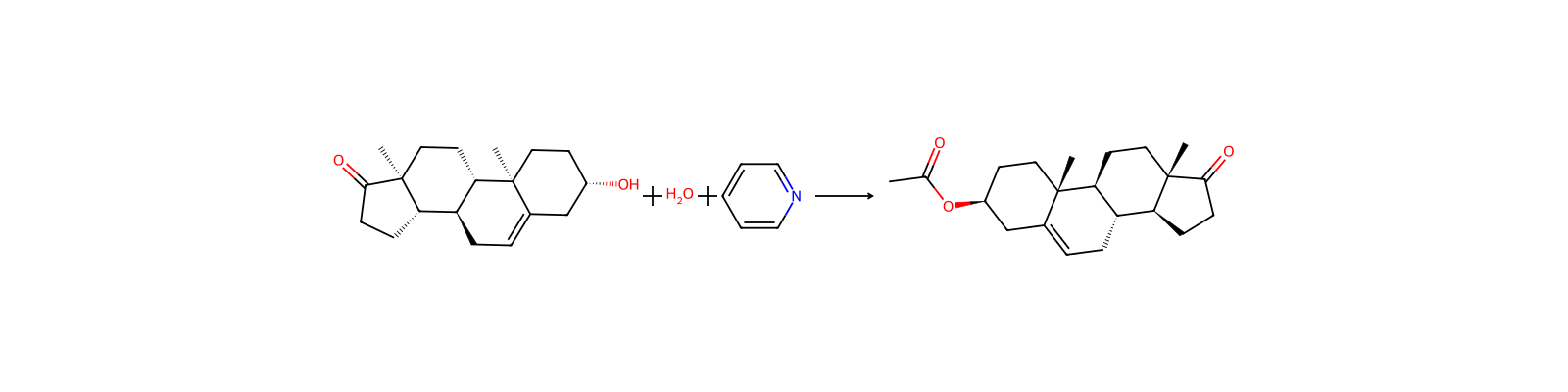

Grundinformationen
- Standard-SMILES
CC(=O)O[C@H]1CC[C@@]2(C)C(=CC[C@@H]3[C@@H]2CC[C@]2(C)C(=O)CC[C@@H]32)C1- InChIKey
NCMZQTLCXHGLOK-ZKHIMWLXSA-N- Summenformel
- C21H30O3
- Durchschnittliche Molmasse
- 330,5 g/mol
- Monoisotopische Masse
- 330,21949481
Namen und Bezeichner
- Bevorzugter Name
- 3beta-Acetoxyandrost-5-en-17-one
- IUPAC
- [(3S,8R,9S,10R,13S,14S)-10,13-dimethyl-17-oxo-1,2,3,4,7,8,9,11,12,14,15,16-dodecahydrocyclopenta[a]phenanthren-3-yl] acetate
- Lokaler Name
- 3β-Hydroxyandrost-5-en-17-onacetat
- Englischer Name
- Dehydroepiandrosterone acetate
- Summenformel
- C21H30O3
- Molmasse
- 330.47
Namen und Synonyme
Dehydroepiandrosterone acetate853-23-63beta-acetoxyandrost-5-en-17-one45751H45MYRefChem:505556Prasterone acetateDehydroisoandrosterone 3-acetateDehydroisoandrosterone acetateDhea acetateDehydroepiandrosterone 3-acetatetrans-Dehydroandrosterone acetateAndrost-5-en-17-one, 3-(acetyloxy)-, (3b)-
Weitere Namen anzeigen
3β-Acetoxyandrost-5-en-17-one3b-Hydroxy-5-androstene-17-one acetate3-β-acetoxy-5-androsten-17-one3BETA-ACETOXY-5-ANDROSTEN-17-ONEDHEA Acetate (Prasterone acetate)DHA, (10,13-DIMETHYL-17-OXO-1,2,3,4,7,8,9,11,12,14,15,16-DODECAHYDROCYCLOPENTA[A]PHENANTHREN-3-YL) ACETATEskf2847
3beta-Acetoxy-5-androstene-17-one[(3S,8R,9S,10R,13S,14S)-10,13-dimethyl-17-oxo-1,2,3,4,7,8,9,11,12,14,15,16-dodecahydrocyclopenta[a]phenanthren-3-yl] acetate17-Oxoandrost-5-en-3beta-yl acetateDehydroisoandosterone 3-acetateDTXSID3020380Androstenolone acetate(3beta)-17-oxoandrost-5-en-3-yl acetate(3S,8R,9S,10R,13S,14S)-10,13-Dimethyl-17-oxo-2,3,4,7,8,9,10,11,12,13,14,15,16,17-tetradecahydro-1H-cyclopenta[a]phenanthren-3-yl acetate
Datenbank-Bezeichner
- CAS
853-23-6- PubChem CID
- 14709
- DTXSID
DTXSID3020380- ChEMBL
CHEMBL1480686- ChEBI
CHEBI:135410- UNII
- 45751H45MY
- EC Number
- 212-714-1
- Nikkaji
- J22.729C
Eigenschaften
Berechnete Struktureigenschaften
- XLogP
- 3,8
- Polarare Oberfläche (TPSA)
- 43,4 Ų
- H-Brücken-Donoren
- 0
- H-Brücken-Akzeptoren
- 3
- Frei drehbare Bindungen
- 2
- Schwere Atome
- 24
- Formalladung
- 0
- Komplexität
- 606
Physikochemische Eigenschaften
- Schmelzpunkt
- 168 · 168-170 °C(lit.)
- Siedepunkt
- 407.89 °C · 407.89°C (rough estimate)
- Dichte
- 1.0998 · 1.0998 (rough estimate)
- Dampfdruck
- 0 Pa · 0Pa at 20℃
- Brechungsindex
- 1.5192 · 1.5192 (estimate)
- storage temp.
- Refrigerator
- Löslichkeit
- Chloroform, DMSO (Slightly), Methanol (Slightly)
- Aggregatzustand
- Solid
- Farbe
- White to Off-White
- Wasserlöslichkeit
- 11.5 mg/L · 11.5mg/L(temperature not stated)
- InChI
- InChI=1/C21H30O3/c1-13(22)24-15-8-10-20(2)14(12-15)4-5-16-17-6-7-19(23)21(17,3)11-9-18(16)20/h4,15-18H,5-12H2,1-3H3/t15-,16-,17-,18-,20-,21-/s3
- InChIKey
- NCMZQTLCXHGLOK-KJBVPOJVSA-N
- SMILES
- C[C@]12CC[C@H](OC(=O)C)CC1=CC[C@@]1([H])[C@]3([H])CCC(=O)[C@@]3(C)CC[C@]21[H] |&1:1,4,13,15,21,25,r|
- LogP
- 5.1 at · 5.1 at 20℃
- CAS Datenbank
- 853 · 853-23-6
Sicherheit und Regulatorisches
GHS-Klassifizierung
GHS Classification
Danger
H302 (75%): Harmful if swallowed [Warning Acute toxicity, oral];H312 (75%): Harmful in contact with skin [Warning Acute toxicity, dermal];H332 (75%): Harmful if inhaled [Warning Acute toxicity, inhalation];H351 (79.2%): Suspected of causing cancer [Warning Carcinogenicity];H360 (16.7%): May damage fertility or the unborn child [Danger Reproductive toxicity];H361 (79.2%): Suspected of damaging fertility or the unborn child [Warning Reproductive toxicity]
P203, P261, P264, P270, P271, P280, P301+P317, P302+P352, P304+P340, P317, P318, P321, P330, P362+P364, P405, and P501 (click each P-code to see the statement)
Aggregated GHS information provided per 24 reports by companies from 5 notifications to the ECHA C&L Inventory. Each notification may be associated with multiple companies.;Information may vary between notifications depending on impurities, additives, and other factors. The percentage value in parenthesis indicates the notified classification ratio from companies that provide hazard codes. Only hazard codes with percentage values above 10% are shown. For more detailed information, please visit ECHA C&L website.
Gefahrenhinweise
Regulatory InformationStatus: Active Update: 12-04-2021 https://echa.europa.eu/registration-dossier/-/registered-dossier/27602
Hazard Classes and CategoriesAcute Tox. 4 (75%);Acute Tox. 4 (75%);Acute Tox. 4 (75%);Carc. 2 (79.2%);Repr. 1B (16.7%);Repr. 2 (79.2%)
Regulatorische Informationen
Regulatory InformationStatus: Active Update: 12-04-2021 https://echa.europa.eu/registration-dossier/-/registered-dossier/27602
Sicherheitsdaten
- wgk
- 3
- RTECS-Nr.
- BV8396810
- safety_code
- 22-24/25
Chemie und Industrie
Anwendungen
VerwendenA metabolite of Dehydroepiandrosterone. This mammalian pro-hormone promotes brain and immune function
Vor- und nachgelagerte Produkte
Nachgelagerte Produkte
Anbieter50 Anbieter
上海阿拉丁生化科技股份有限公司400-6206333 13167063860 · [email protected]
Shanghai Yingrui Biopharma Co.,Ltd21-33585366 · [email protected]
Hebei shuoxi biotechnology co. LTD+8613081092107
南京望知星医药科技有限公司18569809817 · [email protected]
Hebei Yanxi Chemical Co., Ltd.+86-17531190177 · [email protected]
Syntechem Co.,Ltd[email protected]
河北秒变生物科技有限公司17733850068
上海晶抗生物工程有限公司021-54721350 13524668266 · [email protected]
安耐吉化学&3A(安徽泽升科技股份有限公司)400-0056266 · [email protected]
上海恩诺生物科技有限公司+86 (21) 6435-5022
南京圣亿来化工有限公司19951936396 · [email protected]
Cangzhou Wanyou New Material Technology Co.,Ltd18631714998 · [email protected]
上海诗丹德标准技术服务有限公司021-021-57127007-6622-6622 17621252073 · [email protected]
MedBio脉铂医药021-69568360 18916172912 · [email protected]
上海相辉医药科技有限公司13761987713 · [email protected]
上海诺太医药科技有限公司021-50189163 · [email protected]
凯试(上海)科技有限公司021-50135380 · [email protected]
MedChemexpress LLC021-58955995 · [email protected]
Zhejiang J&C Biological Technology Co.,Limited+1-2135480471 · [email protected]
云南西力生物技术股份有限公司0871-65217109 · [email protected]
邯郸市泽池贸易有限公司19293117057 · [email protected]
天津希恩思生化科技有限公司400 638 7771 · [email protected]
Hebei Qige Biological Technology Co. Ltd+86 +8618733132031
上海特伯化学科技有限公司+86-21-60341587 · [email protected]
Wuhan NCE Biomedical Co.,Ltd.4000-027-021 |24 +86-13986109188 | +86-15623472865 | +81-08033611988
上海遐瑞医药科技有限公司+86 21 61551611
TOKYO CHEMICAL INDUSTRY CO., LTD.03-36680489 · [email protected]
TCI Europe320-37350700 · [email protected]
深圳振强药物研发有限公司0755-66853366 13670046396 · [email protected]
上海诺宝化工有限公司+86(0)21 60484900
Clearsynth Labs Limited+91-22-26355700 · [email protected]
南京生利德生物科技有限公司025-57798810 18652991625 · [email protected]
上海倍卓生物科技有限公司021-61119791,13386096464 · [email protected]
湖北鑫源顺医药化工有限公司13971561712, 13995564702, 027-50664929 · [email protected]
上海湄水化工科技有限公司021-60549325 18616193163
上海将来实业股份有限公司400-0066400 13621662912 · [email protected]
上海将来实业股份有限公司021-61552785 · [email protected]
HBCChem, Inc.+1-510-219-6317 · [email protected]
北京汤普森生物科技有限公司+86-13439059536 +86-15201677815 · [email protected]
成都零六生物科技有限公司400-1166-196 13458535857 · [email protected]
雷丁试剂0510-85629785 18013409632 · [email protected]
湖南华腾制药有限公司400-8592883 · [email protected]
上海御略医药科技有限公司021-60345187 13671753212 · [email protected]
上海孚一生物科技有限公司+86 (21) 61124340
Wuhan Biocar Bio-Pharm Co., Ltd.86 15387057351 · [email protected]
武汉森威尔世纪化工有限公司027-86652399 · [email protected]
上海陶术生物科技股份有限公司+1-781-999-5354; +1-00000000000 · [email protected]
九鼎化学(上海)科技有限公司4009209199 · [email protected]
BOC Sciences16314854226; +8616314854226 · [email protected]
武汉鑫儒化工有限公司15927387915 15337108568
Zugehörige Reaktionen
16


Verknüpfte Notizen
Wird geladen…