
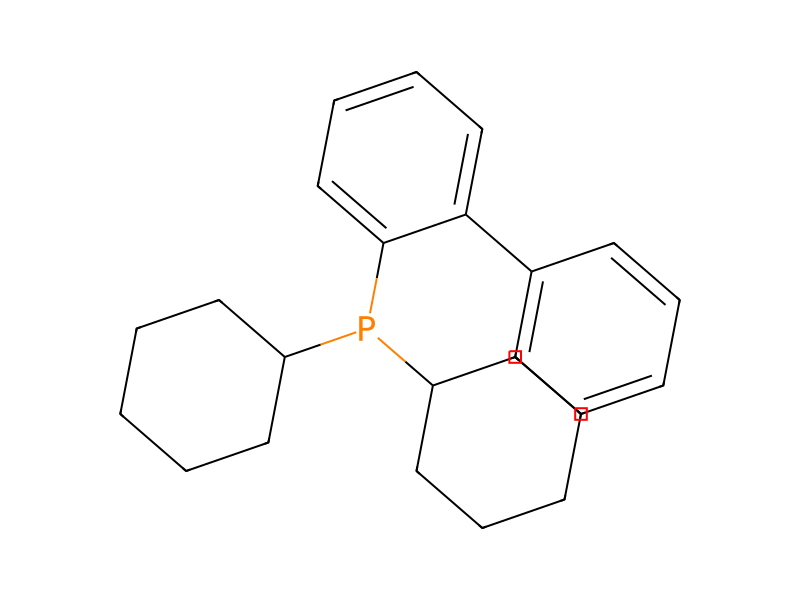
Grundinformationen
- Standard-SMILES
c1ccc(-c2ccccc2P(C2CCCCC2)C2CCCCC2)cc1- InChIKey
LCSNDSFWVKMJCT-UHFFFAOYSA-N- Summenformel
- C24H31P
- Durchschnittliche Molmasse
- 350,5 g/mol
- Monoisotopische Masse
- 350,21633799
Namen und Bezeichner
- Bevorzugter Name
- 2-(Dicyclohexylphosphino)biphenyl
- IUPAC
- dicyclohexyl-(2-phenylphenyl)phosphane
- Englischer Name
- 2-(Dicyclohexylphosphino)biphenyl
- Summenformel
- C24H31P
- Molmasse
- 350.48
Namen und Synonyme
2-(Dicyclohexylphosphino)biphenyl247940-06-3DTXSID603701702-[dicyclohexylphosphino]biphenylRefChem:84662DTXCID40321206480-030-2607-439-2CyJohnPhosCyclohexyl JohnPhosDicyclohexyl-(2-phenylphenyl)phosphane[1,1'-BIPHENYL]-2-YLDICYCLOHEXYLPHOSPHINE
Weitere Namen anzeigen
Cy-John-Phos2-(Dicyclo98% CyJohnPhosCyJohnPhos 97%CyJohnPhos CASCAS:247940-06-3
PHOSPHINE, [1,1'-BIPHENYL]-2-YLDICYCLOHEXYL-biphenyl-2-yldicyclohexylphosphine(2-Biphenylyl)dicyclohexylphosphineMFCD01862441(2-Biphenyl)dicyclohexylphosphineC24H31Po-(dicyclohexylphosphino)biphenyl{[1,1'-biphenyl]-2-yl}dicyclohexylphosphane
Datenbank-Bezeichner
- CAS
247940-06-3- PubChem CID
- 2734216
- DTXSID
DTXSID60370170- EC Number
- 480-030-2、607-439-2
- Nikkaji
- J1.200.103G、J3.476.307K
Eigenschaften
Berechnete Struktureigenschaften
- XLogP
- 6,7
- Polarare Oberfläche (TPSA)
- 0 Ų
- H-Brücken-Donoren
- 0
- H-Brücken-Akzeptoren
- 0
- Frei drehbare Bindungen
- 4
- Schwere Atome
- 25
- Formalladung
- 0
- Komplexität
- 356
Physikochemische Eigenschaften
- Schmelzpunkt
- 102 · 102-106 °C(lit.)
- Siedepunkt
- 499.5 · 499.5±24.0 °C(Predicted)
- storage temp.
- 2 · under inert gas (nitrogen or Argon) at 2-8°C
- Löslichkeit
- soluble in Toluene
- Aggregatzustand
- crystal
- Farbe
- white
- BRN
- 8440533 · 8440533
- InChI
- InChI=1S/C24H31P/c1-4-12-20(13-5-1)23-18-10-11-19-24(23)25(21-14-6-2-7-15-21)22-16-8-3-9-17-22/h1,4-5,10-13,18-19,21-22H,2-3,6-9,14-17H2
- InChIKey
- LCSNDSFWVKMJCT-UHFFFAOYSA-N
- SMILES
- P(C1=CC=CC=C1C1=CC=CC=C1)(C1CCCCC1)C1CCCCC1
- CAS Datenbank
- 247940 · 247940-06-3(CAS DataBase Reference)
Sicherheit und Regulatorisches
GHS-Klassifizierung
GHS Classification
Warning
H315 (13.3%): Causes skin irritation [Warning Skin corrosion/irritation];H319 (13.3%): Causes serious eye irritation [Warning Serious eye damage/eye irritation];H335 (13.3%): May cause respiratory irritation [Warning Specific target organ toxicity, single exposure; Respiratory tract irritation];H413 (88.9%): May cause long lasting harmful effects to aquatic life [Hazardous to the aquatic environment, long-term hazard]
P261, P264, P264+P265, P271, P273, P280, P302+P352, P304+P340, P305+P351+P338, P319, P321, P332+P317, P337+P317, P362+P364, P403+P233, P405, and P501 (click each P-code to see the statement)
Aggregated GHS information provided per 45 reports by companies from 4 notifications to the ECHA C&L Inventory. Each notification may be associated with multiple companies.;Information may vary between notifications depending on impurities, additives, and other factors. The percentage value in parenthesis indicates the notified classification ratio from companies that provide hazard codes. Only hazard codes with percentage values above 10% are shown. For more detailed information, please visit ECHA C&L website.
Gefahrenhinweise
Regulatory InformationStatus: Active Update: 07-03-2012 https://echa.europa.eu/registration-dossier/-/registered-dossier/2550
Hazard Classes and Categories
Skin Irrit. 2 (13.3%);Eye Irrit. 2 (13.3%);STOT SE 3 (13.3%);Aquatic Chronic 4 (88.9%)
Skin Irrit. 2 (100%);Eye Irrit. 2A (100%);STOT SE 3 (100%);Aquatic Chronic 4 (100%)
Regulatorische Informationen
Regulatory InformationStatus: Active Update: 07-03-2012 https://echa.europa.eu/registration-dossier/-/registered-dossier/2550
Sicherheitsdaten
- F
- 10-13-23
- wgk
- 3
- tsca
- No
- hs_code
- 29310099
- risk_code
- 36/37/38-22
- hazard_code
- Xn
- safety_code
- 36/37/39-26
- hazard_class
- AIR SENSITIVE
- Speicherklasse
- 11 - Combustible Solids
- Hazard Classifications
- Aquatic Chronic 4
Chemie und Industrie
Anwendungen
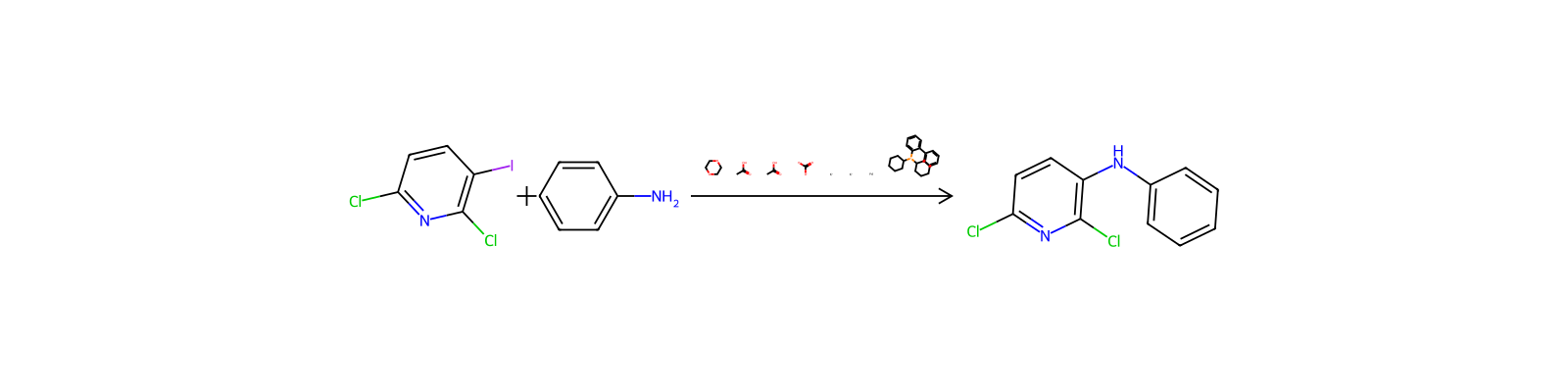
Beschreibung2-(Dicyclohexylphosphino)biphenyl is a ligand for the amination of triflates and aryl halides. Optimal ligand for a novel amination reaction (Buchwald reaction)(2) 2-(Dicyclohexylphosphino)biphenyl, a synthetic chemical compound, has found diverse applications in scientific research. Being a cyclic phosphonate derivative of cyclohexanol, this colourless, odourless, and tasteless solid holds a distinct appeal for laboratory use. In scientific research, 2-(Dicyclohexylphosphino)biphenyl has proven invaluable. It serves as an excellent model compound for delving into protein-ligand interactions, thus aiding in studying small molecule effects on protein folding. Moreover, researchers have utilized 2-(Dicyclohexylphosphino)biphenyl to gain insights into protein structures and unravel the mechanism of action behind various drugs. Additionally, the compound has been a vital tool in assessing how environmental factors influence protein structure and function. The interaction between 2-(Dicyclohexylphosphino)biphenyl and proteins primarily occurs through hydrogen bonding and hydrophobic interactions, resulting in high-affinity and specific protein binding.
Verwenden2-(Dicyclohexylphosphino)biphenyl is used as a catalyst for Suzuki coupling reactions.
Vor- und nachgelagerte Produkte
Vorgelagerte Rohstoffe
Anbieter50 Anbieter
国药集团化学试剂有限公司86-21-63210123 · [email protected]
梯希爱(上海)化成工业发展有限公司021-67121386 · [email protected]
衢州润东化工有限公司0570-8789886 18892685668 · [email protected]
上海阿拉丁生化科技股份有限公司400-6206333 13167063860 · [email protected]
INTATRADE GmbH+49 3493/605464 · [email protected]
T&W GROUP021-61551611 13296011611 · [email protected]
韶远科技(上海)有限公司021-50795510 4000665055 · [email protected]
Syntechem Co.,Ltd[email protected]
上海迈瑞尔生化科技有限公司4006356688 18621169109 · [email protected]
宁波亿诺化学品有限公司86-574-27787657 · [email protected]
阿法埃莎(中国)化学有限公司400-6106006 · [email protected]
上海德默医药科技有限公司400-021-7337 2355568890 · [email protected]
安耐吉化学&3A(安徽泽升科技股份有限公司)400-0056266 · [email protected]
上海柏卡化学技术有限公司400-026-1533/(021) 6478-0600 · [email protected]
上海瀚鸿科技股份有限公司021-54306202 13764082696 · [email protected]
江苏欣诺科催化剂股份有限公司0512-67216630 67216634 · [email protected]
上海景颜化工科技有限公司13817811078 · [email protected]
嘉兴市艾森化工有限公司0573-85285100 18627885956 · [email protected]
维赛诺化学技术(北京)有限公司13811761079 · [email protected]
上海隆盛化工有限公司58099637 13585536065 · [email protected]
陕西瑞科新材料股份有限公司0917-8888777 18691786767
石家庄科诺达科技有限公司0311-85461665 13784393231 · [email protected]
杭州东帆化学有限公司86-0571-85151182
唐山默内德贸易有限公司0315-8309571 15633399667 · [email protected]
玛雅试剂+86 (573) 82222445 (0)18006601000 452520369 · [email protected]
四川库利南科技有限公司400-1166-196 18981987031 · [email protected]
上海钰康生物科技有限公司15618758386 15618758386 · [email protected]
湖南汇百侍生物科技有限公司0731-85526065 13308475853 · [email protected]
南京维奥化工有限公司Please Send Email 18652950785 · [email protected]
南京辛西亚生物科技有限公司0550-5618439 15951861180 · [email protected]
武汉杂环科技有限公司027-88041443 13072715837 · [email protected]
武汉泰宇凯尚科技有限公司027-027-87680032 18963957250 · [email protected]
艾科试剂4008-755-333 18080918076 · [email protected]
上海思域化工科技有限公司86-21-34053660 · [email protected]
苏州思变化学技术有限公司0512-65617459 18915409046 · [email protected]
赛默飞世尔科技(中国)有限公司800-810-5118 · [email protected]
北京伊诺凯科技有限公司400-810-7969 010-59572699 · [email protected]
天津尚德药缘科技有限公司13132578992 · [email protected]
南京诺利斯医药科技有限公司13901585132 · [email protected]
上海健超生物科技有限公司150-2103-5486 18017383231 · [email protected]
上海茵凯化学科技有限公司021-57603038 13601791340;13818007232 · [email protected]
TCI AMERICA800-4238616 · [email protected]
TOKYO CHEMICAL INDUSTRY CO., LTD.03-36680489 · [email protected]
TCI Europe320-37350700 · [email protected]
深圳康特腾科技有限公司86-0755-86635001 · [email protected]
越林试剂021-62960152 · [email protected]
Clearsynth Labs Limited+91-22-26355700 · [email protected]
南京拉瑞创新科技有限公司025-83726959 15851816062
北京格林凯默科技有限公司131-21959385 18804271668 · [email protected]
上海汇凯化学科技有限公司021-61995394 18916691159 · [email protected]
Zugehörige Reaktionen
1.541






Verknüpfte Notizen
Wird geladen…