
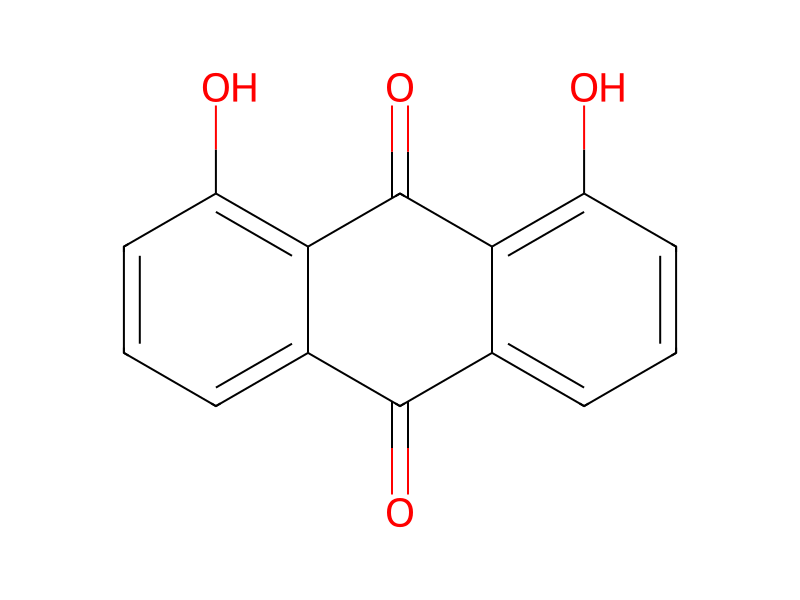
Grundinformationen
- Standard-SMILES
O=C1c2cccc(O)c2C(=O)c2c(O)cccc21- InChIKey
QBPFLULOKWLNNW-UHFFFAOYSA-N- Summenformel
- C14H8O4
- Durchschnittliche Molmasse
- 240,21 g/mol
- Monoisotopische Masse
- 240,04225873
Namen und Bezeichner
- Bevorzugter Name
- 1,8-Dihydroxyanthraquinone
- IUPAC
- 1,8-dihydroxyanthracene-9,10-dione
- Englischer Name
- 1,8-Dihydroxyanthraquinone
- Summenformel
- C14H8O4
- Molmasse
- 240.21
Namen und Synonyme
danthron1,8-Dihydroxyanthraquinone117-10-2DantronChrysazinDorbaneIstizin1,8-Dihydroxyanthracene-9,10-dioneAntrapurolDiaquoneAltanLaxanorm
Weitere Namen anzeigen
LTAN1,8-DihydroxyanthrachinonIstin
LaxanthreenLaxipurinDiononeZwitsalaxDanivacdanthrone9,10-Anthracenedione, 1,8-dihydroxy-Dantrone
Datenbank-Bezeichner
- CAS
117-10-2- PubChem CID
- 2950
- DTXSID
DTXSID9020328- ChEMBL
CHEMBL53418- ChEBI
CHEBI:3682- UNII
- Z4XE6IBF3V
- EC Number
- 204-173-5
- Nikkaji
- J2.905J
Eigenschaften
Berechnete Struktureigenschaften
- XLogP
- 3,2
- Polarare Oberfläche (TPSA)
- 74,6 Ų
- H-Brücken-Donoren
- 2
- H-Brücken-Akzeptoren
- 4
- Frei drehbare Bindungen
- 0
- Schwere Atome
- 18
- Formalladung
- 0
- Komplexität
- 346
Physikochemische Eigenschaften
- Schmelzpunkt
- 191 · 191-193 °C (lit.)
- Siedepunkt
- 342.92 °C · 342.92°C (rough estimate)
- Dichte
- 1.3032 · 1.3032 (rough estimate)
- Brechungsindex
- 1.543 · 1.5430 (estimate)
- Flammpunkt
- 200 °C · >200°C
- storage temp.
- 2 · Sealed in dry,2-8°C
- Löslichkeit
- very faint turbidity in hot Acetic acid
- Aggregatzustand
- Powder
- pka
- 6.27 · 6.27±0.20(Predicted)
- Farbe
- Orange-brown or brown
- Wasserlöslichkeit
- insoluble
- Merck
- 14 · 14,2815
- BRN
- 2054727 · 2054727
- Henry's Law Constant
- 1.8 · 1.8×105 mol/(m3Pa) at 25℃, HSDB (2015)
- InChI
- 1S/C14H8O4/c15-9-5-1-3-7-11(9)14(18)12-8(13(7)17)4-2-6-10(12)16/h1-6,15-16H
- InChIKey
- QBPFLULOKWLNNW-UHFFFAOYSA-N
- SMILES
- Oc1cccc2C(=O)c3cccc(O)c3C(=O)c12
- LogP
- 4.57 · 4.570 (est)
- CAS Datenbank
- 117 · 117-10-2(CAS DataBase Reference)
- NIST chemische Informationen
- 1 · 1,8-Dihydroxyanthraquinone(117-10-2)
- EPA chemische Informationen
- Danthron (117-10-2)
Sicherheit und Regulatorisches
Sicherheitsdaten
- wgk
- 1
- tsca
- TSCA listed
- ridadr
- 2811
- hs_code
- 29146990
- RTECS-Nr.
- CB6650000
- risk_code
- 40
- Toxizität
- LD50 orally in mice: <7 g/kg (Case)
- hazard_code
- Xn
- safety_code
- 36/37-36-22
- hazard_class
- IRRITANT
- Speicherklasse
- 11 - Combustible Solids
- Giftige Stoffe Daten
- 117-10-2(Hazardous Substances Data)
- Hazard Classifications
- Carc. 2Eye Irrit. 2Skin Irrit. 2STOT SE 3
Chemie und Industrie
Anwendungen
BeschreibungDanthron, a natural product, was originally extracted from the roots and rhizome of Polygonaceae plant, also called Da Huang in traditional Chinese herbal medicine. Now it is synthesized in many countries, such as Germany, India, Japan, Poland, the United Kingdom, and the United States. Danthron is reasonably anticipated to be a human carcinogen. Danthron is an anthraquinone that exists at room temperature as a red or orange crystalline powder.It is practically insoluble in water, but soluble in a variety of solvents (acetone, chloroform, diethyl ether, ethanol) and alkaline hydroxide solutions. The stability of danthron is generally good. It is stable under room temperatures and normal pressures.
Verwenden1,8-Dihydroxyanthraquinone can be used:To prepare an inclusion complex with β-cyclodextrin, applicable as a sensor in the estimation of Cu2+ions in an aqueous solution.As a starting material in the synthesis of 1,4,5,8-tetramethoxyanthracene.As an aromatic scavenger in the modification of lignin, which acts as a corrosion inhibitor for steel.
Vor- und nachgelagerte Produkte
Vorgelagerte Rohstoffe
Nachgelagerte Produkte
Anbieter50 Anbieter
国药集团化学试剂有限公司86-21-63210123 · [email protected]
梯希爱(上海)化成工业发展有限公司021-67121386 · [email protected]
上海阿拉丁生化科技股份有限公司400-6206333 13167063860 · [email protected]
上海如吉生物科技发展有限公司+86-21-65211385-8001 36031160 · [email protected]
科瑞迪化学400-821-5857 021-64326257 · [email protected]
Syntechem Co.,Ltd[email protected]
上海迈瑞尔生化科技有限公司4006356688 18621169109 · [email protected]
阿法埃莎(中国)化学有限公司400-6106006 · [email protected]
太原市瑞和丰科贸有限公司+86 351 7031519 · [email protected]
安耐吉化学&3A(安徽泽升科技股份有限公司)400-0056266 · [email protected]
上海瀚鸿科技股份有限公司021-54306202 13764082696 · [email protected]
常州市淇奥化工有限公司0519-85607258
天津万象恒远科技有限公司15722085254 · [email protected]
成都普菲德生物技术有限公司028-82610909 13388174823 · [email protected]
上海景颜化工科技有限公司13817811078 · [email protected]
嘉兴市艾森化工有限公司0573-85285100 18627885956 · [email protected]
MedChemexpress LLC021-58955995 · [email protected]
武汉丰泰威远科技有限公司027-87465837 19945049750 · [email protected]
孝感深远化工有限公司15527621225; 15527621225 · [email protected]
云南西力生物技术股份有限公司0871-65217109 · [email protected]
山东西亚化学有限公司13355009207 13355009207 · [email protected]
玛雅试剂+86 (573) 82222445 (0)18006601000 452520369 · [email protected]
四川库利南科技有限公司400-1166-196 18981987031 · [email protected]
上海耐士化工科技有限公司400-188-0725 +86 21 34310725 13611771617
天津希恩思生化科技有限公司400 638 7771 · [email protected]
上海源叶生物科技有限公司13636370518 · [email protected]
上海和宁美生物医药科技有限公司021-18019086215 18019086215 · [email protected]
艾科试剂4008-755-333 18080918076 · [email protected]
上海思域化工科技有限公司86-21-34053660 · [email protected]
赛默飞世尔科技(中国)有限公司800-810-5118 · [email protected]
北京伊诺凯科技有限公司400-810-7969 010-59572699 · [email protected]
TCI AMERICA800-4238616 · [email protected]
TOKYO CHEMICAL INDUSTRY CO., LTD.03-36680489 · [email protected]
TCI Europe320-37350700 · [email protected]
上海贤鼎生物科技有限公司4009209199 · [email protected]
河南赢创生物科技有限公司15672878902 · [email protected]
成都瑞芬思德丹生物科技有限公司2355253622; 18981954830 · [email protected]
上海将来实业股份有限公司400-0066400 13621662912 · [email protected]
安徽科迪达化工有限公司0554-2106669 · [email protected]
上海笛柏生物科技有限公司400-008-9730,021-54359730 400-008-9730 · [email protected]
四川省维克奇生物科技有限公司028-81700200 18116577057 · [email protected]
雷丁试剂0510-85629785 18013409632 · [email protected]
上海卓因生物科技有限公司021-61317773 · [email protected]
上海麦克林生化科技股份有限公司15221275939 15221275939 · [email protected]
杭州杰恒化工有限公司0571-87396432 · [email protected]
上海永叶生物科技有限公司86-021-61559134 15921386130 · [email protected]
上海有朋化工有限公司021-69005955 13701776567 · [email protected]
北京海力扬化学科技有限公司13718199399 · [email protected]
北京欣赛维化学科技有限公司010-56218822 13717722232 · [email protected]
四川海诺威科技有限公司13708085536 13708085536 · [email protected]
Ergänzende Hinweise
DefinitionChEBI: 1,8-Dihydroxyanthraquinone is a dihydroxyanthraquinone that is anthracene-9,10-dione substituted by hydroxy groups at positions 1 and 8. It has a role as an apoptosis inducer and a plant metabolite.
Zugehörige Reaktionen
5


Verknüpfte Notizen
Wird geladen…