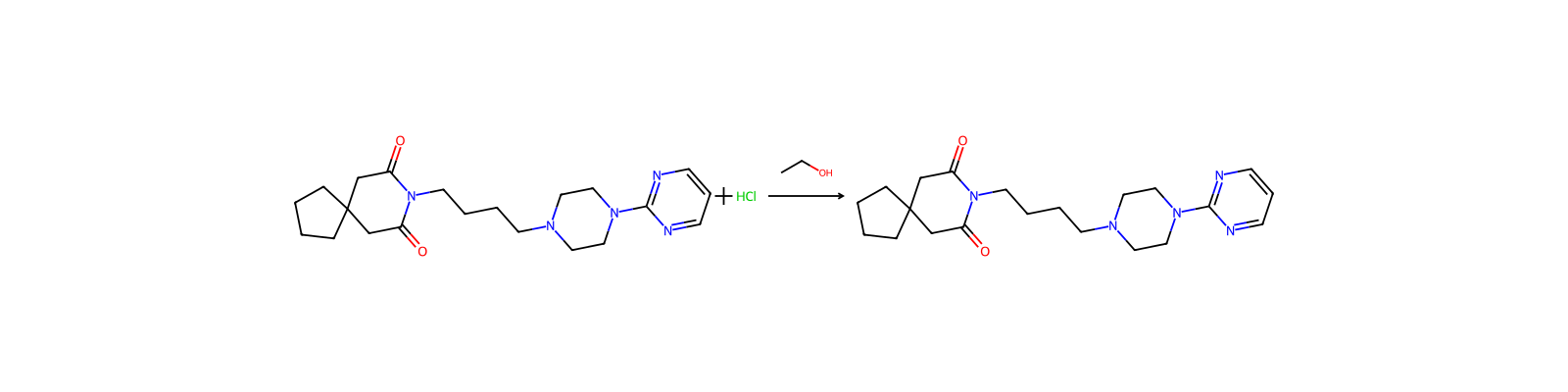
8-[4-[4-(2-Pyrimidinyl)-1-piperazinyl]butyl]-8-azaspiro[4.5]decan-7,9-dionmonohydrochlorid
Buspirone Hydrochloride

Grundinformationen
- CAS
33386-08-2- Standard-SMILES
Cl.O=C1CC2(CCCC2)CC(=O)N1CCCCN1CCN(c2ncccn2)CC1- InChIKey
RICLFGYGYQXUFH-UHFFFAOYSA-N- Summenformel
- C21H32ClN5O2
- Durchschnittliche Molmasse
- 422 g/mol
- Monoisotopische Masse
- 421,224453
Überblick
Buspirone hydrochloride is a hydrochloride salt resulting from the reaction of equimolar amounts of buspirone and hydrogen chloride. It has a role as an anxiolytic drug, a sedative, a serotonergic agonist and an EC 3.4.21.26 (prolyl oligopeptidase) inhibitor. It contains a buspirone(1+).
Namen und Bezeichner
- Bevorzugter Name
- Buspirone Hydrochloride
- IUPAC
- 8-[4-(4-pyrimidin-2-ylpiperazin-1-yl)butyl]-8-azaspiro[4.5]decane-7,9-dione;hydrochloride
- Lokaler Name
- 8-[4-[4-(2-Pyrimidinyl)-1-piperazinyl]butyl]-8-azaspiro[4.5]decan-7,9-dionmonohydrochlorid
- Englischer Name
- Buspirone hydrochloride
- Summenformel
- C21H32ClN5O2
- Molmasse
- 421.96
Namen und Synonyme
Buspirone hydrochloride33386-08-2Buspirone HCLSpamilanMJ 9022-1NSC-751138NSC-759571207LT9J9OCAPD405MJ-9022-1APD-405Hydrochloride, Buspirone
Weitere Namen anzeigen
NarolbesparaxorentravinAnsialcensparlucelanAnsicedbuspinol
N-(4-(4-(2-Pyrimidinyl)-1-piperazinyl)butyl)-1,1-cyclopentanediacetamide monohydrochlorideCHEBI:3224DTXSID10371938-[4-(4-pyrimidin-2-ylpiperazin-1-yl)butyl]-8-azaspiro[4.5]decane-7,9-dione hydrochloride8-Azaspiro[4.5]decane-7,9-dione, 8-[4-[4-(2-pyrimidinyl)-1-piperazinyl]butyl]-, monohydrochloride8-(4-(4-pyrimidin-2-ylpiperazin-1-yl)butyl)-8-azaspiro(4.5)decane-7,9-dione hydrochlorideN-[4-[4-(2-Pyrimidinyl)-1-piperazinyl]butyl]-1,1-cyclopentanediacetamide monohydrochloride8-Azaspiro(4.5)decane-7,9-dione, 8-(4-(4-(2-pyrimidinyl)-1-piperazinyl)butyl)-, monohydrochloride
Datenbank-Bezeichner
- CAS
33386-08-2
Eigenschaften
Berechnete Struktureigenschaften
- Polarare Oberfläche (TPSA)
- 69,6 Ų
- H-Brücken-Donoren
- 1
- H-Brücken-Akzeptoren
- 6
- Frei drehbare Bindungen
- 6
- Schwere Atome
- 29
- Formalladung
- 0
- Komplexität
- 529
Experimentelle und physikochemische Eigenschaften
Human Drugs
FDA approved drugs -> Active ingredient
FDA approved drugs -> Active ingredient
Collision Cross Section197.7 Ų [M+H]+ [CCS Type: TW; Method: calibrated with polyalanine and drug standards]
Physikochemische Eigenschaften
- Schmelzpunkt
- 201.5 · 201.5-202.50C
- Flammpunkt
- 9 ℃ · 9℃
- storage temp.
- 2 · 2-8°C
- Löslichkeit
- Freely soluble in water and in methanol, practically insoluble in acetone.
- Aggregatzustand
- Solid
- Farbe
- White to off-white
- Wasserlöslichkeit
- Soluble in methanol (50 mg/ml), water (partly), DMSO (100 mM).
- Major Application
- pharmaceutical
- InChI
- InChI=1S/C21H31N5O2.ClH/c27-18-16-21(6-1-2-7-21)17-19(28)26(18)11-4-3-10-24-12-14-25(15-13-24)20-22-8-5-9-23-20;/h5,8-9H,1-4,6-7,10-17H2;1H
Sicherheit und Regulatorisches
Sicherheitsangaben dienen nur zur Orientierung und ersetzen weder das Sicherheitsdatenblatt (SDB) des Lieferanten noch geltende Vorschriften oder eine fachliche Bewertung.
GHS-Klassifizierung
GHS Classification
Danger
H301 (100%): Toxic if swallowed [Danger Acute toxicity, oral]
P264, P270, P301+P316, P321, P330, P405, and P501 (click each P-code to see the statement)
Aggregated GHS information provided per 47 reports by companies from 4 notifications to the ECHA C&L Inventory.
Gefahrenhinweise
Regulatory InformationBuspirone hydrochloride: Does not have an individual approval but may be used under an appropriate group standard
Hazard Classes and CategoriesAcute Tox. 3 (100%)
Toxikologische Informationen
Treatment
General symptomatic and supportive measures should be used along with immediate gastric lavage. Respiration, pulse, and blood pressure should be monitored as in all cases of drug overdosage. No specific antidote is known to buspirone, and dialyzability of buspirone has not been determined. (L1712)
Exposure RoutesOral.
Rapidly absorbed in man. Bioavailability is low and variable (approximately 5%) due to extensive first pass metabolism.
Toxicity Summary
Buspirone binds to 5-HT type 1A serotonin receptors on presynaptic neurons in the dorsal raphe and on postsynaptic neurons in the hippocampus, thus inhibiting the firing rate of 5-HT-containing neurons in the dorsal raphe. Buspirone also binds at dopamine type 2 (DA2) receptors, blocking presynaptic dopamine receptors. Buspirone increases firing in the locus ceruleus, an area of brain where norepinephrine cell bodies are found in high concentration. The net result of buspirone actions is that serotonergic activity is suppressed while noradrenergic and dopaminergic cell firing is enhanced.
Chemie und Industrie
Pharmakologische Informationen
Metabolism/Metabolites
Metabolized hepatically, primarily by oxidation by cytochrome P450 3A4 producing several hydroxylated derivatives and a pharmacologically active metabolite, 1-pyrimidinylpiperazine (1-PP) Route of Elimination: In a single-dose study using 14C-labeled buspirone, 29% to 63% of the dose was excreted in the urine within 24 hours, primarily as metabolites; fecal excretion accounted for 18% to 38% of the dose. Half Life: 2-3 hours (although the action of a single dose is much longer than the short halflife indicates).
MeSH Pharmacological Classification
Agents that alleviate ANXIETY, tension, and ANXIETY DISORDERS, promote sedation, and have a calming effect without affecting clarity of consciousness or neurologic conditions. ADRENERGIC BETA-ANTAGONISTS are commonly used in the symptomatic treatment of anxiety but are not included here.
Endogenous compounds and drugs that bind to and activate SEROTONIN RECEPTORS. Many serotonin receptor agonists are used as ANTIDEPRESSANTS; ANXIOLYTICS; and in the treatment of MIGRAINE DISORDERS.
Verwendung und Herstellung
UsesFor the management of anxiety disorders or the short-term relief of the symptoms of anxiety, and also as an augmention of SSRI-treatment against depression.
Anwendungen
BeschreibungBuspirone hydrochloride is an anxiolytic agent indicated for the management of anxiety disorders with or without accompanying depression. In contrast to the benzodiazepines, buspirone does not interact with alcohol, and lacks sedative, anticonvulsant, and muscle relaxant effects, and abuse potential.
VerwendenNon-benzodiazepine anxiolitic; 5-hydroxytryptamine (5-HT1) receptor agonist.
Vor- und nachgelagerte Produkte
Zugehörige Reaktionen
8


Notizen zur Verbindung
Wird geladen…