
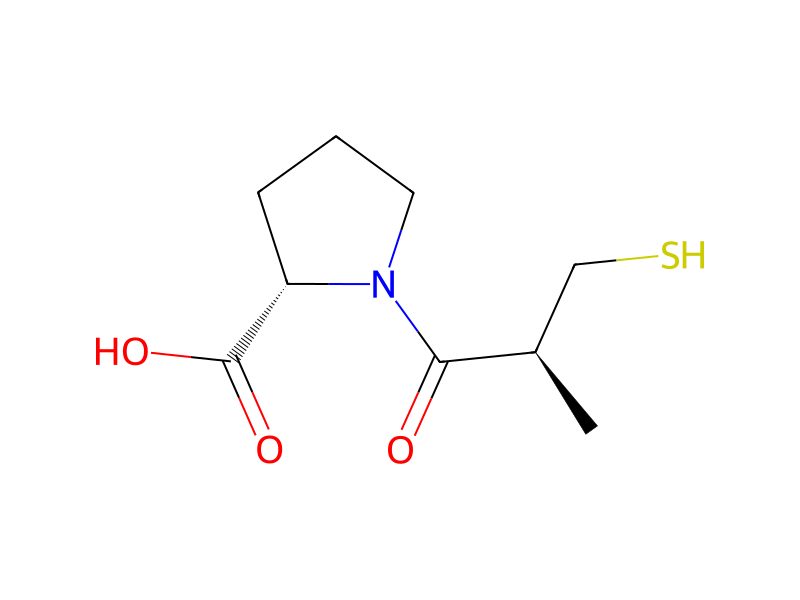
Grundinformationen
- Standard-SMILES
C[C@H](CS)C(=O)N1CCC[C@H]1C(=O)O- InChIKey
FAKRSMQSSFJEIM-RQJHMYQMSA-N- Summenformel
- C9H15NO3S
- Durchschnittliche Molmasse
- 217,29 g/mol
- Monoisotopische Masse
- 217,07726434
Überblick
Captopril is a L-proline derivative in which L-proline is substituted on nitrogen with a (2S)-2-methyl-3-sulfanylpropanoyl group. It is used as an anti-hypertensive ACE inhibitor drug. It has a role as an EC 3.4.15.1 (peptidyl-dipeptidase A) inhibitor and an antihypertensive agent. It is a pyrrolidinemonocarboxylic acid, a N-acylpyrrolidine, an alkanethiol and a L-proline derivative.
Namen und Bezeichner
- Bevorzugter Name
- Captopril
- IUPAC
- (2S)-1-[(2S)-2-methyl-3-sulfanylpropanoyl]pyrrolidine-2-carboxylic acid
- Lokaler Name
- Captopril
- Englischer Name
- Captopril
- Summenformel
- C9H15NO3S
- Molmasse
- 217.29
Namen und Synonyme
captopril62571-86-2CapotenL-CaptoprilCaptoprylAcepressCaptorilGarranilCesplonCaptolaneTensoprelDilabar
Weitere Namen anzeigen
onacidic(2S)-1-[(2S)-2-Methyl-3-sulfanylpropanoyl]pyrrolidine-2-carboxylic acid(2S)-1-[(2S)-3-Mercapto-2-methylpropionyl]-2-pyrrolidinecarboxylic acidTimoloCaptopril APICAPTOPRIL USPcysteine-rich
LoprilAlopresinHypertilTenosbonAceprilApoprilCaptoprilumAcediur
Datenbank-Bezeichner
- CAS
62571-86-2- PubChem CID
- 44093
- DTXSID
DTXSID1037197- ChEMBL
CHEMBL1560- ChEBI
CHEBI:3380- UNII
- 9G64RSX1XD
- EC Number
- 263-607-1
- Nikkaji
- J3.203D
Eigenschaften
Berechnete Struktureigenschaften
- XLogP
- 0,3
- Polarare Oberfläche (TPSA)
- 58,6 Ų
- H-Brücken-Donoren
- 2
- H-Brücken-Akzeptoren
- 4
- Frei drehbare Bindungen
- 3
- Schwere Atome
- 14
- Formalladung
- 0
- Komplexität
- 244
Experimentelle und physikochemische Eigenschaften
Drugs
Pharmaceuticals -> Listed in ZINC15
Pharmaceuticals -> Antihypertensives
LogP
log Kow = 0.34
0.6
OdorSlight sulfurous odor
Color/Form
White to off-white, crystalline powder
Crystals from ethyl acetate/hexane
Solubility
Freely soluble
Freely soluble in water (approximately 160 mg/mL)
Freely soluble in alcohol, chloroform, methylene chloride; sparingly soluble in ethyl acetate
4.52e+00 g/L
Human Drugs
Breast Feeding; Lactation; Milk, Human; Antihypertensive Agents; Angiotensin-Converting Enzyme Inhibitors; ACE Inhibitors
FDA approved drugs -> Active ingredient
FDA approved drugs -> Active ingredient
Pharmaceuticals
DecompositionWhen heated to decomposition it emits every toxic fumes of /nitrogen oxides and sulfur oxides/
Melting Point
103-104
103-104 °C
106 °C
Optical RotationSpecific optical rotation: -131.0 deg at 22 °C/D (c = 1.7 in ethanol)
Physical DescriptionSolid
Stability/Shelf LifeStable under recommended storage conditions.
Dissociation ConstantspKa1 = 3.7; pKa2 = 9.8
Physikochemische Eigenschaften
- Schmelzpunkt
- 104 · 104-108 °C (lit.)
- Siedepunkt
- 427 · 427.0±40.0 °C(Predicted)
- Dichte
- 1.2447 · 1.2447 (rough estimate)
- Brechungsindex
- -127.5 ° · -127.5 ° (C=1.7, EtOH)
- storage temp.
- room temp
- Löslichkeit
- 2 O: · H2O: 0.1 g/mL, very slightly hazy, colorless
- Aggregatzustand
- Crystalline Powder
- pka
- 3.7 · 3.7, 9.8(at 25℃)
- Farbe
- white to off-white
- Biologische Quelle
- synthetic (organic)
- Wasserlöslichkeit
- soluble
- Merck
- 14 · 14,1774
- BRN
- 477887 · 477887
- BCS Class
- 3 · 3
- Stabilität
- Stable. Incompatible with strong oxidizing agents.
- InChI
- 1S/C9H15NO3S/c1-6(5-14)8(11)10-4-2-3-7(10)9(12)13/h6-7,14H,2-5H2,1H3,(H,12,13)/t6-,7+/m1/s1
- InChIKey
- FAKRSMQSSFJEIM-RQJHMYQMSA-N
- SMILES
- C[C@H](CS)C(=O)N1CCC[C@H]1C(O)=O
- CAS Datenbank
- 62571 · 62571-86-2(CAS DataBase Reference)
- NIST chemische Informationen
- Captopril(62571-86-2)
Sicherheit und Regulatorisches
GHS-Klassifizierung
GHS Classification
Danger
H317 (95.6%): May cause an allergic skin reaction [Warning Sensitization, Skin]
P203, P261, P264+P265, P272, P280, P302+P352, P305+P354+P338, P317, P318, P321, P333+P317, P362+P364, P405, and P501 (click each P-code to see the statement)
Aggregated GHS information provided per 137 reports by companies from 18 notifications to the ECHA C&L Inventory. Each notification may be associated with multiple companies.
Warning
H317: May cause an allergic skin reaction [Warning Sensitization, Skin]
Gefahrenhinweise
Regulatory InformationCaptopril: Does not have an individual approval but may be used under an appropriate group standard
Other Safety InformationIMAP assessments - L-Proline, 1-(3-mercapto-2-methyl-1-oxopropyl)-, (S)-: Environment tier I assessment
FDA Requirements
The Approved Drug Products with Therapeutic Equivalence Evaluations identifies currently marketed prescription drug products, including captopril, approved on the basis of safety and effectiveness by FDA under sections 505 of the Federal Food, Drug, and Cosmetic Act.
Special Reports
Raia JJ Jr et al; Angiotensin-converting Enzyme Inhibitors: A Comparative Review; DICP 24 (5): 506-25 (1990) The chemistry, pharmacology, pharmacokinetics, adverse effects, and dosages of the three currently available angiotensin converting enzyme (ACE) inhibitors are reviewed.
Brogden RN et al; Drugs 36 (Nov): 540-600 (1988); A review of the pharmacodynamics, pharmacokinetics, therapeutic trials, side effects, overdosage, interactions and dosage and administration of captopril is presented.
Toxic Combustion ProductsSpecial hazards arising from the substance or mixture: Carbon oxides, nitrogen oxides (NOx), sulfur oxides.
Hazard Classes and CategoriesSkin Sens. 1 (95.6%)
Sicherheit und Schutzausrüstung
Fire Fighting Procedures
Suitable extinguishing media: Use water spray, alcohol-resistant foam, dry chemical or carbon dioxide.
Advice for firefighters: Wear self contained breathing apparatus for fire fighting if necessary.
Storage Conditions
Keep container tightly closed in a dry and well-ventilated place. Keep in a dry place.
Tablets should be stored in tighy containers at a temperature not exceeding 30 °C
Cleanup Methods
ACCIDENTAL RELEASE MEASURES: Personal precautions, protective equipment and emergency procedures: Use personal protective equipment. Avoid dust formation. Avoid breathing vapors, mist or gas. Ensure adequate ventilation. Evacuate personnel to safe areas. Avoid breathing dust. Environmental precautions: Prevent further leakage or spillage if safe to do so. Do not let product enter drains. Methods and materials for containment and cleaning up: Pick up and arrange disposal without creating dust. Sweep up and shovel. Keep in suitable, closed containers for disposal.
Disposal Methods
SRP: Expired or waste pharmaceuticals shall carefully take into consideration applicable DEA, EPA, and FDA regulations. It is not appropriate to dispose by flushing the pharmaceutical down the toilet or discarding to trash. If possible return the pharmaceutical to the manufacturer for proper disposal being careful to properly label and securely package the material. Alternatively, the waste pharmaceutical shall be labeled, securely packaged and transported by a state licensed medical waste contractor to dispose by burial in a licensed hazardous or toxic waste landfill or incinerator.
Product Offer surplus and non-recyclable solutions to a licensed disposal company. Contact a licensed professional waste disposal service to dispose of this material. Dissolve or mix the material with a combustible solvent and burn in a chemical incinerator equipped with an afterburner and scrubber. Contaminated packaging: Dispose of as unused product.
Preventive Measures
ACCIDENTAL RELEASE MEASURES: Personal precautions, protective equipment and emergency procedures: Use personal protective equipment. Avoid dust formation. Avoid breathing vapors, mist or gas. Ensure adequate ventilation. Evacuate personnel to safe areas. Avoid breathing dust. Environmental precautions: Prevent further leakage or spillage if safe to do so. Do not let product enter drains.
Precautions for safe handling: Avoid contact with skin and eyes. Avoid formation of dust and aerosols. Provide appropriate exhaust ventilation at places where dust is formed.
Appropriate engineering controls: Handle in accordance with good industrial hygiene and safety practice. Wash hands before breaks and at the end of workday.
Gloves must be inspected prior to use. Use proper glove removal technique (without touching glove's outer surface) to avoid skin contact with this product. Dispose of contaminated gloves after use in accordance with applicable laws and good laboratory practices. Wash and dry hands.
SRP: Local exhaust ventilation should be applied wherever there is an incidence of point source emissions or dispersion of regulated contaminants in the work area. Ventilation control of the contaminant as close to its point of generation is both the most economical and safest method to minimize personnel exposure to airborne contaminants. Ensure that the local ventilation moves the contaminant away from the worker.
Personal Protective Equipment (PPE)
Eye/face protection: Use equipment for eye protection tested and approved under appropriate government standards such as NIOSH (US) or EN 166(EU).
Skin protection: Handle with gloves.
Body Protection: Choose body protection in relation to its type, to the concentration and amount of dangerous substances, and to the specific work-place.
Respiratory protection: Where risk assessment shows air-purifying respirators are appropriate use a full-face particle respirator type N100 (US) or type P3 (EN 143) respirator cartridges as a backup to engineering controls. If the respirator is the sole means of protection, use a full-face supplied air respirator. Use respirators and components tested and approved under appropriate government standards such as NIOSH (US) or CEN (EU).
Toxikologische Informationen
Interactions
The case of a 70 yr old hypertensive man who presented with a 2 month history of 3 nodular angiomatous lesions on the left arm following treatment with 75 mg/day of oral captopril (Lopril) and 200 mg/day of oral acebutolol hydrochloride (Sectral) for 6 yr is reported. The patient had no history of drug product transfusion, iv drugs, or opportunistic infections. Clinical and histopathological findings were typical of Kaposi's sarcoma. Captopril was stopped, and one month later, the Kaposi's sarcoma lesions had begun to disappear; after 3 months, no lesions were seen. Biopsy showed residual features of Kaposi's sarcoma. However, it is not known whether captopril alone or an interaction with acebutolol hydrochloride resulted in Kaposi's sarcoma.
Concomitant oral administration of captopril and antacids may decrease the rate and extent of GI absorption of captopril. Oral administration of a single, 50-mg dose of captopril 15 minutes after an oral dose of an antacid containing magnesium carbonate and aluminum and magnesium hydroxides resulted in a 40-45% decrease in captopril bioavailability, and a delay and decrease in peak serum concentrations of the drug. However, there is some evidence that this potential interaction may not be clinically important, but additional study is necessary.
Neuropathy reportedly developed in 2 patients receiving captopril and cimetidine. However, further documentation of this potential interaction is necessary.
Initiation of captopril therapy has been associated with unexplained hypoglycemia in several diabetic patients whose diabetes had been controlled with insulin or oral antidiabetic agents. Testing in these patients indicated that captopril may increase insulin sensitivity; the mechanism of this effect is not known. The risk of precipitating hypoglycemia should be considered when captopril therapy is initiated in diabetic patients.
For more Interactions (Complete) data for Captopril (22 total), please visit the HSDB record page.
HepatotoxicityCaptopril, like other ACE inhibitors, has been associated with a low rate of serum aminotransferase elevations (
Ecotoxicity Values
EC50; Species: Desmodesmus subspicatus (Green Algae) initial 10X10+4 cells; Conditions: freshwater, static, 23 °C; Concentration: 168000 ug/L for 3 days; Effect: population, decreased population growth rate
EC50; Species: Daphnia magna (Water Flea) age <24 hr; Conditions: freshwater, static, 20 °C; Concentration: >100000 ug/L for 48 hr; Effect: intoxication, immobilization
EC50; Species: Lemna minor (Duckweed) 2-3 frond; Conditions: freshwater, static, 25 °C; Concentration: 100000 ug/L for 48 hr; Effect: population, decreased population growth rate
EC50; Species: Lemna minor (Duckweed) 3-4 frond; Conditions: freshwater, static, pH 5.5-8.0; Concentration: >200000 ug/L for 7 days; Effect: population, decreased population growth rate
Environmental Fate
TERRESTRIAL FATE: Based on a classification scheme(1), an estimated Koc value of 10(SRC), determined from a structure estimation method(2), indicates that captopril is expected to have very high mobility in soil(SRC). The pKa values of captopril are 3.7 and 9.8(3), indicating that this compound will exist almost entirely in the anion form in the environment and anions generally do not adsorb more strongly to soils containing organic carbon and clay than their neutral counterparts(4). Volatilization from moist soil is not expected because the compound exists as an anion and anions do not volatilize. Captopril is not expected to volatilize from dry soil surfaces(SRC) based upon an estimated vapor pressure of 7.3X10⁻⁶ mm Hg at 25 °C(SRC), determined from a fragment constant method(2). Complete biodegradaton using the modified Zahn-Welllens test(5) indicates that biodegradation may be an important environmental fate process in soil(SRC).
AQUATIC FATE: Based on a classification scheme(1), an estimated Koc value of 10(SRC), determined from a structure estimation method(2), indicates that captopril is not expected to adsorb to suspended solids and sediment(SRC). The pKa values of 3.7 and 9.8(3) indicate captopril will exist almost entirely in the anion form at pH values of 5 to 9 and, therefore, volatilization from water surfaces is not expected to be an important fate process(SRC). According to a classification scheme(4), an estimated BCF of 3(SRC), from its log Kow of 0.34(5) and a regression-derived equation(2), suggests the potential for bioconcentration in aquatic organisms is low(SRC). Complete biodegradaton using the modified Zahn-Welllens test(6) indicates that biodegradation may be an important environmental fate process in water(SRC).
ATMOSPHERIC FATE: According to a model of gas/particle partitioning of semivolatile organic compounds in the atmosphere(1), captopril, which has an estimated vapor pressure of 7.3X10⁻⁶ mm Hg at 25 °C(SRC), determined from a fragment constant method(2), will exist in both the vapor and particulate phases in the ambient atmosphere. Vapor-phase captopril is degraded in the atmosphere by reaction with photochemically-produced hydroxyl radicals(SRC); the half-life for this reaction in air is estimated to be 4 hrs(SRC), calculated from its rate constant of 8.8X10⁻¹¹ cu cm/molecule-sec at 25 °C(SRC) that was derived using a structure estimation method(3). Particulate-phase captopril may be removed from the air by wet and dry deposition(SRC). Captopril contains chromophores that absorb at wavelengths >290 nm(4) and, therefore, may be susceptible to direct photolysis by sunlight(SRC).
Adverse EffectsWhile captopril is generally well-tolerated, it does have several potential adverse effects.
Milk Concentrations/MILK/ Concentrations of captopril in human milk are approximately one percent of those in maternal blood.
Toxicity Summary
IDENTIFICATION AND USE: Captopril is angiotensin-converting enzyme (ACE) inhibitor and antihypertensive agent. HUMAN STUDIES: Captopril prevents the conversion of angiotensin I to angiotensin II (a potent vasoconstrictor) by competing with the physiologic substrate (angiotensin I) for the active site of ACE. The affinity of the drug for ACE is approximately 30,000 times greater than that of angiotensin I. Inhibition of ACE results in decreased plasma angiotensin II concentrations and, consequently, blood pressure may be reduced in part through decreased vasoconstriction. Captopril-induced bone marrow suppression is rare, except in certain high-risk patient populations. Severe exfoliative rashes have also been associated with captopril. A 57 year old male with mild impairment of renal function secondary to diabetic glomerulosclerosis developed acute renal failure associated with a generalized desquamative skin rash and peripheral eosinophilia shortly after initiation of antihypertensive therapy with captopril. Cholestatic jaundice is a rare complication associated with the use captopril. The severity of the disease may range from cholestasis on liver histology to overt fulminant hepatic failure. A case of a 75 year old male who committed suicide by taking an overdose of captopril was reported. He took approximately ninety 12.5 mg captopril tablets. Captopril administration over 3 months or more generates red blood cells zinc depletion. Hypogeusia (a reduced ability to taste things) is a reported side effect of captopril. Linkage of hypogeusia to zinc deficiency has been suggested. The fetal toxicity of captopril in the 2nd and 3rd trimesters is similar to other ACE inhibitors. The use of this drug during the 2nd and 3rd trimesters may cause teratogenicity and severe fetal and neonatal toxicity. Fetal toxic effects may include anuria, oligohydramnios, fetal hypocalvaria, intrauterine growth restriction, prematurity, and patent ductus arteriosus. Still birth or neonatal death may occur. Anuria-associated oligohydramnios may product fetal limb contractures, craniofacial deformation, and pulmonary hypoplasia. Sever anuria and hypotension, which is resistant to both pressor agents and volume expansion, may occur in the newborn following in utero exposure. Newborn renal function and blood pressure should be closely monitored. Mutagenicity studies with captopril in fixed combination with hydrochlorothiazide have not been conducted, but the effects of the individual components in a 2:1 ratio have been studied. Captopril/hydrochlorothiazide did not exhibit mutagenic or clastogenic potential in a sister chromatid exchange test in human lymphocytes. In a cytogenetics assay in human lymphocytes exposed to captopril/hydrochlorothiazide concentrations of 5, 25, and 50 ug/mL (total concentration of both drugs) with metabolic activation, chromosomal abnormalities were not observed consistently. When such aberrations were observed, no concentration response was noted. ANIMAL STUDIES: No evidence of carcinogenesis was observed in rats or mice receiving captopril dosages of 50-1350 mg/kg daily for 2 years. Reproduction studies in hamsters and rats using large doses of captopril have not revealed evidence of teratogenic effects. However, the drug was embryocidal and was associated with a low incidence of craniofacial malformations in rabbits, probably as a result of the marked decrease in blood pressure caused by the drug in this species. Reduction in neonatal survival occurred in the offspring of rats receiving captopril continuously during gestation and lactation, and an increased incidence of stillbirths has reportedly occurred in ewes. Mutagenicity studies with captopril in fixed combination with hydrochlorothiazide have not been conducted, but the effects of the individual components in a 2:1 ratio have been studied. Captopril/hydrochlorothiazide did not exhibit mutagenic or clastogenic potential in vitro with or without metabolic activation in a bacterial reverse mutation (Ames) assays using Salmonella, a forward mutation assay in Saccharomyces pombe, and a gene conversion assay using Saccharomyces cerevisiae. Captopril and hydrochlorothiazide in a 2:1 ratio were not genotoxic in the in vivo mouse micronucleus test at an oral dose of 2,500 mg/kg (total concentration of both drugs). ECOTOXICITY STUDIES: Captopril induces oxidative stress in C. carpio.
Correction of hypotension is the primary concern through volume expansion with an intravenous infusion of normal saline. Excessive hypotension has been rarely seen in hypertensive patients but is a possible consequence of captopril use in salt/volume-depleted persons. ACE inhibitors have rarely shown an association with a syndrome that begins with cholestatic jaundice and progresses to fulminant hepatic necrosis and sometimes death.
Ecotoxicity Excerpts
/AQUATIC SPECIES/ ... The present study aimed to evaluate the sublethal effects induced by three different concentrations of captopril, on C. carpio), by determination of activity of the antioxidant enzymes superoxide dismutase (SOD), catalase (CAT) and glutathione peroxidase (GPx), as well as indicators of cellular oxidation: hydroperoxide content (HPC), lipid peroxidation (LPX) and protein carbonyl content (PCC). Specimens were exposed for 12, 24, 48, 72 and 96 hr to three different captopril concentrations: 1 ug/L, 1 mg/L and 100 mg/L (the first one has been detected environmentally, the other two have been associated with diverse toxic effects in aquatic species), and brain, gill, liver, kidney and blood samples were evaluated. Significant increases in HPC and LPX were observed mainly in kidney and gill, while PCC also increased in brain. Modifications were found in the activity of SOD (mostly in kidney, brain and blood), CAT (all organs) and GPx (kidney and gill). In conclusion, captopril induces oxidative stress in C. carpio.
Ongoing Test Status
EPA has released the Interactive Chemical Safety for Sustainability (iCSS) Dashboard. The iCSS Dashboard provides an interactive tool to explore rapid, automated (or in vitro high-throughput) chemical screening data generated by the Toxicity Forecaster (ToxCast) project and the federal Toxicity Testing in the 21st century (Tox21) collaboration. /The title compound was tested by ToxCast and/or Tox21 assays/[USEPA; ICSS Dashboard Application; Available from, as of November 16, 2017: http://actor.epa.gov/dashboard/]
Soil Adsorption/Mobility
Using a structure estimation method based on molecular connectivity indices(1), the Koc of captopril can be estimated to be 10(SRC). According to a classification scheme(2), this estimated Koc value suggests that captopril is expected to have very high mobility in soil. The pKa values of captopril are 3.7 and 9.8(3), indicating that this compound will exist almost entirely in the anion form in the environment and anions generally do not adsorb more strongly to soils containing organic carbon and clay than their neutral counterparts(4).
Human Toxicity Excerpts
/HUMAN EXPOSURE STUDIES/ Coronary artery disease (CAD) and hypertension are the main reasons of ischemic heart diseases (IHDs). Cytokines as the small glycoproteins are the main arm of immune system and manipulate all of the cardiovascular diseases. The aim of the current study was to examine the effects of treatment of hypertension and CAD on serum levels of IL-6, IL-8, TGF-beta and TNF-alpha. This interventional study was performed on the patients with hypertension without CAD (group 1), hypertension and CAD (group 2), CAD but not hypertension (group 3) and without hypertension and CAD as controls (group 4). The patients received routine treatment for hypertension and CAD. Serum levels of IL-6, IL-8, TGF-beta and TNF-alpha were analyzed in the groups treated with various drugs, using ELISA technique. With regard to the medications, Atorvastatin, Losartan and Captopril were administered more in patients (groups 1, 2 and 3) than the patients without hypertension and CAD. The results revealed that serum levels of TGF-beta and IL-6 were significantly increased and decreased, respectively, in the groups 1, 2 and 3 when compared to group 4. Serum levels of TGF-beta were also increased in females in comparison to males in the group 4. According to the results it seems that Atorvastatin, Losartan and Captopril have reduced inflammation in in vivo conditions via downregulation of IL-6 and upregulation of TGF-beta.
/SIGNS AND SYMPTOMS/ Angioedema involving the extremities, face, lips, mucous membranes, tongue, glottis or larynx has been seen in patients treated with angiotensin-converting enzyme (ACE) inhibitors, including captopril. If angioedema involves the tongue, glottis or larynx, airway obstruction may occur and be fatal. Emergency therapy, including but not necessarily limited to, subcutaneous administration of a 1:1000 solution of epinephrine should be promptly instituted. Swelling confined to the face, mucous membranes of the mouth, lips and extremities has usually resolved with discontinuation of captopril; some cases required medical therapy
/CASE REPORTS/ Captopril-induced bone marrow suppression is rare, except in certain high-risk patient populations. Severe exfoliative rashes have also been associated with captopril, but a combined presentation of toxic epidermal necrolysis and agranulocytosis has not been previously described. We report an unusual case of captopril-induced toxic epidermal necrolysis with agranulocytosis in a patient with no known risk factors. The bone marrow suppression was successfully treated using granulocyte colony-stimulating factor (G-CSF), and the white blood cell (WBC) count recovered within 3 days after starting therapy. This case underscores the early experience with captopril, which showed a strong correlation between high doses used to treat hypertension and bone marrow suppression.
/CASE REPORTS/ A 57 year old male with mild impairment of renal function secondary to diabetic glomerulosclerosis developed acute renal failure (creatinine 32.4 mg/dL) associated with a generalized desquamative skin rash and peripheral eosinophilia shortly after initiation of antihypertensive therapy with captopril. An acute interstitial nephritis was demonstrated on renal biopsy, and improvement was temporally related to initiation of therapy with prednisone. A review of the literature revealed 5 similar cases in whom acute deterioration of renal function occurred following initiation of captopril and in whom there were features of a hypersensitivity reaction, including skin rash, fever, eosinophilia, azotemia, eosinophiluria, and a Coombs positive hemolytic anemia. Renal biopsy, where available, revealed an acute interstitial nephritis. Observations from these cases suggest that, of the angiotensin converting enzyme inhibitors, this syndrome appears to be specific for captopril, begins within the 1st month of therapy, is not dose dependent, and generally resolves on cessation of therapy. Steroids may hasten recovery, but sufficient data are not available to confirm their efficacy.
For more Human Toxicity Excerpts (Complete) data for Captopril (18 total), please visit the HSDB record page.
Artificial Pollution SourcesCaptopril's production and administration as a human and veterinary antihypertensive(1) may result in its release to the environment through various waste streams(SRC).
Regulatorische Informationen
FDA Requirements
The Approved Drug Products with Therapeutic Equivalence Evaluations identifies currently marketed prescription drug products, including captopril, approved on the basis of safety and effectiveness by FDA under sections 505 of the Federal Food, Drug, and Cosmetic Act.
Sicherheitsdaten
- wgk
- 2
- hs_code
- 29339900
- RTECS-Nr.
- UY0550000
- risk_code
- 43-63-36/37/38-40
- Toxizität
- LD50 in mice (mg/kg): 1040 i.v.; 6000 orally (Keim)
- hazard_code
- Xn,Xi
- safety_code
- 36/37-37/39-26-36-22
- Speicherklasse
- 6.1C - Combustible acute toxic Cat.3toxic compounds or compounds which causing chronic effects
- Giftige Stoffe Daten
- 62571-86-2(Hazardous Substances Data)
- Hazard Classifications
- Muta. 2Repr. 1B
Chemie und Industrie
Pharmakologische Informationen
ATC Code
C09AA01
C - Cardiovascular system
QC - Cardiovascular system
Protein Binding25-30% bound to plasma proteins, primarily albumin
Pharmacodynamics
Captopril, an ACE inhibitor, antagonizes the effect of the RAAS. The RAAS is a homeostatic mechanism for regulating hemodynamics, water and electrolyte balance. During sympathetic stimulation or when renal blood pressure or blood flow is reduced, renin is released from the granular cells of the juxtaglomerular apparatus in the kidneys. In the blood stream, renin cleaves circulating angiotensinogen to ATI, which is subsequently cleaved to ATII by ACE. ATII increases blood pressure using a number of mechanisms. First, it stimulates the secretion of aldosterone from the adrenal cortex. Aldosterone travels to the distal convoluted tubule (DCT) and collecting tubule of nephrons where it increases sodium and water reabsorption by increasing the number of sodium channels and sodium-potassium ATPases on cell membranes. Second, ATII stimulates the secretion of vasopressin (also known as antidiuretic hormone or ADH) from the posterior pituitary gland. ADH stimulates further water reabsorption from the kidneys via insertion of aquaporin-2 channels on the apical surface of cells of the DCT and collecting tubules. Third, ATII increases blood pressure through direct arterial vasoconstriction. Stimulation of the Type 1 ATII receptor on vascular smooth muscle cells leads to a cascade of events resulting in myocyte contraction and vasoconstriction. In addition to these major effects, ATII induces the thirst response via stimulation of hypothalamic neurons. ACE inhibitors inhibit the rapid conversion of ATI to ATII and antagonize RAAS-induced increases in blood pressure. ACE (also known as kininase II) is also involved in the enzymatic deactivation of bradykinin, a vasodilator. Inhibiting the deactivation of bradykinin increases bradykinin levels and may sustain its effects by causing increased vasodilation and decreased blood pressure.
Mechanism of Action
There are two isoforms of ACE: the somatic isoform, which exists as a glycoprotein comprised of a single polypeptide chain of 1277; and the testicular isoform, which has a lower molecular mass and is thought to play a role in sperm maturation and binding of sperm to the oviduct epithelium. Somatic ACE has two functionally active domains, N and C, which arise from tandem gene duplication. Although the two domains have high sequence similarity, they play distinct physiological roles. The C-domain is predominantly involved in blood pressure regulation while the N-domain plays a role in hematopoietic stem cell differentiation and proliferation. ACE inhibitors bind to and inhibit the activity of both domains, but have much greater affinity for and inhibitory activity against the C-domain. Captopril, one of the few ACE inhibitors that is not a prodrug, competes with ATI for binding to ACE and inhibits and enzymatic proteolysis of ATI to ATII. Decreasing ATII levels in the body decreases blood pressure by inhibiting the pressor effects of ATII as described in the Pharmacology section above. Captopril also causes an increase in plasma renin activity likely due to a loss of feedback inhibition mediated by ATII on the release of renin and/or stimulation of reflex mechanisms via baroreceptors. Captopril’s affinity for ACE is approximately 30,000 times greater than that of ATI.
The local role of the renin angiotensin system (RAS) was documented recently beside its conventional systemic functions. Studies showed that the effector angiotensin II (AngII) alters bone health, while inhibition of the angiotensin converting enzyme (ACE-1) preserved these effects. The newly identified Ang1-7 exerts numerous beneficial effects opposing the AngII. Thus, the current study examines the role of Ang1-7 in mediating the osteo-preservative effects of ACEI (captopril) through the G-protein coupled Mas receptor using an ovariectomized (OVX) rat model of osteoporosis. 8 weeks after the surgical procedures, captopril was administered orally (40 mg/kg/day), while the specific Mas receptor blocker (A-779) was delivered at infusion rate of 400 ng/kg/1 min for 6 weeks. Bone metabolic markers were measured in serum and urine. Minerals concentrations were quantified in serum, urine and femoral bones by inductive coupled plasma mass spectroscopy (ICP-MS). Trabecular and cortical morphometry was analyzed in the right distal femurs using micro-CT. Finally, the expressions of RAS peptides, enzymes and receptors along with the receptor activator of NF-kappaB ligand (RANKL) and osteoprotegerin (OPG) were determined femurs heads. OVX animals markedly showed altered bone metabolism and mineralization along with disturbed bone micro-structure. Captopril significantly restored the metabolic bone bio-markers and corrected Ca2+ and P values in urine and bones of estrogen deficient rats. Moreover, the trabecular and cortical morphometric features were repaired by captopril in OVX groups. Captopril also improved the expressions of ACE-2, Ang1-7, Mas and OPG, while abolished OVX-induced up-regulation of ACE-1, AngII, Ang type 1 receptor (AT1R) and RANKL. Inhibition of Ang1-7 cascade by A-779 significantly eradicated captopril protective effects on bone metabolism, mineralization and micro-structure. A-779 also restored OVX effects on RANKL expression and ACE-1/AngII/AT1R cascade and down-regulated OPG expression and ACE-2/Ang1-7/Mas pathway. In line with the clinical observations of the bone-preservative properties following ACE-1 inhibition, local activation of ACE-2/Ang1-7/Mas signaling and suppressed osteoclastogenesis seem responsible for the osteo-preservative effect of captopril, which could offers a potential therapeutic value in treatment of disabling bone and skeletal muscular diseases.
Biological Half-Life
2 hours
A 43 year old patient with mild heart failure attempted suicide by ingesting between 5000 and 7500 mg of captopril. Blood pressure oscillated around 100-120/50-75 mm Hg and pulse rate showed no tendency to accelerate (75-100/min). ... The calculated half-life of captopril was 4.4 hr. ...
The half life of captopril is about 2.8 hours in dogs ... .
The elimination half-life of unchanged captopril appears to be less than 2 hours in patients with normal renal function. The elimination half-life of captopril and its metabolites is correlated with creatinine clearance and increases to about 20-40 hours in patients with creatinine clearances less than 20 mL/minute and as long as 6.5 days in anuric patients.
Metabolism/Metabolites
Hepatic. Major metabolites are captopril-cysteine disulfide and the disulfide dimer of captopril. Metabolites may undergo reversible interconversion.
About half the absorbed dose of captopril is rapidly metabolized, mainly to captopril-cysteine disulfide and the disulfide dimer of captopril. In vitro studies suggest that captopril and its metabolites may undergo reversible interconversions. It has been suggested that the drug may be more extensively metabolized in patients with renal impairment than in patients with normal renal function.
FDA Pharmacological Classification
9G64RSX1XD
CAPTOPRIL
Established Pharmacologic Class [EPC] - Angiotensin Converting Enzyme Inhibitor
Mechanisms of Action [MoA] - Angiotensin-converting Enzyme Inhibitors
Captopril is an Angiotensin Converting Enzyme Inhibitor. The mechanism of action of captopril is as an Angiotensin-converting Enzyme Inhibitor.
CAPTOPRIL
MeSH Pharmacological Classification
A class of drugs whose main indications are the treatment of hypertension and heart failure. They exert their hemodynamic effect mainly by inhibiting the renin-angiotensin system. They also modulate sympathetic nervous system activity and increase prostaglandin synthesis. They cause mainly vasodilation and mild natriuresis without affecting heart rate and contractility.
Drugs used in the treatment of acute or chronic vascular HYPERTENSION regardless of pharmacological mechanism. Among the antihypertensive agents are DIURETICS; (especially DIURETICS, THIAZIDE); ADRENERGIC BETA-ANTAGONISTS; ADRENERGIC ALPHA-ANTAGONISTS; ANGIOTENSIN-CONVERTING ENZYME INHIBITORS; CALCIUM CHANNEL BLOCKERS; GANGLIONIC BLOCKERS; and VASODILATOR AGENTS.
Absorption, Distribution and Excretion
60-75% in fasting individuals; food decreases absorption by 25-40% (some evidence indicates that this is not clinically significant)
The drug /captopril/ is metabolized and renally excreted. More than 95% of a dose is excreted renally, both as unchanged (45-50%) drug and as metabolites.
In dogs, approximately 75% of an oral dose is absorbed but food in the GI tract reduces bioavailability by 30-40%. It is distributed to most tissues (not the CNS) and is 40% bound to plasma proteins in dogs.
Approximately 60-75% of an oral dose of captopril is rapidly absorbed from the GI tract in fasting healthy individuals or hypertensive patients. Food may decrease absorption of captopril by up to 25-40%, although there is some evidence that this effect is not clinically important. Following oral administration of a single 100-mg dose of captopril in fasting healthy individuals in one study, average peak blood drug concentrations of 800 ng/mL were attained in 1 hour.
/MILK/ Concentrations of captopril in human milk are approximately one percent of those in maternal blood.
For more Absorption, Distribution and Excretion (Complete) data for Captopril (7 total), please visit the HSDB record page.
Cellular LocationsCytoplasm
Metabolite PathwaysCaptopril Action Pathway
Verwendung und Herstellung
Uses
Angiotensin-Converting Enzyme Inhibitors; Antihypertensive Agents
MEDICATION
MEDICATION (VET)
Use (kg; approx.) in Germany (2009): >7500
Methods of ManufacturingPreparation: M.A. Ondetti, D.W. Cushman, German patent 2703828; eidem, United States of America patents 4046889 and 4105776 (1977, 1977, 1978 all to Squibb).
Formulations/Preparations
Table: Captopril Preparations [Table#6035]
Table: Captopril and Hydrochlorothiazide Combination Preparations [Table#6036]
Use ClassificationPharmaceuticals
Anwendungen
BeschreibungCaptopril is the most studied of the angiotensin-converting enzyme inhibitors proposed as an antihypertensive drug. It blocks angiotensin-converting enzyme, which suppresses formation of angiotensin II and relieves its vasoconstricting effect on arterial and venous vessels. Overall vascular peripheral tension is reduced, which results in the lowering of arterial pressure.
VerwendenCaptopril has also been shown to inhibit the formation of angiotensin II, a bioactive peptide that stimulates angiogenesis and increases microvessel density. Captopril demonstrates noncompetitive inhibition of tyrosinase monophenolase activity and competitive inhibition of diphenolase activity
Vor- und nachgelagerte Produkte
Vorgelagerte Rohstoffe
Anbieter50 Anbieter
国药集团化学试剂有限公司86-21-63210123 · [email protected]
北京华美互利生物化工010-56205725 · [email protected]
梯希爱(上海)化成工业发展有限公司021-67121386 · [email protected]
上海阿拉丁生化科技股份有限公司400-6206333 13167063860 · [email protected]
湖北威德利化学试剂有限公司181-6332-1995 18062128043 · [email protected]
T&W GROUP021-61551611 13296011611 · [email protected]
LGM Pharma1-(800)-881-8210 · [email protected]
上海迈瑞尔生化科技有限公司4006356688 18621169109 · [email protected]
武汉易泰科技有限公司上海分公司18930552037 · [email protected]
大连美仑生物技术有限公司0411-62910999 13889544652 · [email protected]
北京绿百草科技发展有限公司010-61136123 · [email protected]
上海柯维化学技术有限公司021-64609169 18901607656 · [email protected]
上海相辉医药科技有限公司13761987713 · [email protected]
Pure Chemistry Scientific Inc.001-857-928-2050 or 1-888-588-9418 · [email protected]
武汉威顺达科技发展有限公司86-027-88774375 · [email protected]
MedChemexpress LLC021-58955995 · [email protected]
上海瀚香生物科技有限公司177-54423994 17754423994 · [email protected]
孝感深远化工有限公司15527621225; 15527621225 · [email protected]
天津希恩思生化科技有限公司400 638 7771 · [email protected]
湖南汇百侍生物科技有限公司0731-85526065 13308475853 · [email protected]
斯百全化学(上海)有限公司021-021-021-67601398-809-809-809 15221380277 · [email protected]
上海源叶生物科技有限公司13636370518 · [email protected]
深圳菲斯生物科技有限公司0755-83725681-603
赛默飞世尔科技(中国)有限公司800-810-5118 · [email protected]
AdooQ BioScience, LLC+1 (866) 930-6790 · [email protected]
上海遐瑞医药科技有限公司+86 21 61551611
TCI AMERICA800-4238616 · [email protected]
TOKYO CHEMICAL INDUSTRY CO., LTD.03-36680489 · [email protected]
TCI Europe320-37350700 · [email protected]
深圳振强药物研发有限公司0755-66853366 13670046396 · [email protected]
南京杜莱生物技术有限公司025-84699383-8003;025-846993838003-8003 18013301590 · [email protected]
广州爱纯医药科技有限公司020-39119399 18927568969 · [email protected]
南京生利德生物科技有限公司025-57798810 18652991625 · [email protected]
上海弘邦医药科技有限公司021-021-64975436 18917636693 · [email protected]
湖北威德利化学试剂有限公司186-02735115 18602735115 · [email protected]
Cato Research Chemicals Inc.020-81960175 · [email protected]
湖北鑫源顺医药化工有限公司13971561712, 13995564702, 027-50664929 · [email protected]
HBCChem, Inc.+1-510-219-6317 · [email protected]
四川省维克奇生物科技有限公司028-81700200 18116577057 · [email protected]
湖南华腾制药有限公司400-8592883 · [email protected]
上海创赛科技有限公司400-6087598 15021221957 · [email protected]
上海麦克林生化科技股份有限公司15221275939 15221275939 · [email protected]
上海乾劲化工科技有限公司021-20900665 17321230821 · [email protected]
杭州杰恒化工有限公司0571-87396432 · [email protected]
上海永叶生物科技有限公司86-021-61559134 15921386130 · [email protected]
南京恰风和医药科技有限公司025-57018978 18251899859 · [email protected]
南京百鑫德诺生物科技有限公司025-58849295 · [email protected]
上海孚一生物科技有限公司+86 (21) 61124340
郑州佰宇药业有限公司13938569199 · [email protected]
凯试(上海)科技有限公司021-50135380 · [email protected]
Ergänzende Hinweise
DefinitionChEBI: A L-proline derivative in which L-proline is substituted on nitrogen with a (2S)-2-methyl-3-sulfanylpropanoyl group. It is used as an anti-hypertensive ACE inhibitor drug.
Zugehörige Reaktionen
26


Verknüpfte Notizen
Wird geladen…