
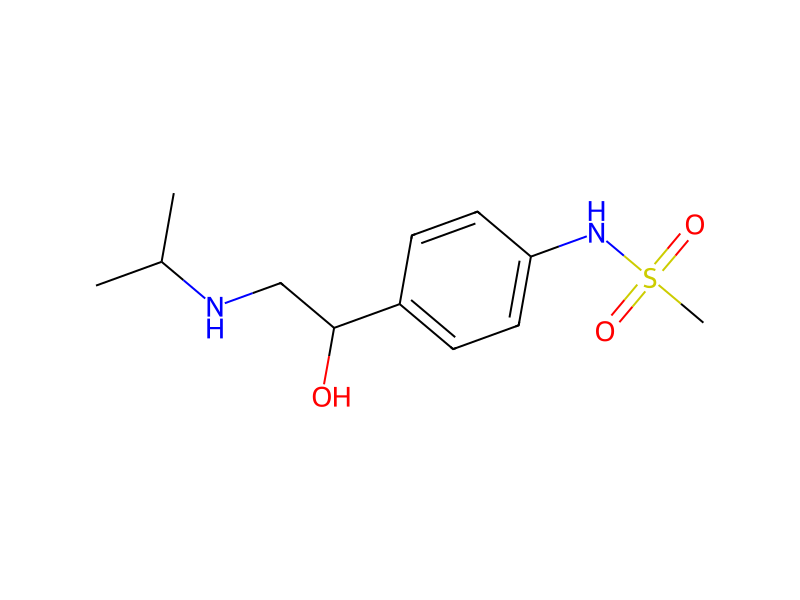
Grundinformationen
- Standard-SMILES
CC(C)NCC(O)c1ccc(NS(C)(=O)=O)cc1- InChIKey
ZBMZVLHSJCTVON-UHFFFAOYSA-N- Summenformel
- C12H20N2O3S
- Durchschnittliche Molmasse
- 272,37 g/mol
- Monoisotopische Masse
- 272,1194635
Überblick
Sotalol is a sulfonamide that is N-phenylmethanesulfonamide in which the phenyl group is substituted at position 4 by a 1-hydroxy-2-(isopropylamino)ethyl group. It has both beta-adrenoreceptor blocking (Vaughan Williams Class II) and cardiac action potential duration prolongation (Vaughan Williams Class III) antiarrhythmic properties. It is used (usually as the hydrochloride salt) for the management of ventricular and supraventricular arrhythmias. It has a role as a beta-adrenergic antagonist, a xenobiotic, an anti-arrhythmia drug and an environmental contaminant. It is a member of ethanolamines, a sulfonamide, a secondary alcohol and a secondary amino compound. It is a conjugate base of a sotalol(1+).
Namen und Bezeichner
- Bevorzugter Name
- Sotalol
- IUPAC
- N-[4-[1-hydroxy-2-(propan-2-ylamino)ethyl]phenyl]methanesulfonamide
- Englischer Name
- Sotalol
- Summenformel
- C12H20N2O3S
- Molmasse
- 272.36
Namen und Synonyme
sotalol3930-20-9beta-CardoneDL-SotalolSotalolumDarob miteDTXSID00235894'-(1-Hydroxy-2-(isopropylamino)ethyl)methane sulfonanilideMethanesulfonanilide, 4'-(1-hydroxy-2-(isopropylamino)ethyl)-C07AA07A6D97U294IN-(4-{1-hydroxy-2-[(propan-2-yl)amino]ethyl}phenyl)methanesulfonamide
Weitere Namen anzeigen
SORBITOLSotalol (base and/or unspecified salts)SotololBetacotdoneAURORA KA-855Sotalol USP/EP/BPSotalol Intermediate
Methanesulfonamide, N-(4-(1-hydroxy-2-((1-methylethyl)amino)ethyl)phenyl)-DTXCID303589CHEBI:63622Methanesulfonamide, N-[4-[1-hydroxy-2-[(1-methylethyl)amino]ethyl]phenyl]-SotaloloN-(4-(1-hydroxy-2-((propan-2-yl)amino)ethyl)phenyl)methanesulfonamideRefChem:56607MJ1999
Datenbank-Bezeichner
- CAS
3930-20-9- PubChem CID
- 5253
- DTXSID
DTXSID0023589- ChEMBL
CHEMBL471- ChEBI
CHEBI:63622- UNII
- A6D97U294I
- EC Number
- 977-025-7
- Nikkaji
- J10.583J
Eigenschaften
Berechnete Struktureigenschaften
- XLogP
- 0,2
- Polarare Oberfläche (TPSA)
- 86,8 Ų
- H-Brücken-Donoren
- 3
- H-Brücken-Akzeptoren
- 5
- Frei drehbare Bindungen
- 6
- Schwere Atome
- 18
- Formalladung
- 0
- Komplexität
- 330
Experimentelle und physikochemische Eigenschaften
Drugs
Pharmaceuticals
Pharmaceuticals -> Used in Switzerland
LogP
1.1
0.53
Solubility7.82e-01 g/L
Human Drugs
Breast Feeding; Lactation; Milk, Human; Antihypertensive Agents; Adrenergic Beta-Antagonists; Antiarrhythmics
Pharmaceuticals
Melting Point206.5 - 207 °C
Physical DescriptionSolid
Dissociation Constants9.76
Collision Cross Section167 Ų [M+H]+ [CCS Type: TW; Method: Major Mix IMS/Tof Calibration Kit (Waters)]
Physikochemische Eigenschaften
- Schmelzpunkt
- 206.5 · 206.5-207 °C
- Siedepunkt
- 443.3 · 443.3±55.0 °C(Predicted)
- Dichte
- 1.298 g/cm3 · 1.298 g/cm3
- storage temp.
- -20 °C · Hygroscopic, -20°C Freezer, Under inert atmosphere
- Löslichkeit
- Chloroform (Slightly, Heated), Methanol (Slightly, Sonicated)
- Aggregatzustand
- Solid
- pka
- 1 · pK1 8.2, pK2 9.8(at 25℃)
- Farbe
- Pale Yellow to Light Yellow
- BCS Class
- 1 · 1
- Stabilität
- Hygroscopic
- InChI
- InChI=1S/C12H20N2O3S/c1-9(2)13-8-12(15)10-4-6-11(7-5-10)14-18(3,16)17/h4-7,9,12-15H,8H2,1-3H3
- InChIKey
- ZBMZVLHSJCTVON-UHFFFAOYSA-N
- SMILES
- CS(NC1=CC=C(C(O)CNC(C)C)C=C1)(=O)=O
- CAS Datenbank
- 3930 · 3930-20-9(CAS DataBase Reference)
- NIST chemische Informationen
- 4 · Methanesulfonanilide, 4'-(1-hydroxy-2-(isopropylamino)ethyl)-(3930-20-9)
- EPA chemische Informationen
- 4 · Methanesulfonamide, N-[4-[1-hydroxy-2-[(1-methylethyl)amino]ethyl]phenyl]- (3930-20-9)
Sicherheit und Regulatorisches
GHS-Klassifizierung
GHS Classification
Danger
H315 (100%): Causes skin irritation [Warning Skin corrosion/irritation]
P203, P260, P263, P264, P264+P265, P270, P280, P302+P352, P305+P351+P338, P318, P319, P321, P332+P317, P337+P317, P362+P364, and P501 (click each P-code to see the statement)
The GHS information provided by 1 company from 1 notification to the ECHA C&L Inventory.
Gefahrenhinweise
Hazard Classes and CategoriesSkin Irrit. 2 (100%)
Toxikologische Informationen
Hepatotoxicity
Mild-to-moderate elevations in serum aminotransferase levels occur in less than 2% of patients on sotalol and are usually transient and asymptomatic, resolving even with continuation of therapy. Sotalol has been linked to a single case of clinically apparent liver injury, with onset of an acute hepatitis-like syndrome with prolonged jaundice 12 weeks after sotalol was initiated. The injury improved but did not resolve with discontinuation of sotalol. In large case series of drug induced liver disease and acute liver failure, sotalol has not been listed as a cause. Other beta-blockers have been linked to rare instances of acute clinically apparent liver injury with a latency to onset ranging from 4 to 24 weeks, a hepatocellular pattern of serum enzyme elevations and a mild, self-limiting course without evidence of hypersensitivity or autoimmune reactions.
Adverse Effects
Sotalol's adverse effect profile is inherent in the mechanisms of action as both a potassium channel blocker and a non-cardioselective β-blocker. The potassium channel blockade, primarily in phase 3 of the cardiac action potential, prolongs the QTc. Thus, the electrocardiogram (ECG) must be monitored upon initiating sotalol or adding other QTc-prolonging medications. Prolongation of the QT interval occurs in 1% to 2% of cases, which could lead to torsades de pointes or new ventricular tachycardia/ventricular fibrillation.
Toxicity Summary
Sotalol toxicity is inherent due to the mechanism of action as both a potassium channel blocker and a non-cardioselective β-blocker and mirrors the adverse effect profile. The most obvious and potentially problematic sign of toxicity is concentration-related QTc prolongation. If QTc is over 500 ms during initiation, the sotalol dose should be reduced or discontinued. If QTc exceeds 520 ms during the maintenance phase of dosing, the clinician should either reduce the dose or discontinue sotalol.
Drug Induced Liver Injury
Drug-Induced Liver Injury Severity and Toxicity (DILIst)
sotalol
DILI Negative
Oral
DOI:10.1016/j.drudis.2019.09.022
Effects During Pregnancy and Lactation◉ Summary of Use during Lactation
Sicherheitsdaten
- risk_code
- 36/37/38
- hazard_code
- Xi
- safety_code
- 26-36
Chemie und Industrie
Pharmakologische Informationen
ATC Code
C07AA07
C - Cardiovascular system
QC - Cardiovascular system
Protein Binding0%.
Pharmacodynamics
Sotalol is a competitive inhibitor of the rapid potassium channel. This inhibition lengthens the duration of action potentials and the refractory period in the atria and ventricles. The inhibition of rapid potassium channels is increases as heart rate decreases, which is why adverse effects like torsades de points is more likely to be seen at lower heart rates. L-sotalol also has beta adrenergic receptor blocking activity seen above plasma concentrations of 800ng/L. The beta blocking ability of sotalol further prolongs action potentials. D-sotalol does not have beta blocking activity but also reduces a patient's heart rate while standing or exercising. These actions combine to produce a negative inotropic effect that reduces the strength of contractility of muscle cells in the heart. Extension of the QT interval is also adversely associated with the induction of arrhythmia in patients. Hyperglycemia is a greater risk for non insulin dependant diabetics than insulin dependant diabetics. Beta blockers inhibit insulin secretion which may cause hyperglycemia in type II diabetes mellitus. The risk of hypoglycemia is higher in insulin dependant diabetes than non insulin dependant diabetics. Beta blockers decrease secretion of insulin, which may mask hypoglycemia in an insulin dependant patient. Beta blockers also increase glucose uptake into cells which may prolong or potentiate hypoglycemia. Further information regarding adverse reactions can be found here.
Mechanism of Action
Sotalol inhibits beta-1 adrenoceptors in the myocardium as well as rapid potassium channels to slow repolarization, lengthen the QT interval, and slow and shorten conduction of action potentials through the atria. The action of sotalol on beta adrenergic receptors lengthens the sinus node cycle, conduction time through the atrioventricular node, refractory period, and duration of action potentials.
Biological Half-Life
The terminal elimination half life is 10-20 hours in healthy patients. In patients with a creatinine clearance >80mL/min, the half life is 17.5±0.97h. In patients with a creatinine clearance 30-80mL/min, the half life is 22.7±6.4h. In patients with a creatinine clearance 10-30mL/min, the half life is 64±27.2h. In patients with a creatinine clearance <10mL/min, the half life is 97.9±57.3h.
Metabolism/MetabolitesSotalol is not metabolized.
FDA Pharmacological Classification
A6D97U294I
SOTALOL
Established Pharmacologic Class [EPC] - Antiarrhythmic
Physiologic Effects [PE] - Cardiac Rhythm Alteration
Mechanisms of Action [MoA] - Adrenergic beta-Antagonists
Sotalol is an Antiarrhythmic. The mechanism of action of sotalol is as an Adrenergic beta-Antagonist. The physiologic effect of sotalol is by means of Cardiac Rhythm Alteration.
MeSH Pharmacological Classification
Drugs that bind to but do not activate beta-adrenergic receptors thereby blocking the actions of beta-adrenergic agonists. Adrenergic beta-antagonists are used for treatment of hypertension, cardiac arrhythmias, angina pectoris, glaucoma, migraine headaches, and anxiety.
Agents used for the treatment or prevention of cardiac arrhythmias. They may affect the polarization-repolarization phase of the action potential, its excitability or refractoriness, or impulse conduction or membrane responsiveness within cardiac fibers. Anti-arrhythmia agents are often classed into four main groups according to their mechanism of action: sodium channel blockade, beta-adrenergic blockade, repolarization prolongation, or calcium channel blockade.
Drugs that inhibit the actions of the sympathetic nervous system by any mechanism. The most common of these are the ADRENERGIC ANTAGONISTS and drugs that deplete norepinephrine or reduce the release of transmitters from adrenergic postganglionic terminals (see ADRENERGIC AGENTS). Drugs that act in the central nervous system to reduce sympathetic activity (e.g., centrally acting alpha-2 adrenergic agonists, see ADRENERGIC ALPHA-AGONISTS) are included here.
Absorption, Distribution and Excretion
Sotalol is 90-100% bioavailable. When taken with a meal, adsorption is lowered by 18%. In patients with a creatinine clearance >80mL/min, the maximum concentration is 6.25±2.19.
80-90% of a given dose is excreted in the urine as unchanged sotalol. A small fraction of the doses is excreted in the feces as unchanged sotalol.
The apparent volume of distribution is 1.2-2.4L/kg.
In patients with a creatinine clearance >80mL/min, the plasma clearance is 6.78±2.72L/h and the renal clearance is 4.99±1.43L/h. In patients with a creatinine clearance 30-80mL/min, the plasma clearance is 2.74±0.53L/h and the renal clearance is 2.00±0.67L/h. In patients with a creatinine clearance 10-30mL/min, the plasma clearance is 1.56±0.44L/h and the renal clearance is 0.65±0.31L/h. In patients with a creatinine clearance <10mL/min, the plasma clearance is 0.65±0.20L/h and the renal clearance is 0.27±0.13L/h.
Cellular LocationsMembrane
Metabolite PathwaysSotalol Action Pathway
Verwendung und Herstellung
UsesUse (kg) in Switzerland (2009): >250
Use ClassificationPharmaceuticals
Vor- und nachgelagerte Produkte
Vorgelagerte Rohstoffe
Anbieter24 Anbieter
陕西缔都医药有限责任公司029-81124775 17791530730 · [email protected]
Anhui Zhongda Biotechnology Co., Ltd+86-15689548120 · [email protected]
LGM Pharma1-(800)-881-8210 · [email protected]
Anhui Zhongda Biotechnology Co., Ltd+86-19956560829 · [email protected]
医恩医疗系统研发(上海)有限公司021-58958002 18930822973 · [email protected]
佛山宝诺生物科技有限公司0757-85921206 18520245316 · [email protected]
Clearsynth Labs Limited+91-22-26355700 · [email protected]
西安美川生物科技有限公司029-89275612 +8618991951683 · [email protected]
HANGZHOU LEAP CHEM CO., LTD.+86-571-87711850 +86-15355479329 · [email protected]
艾吉析科技(上海)有限公司17721401538;17717235263 17721401538 · [email protected]
Anhui Ruihan Technology Co., Ltd+undefined17756083858 · [email protected]
武汉研哲科技有限公司15527250409 · [email protected]
厦门盈融达化工有限公司+86-0592-6210733 · [email protected]
常州非凡医药科技有限公司0519-82111935 15195055733 · [email protected]
成都圣美凯生物科技有限公司028-85157043 15882256948 · [email protected]
上海瀚香生物科技有限公司17754423994 · [email protected]
XIAMEN AMITY INDUSTRY AND TRADE CO., LTD.+8618950047208 · [email protected]
山西诺诚生物科技有限公司17835231871 · [email protected]
上海陌孚医药科技有限公司4000862158 18117107507 · [email protected]
上海贝万塔生物科技有限公司021-67187366 19901745723 · [email protected]
梯尔希(南京)药物研发有限公司18012923235 18012923235 · [email protected]
上海甄准生物科技有限公司18019219489 18901678489 · [email protected]
南京世洲生物科技有限公司17301488900 · [email protected]
Shandong Huisheng Import & Export Co., Ltd.+86-13176845580 · [email protected]
Ergänzende Hinweise
DefinitionChEBI: A sulfonamide that is N-phenylmethanesulfonamide in which the phenyl group is sustituted at position 4 by a 1-hydroxy-2-(isopropylamino)ethyl group. It has both beta-adrenoreceptor blocking (Vaughan Williams Class II) and ardiac action potential duration prolongation (Vaughan Williams Class III) antiarrhythmic properties. It is used (usually as the hydrochloride salt) for the management of ventricular and supraventricular arrhythmias.
Zugehörige Reaktionen
5


Verknüpfte Notizen
Wird geladen…