
Benzenediazonium tetrafluoroborate
Daten werden ergänzt – lade die Seite später neu, um den aktuellen Stand zu sehen
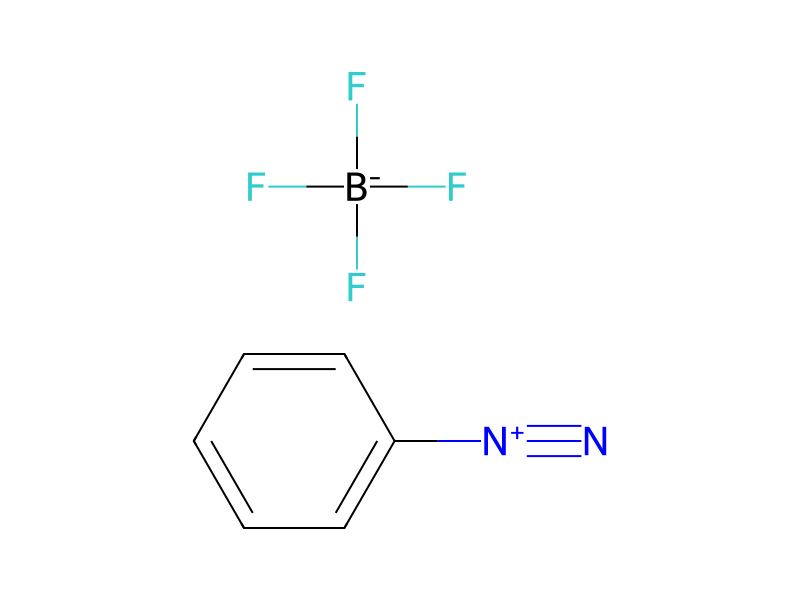
Grundinformationen
- CAS
369-57-3- Standard-SMILES
F[B-](F)(F)F.N#[N+]c1ccccc1- InChIKey
JNCLVGMBRSKDED-UHFFFAOYSA-N- Summenformel
- C6H5BF4N2
- Durchschnittliche Molmasse
- 191,92 g/mol
- Monoisotopische Masse
- 192,048191
Namen und Bezeichner
- Bevorzugter Name
- Benzenediazonium tetrafluoroborate
- IUPAC
- benzenediazonium tetrafluoroborate
- Englischer Name
- Benzenediazonium,tetrafluoroborate
- Summenformel
- BF4*C6H5N2
- Molmasse
- 0
Namen und Synonyme
Benzenediazonium tetrafluoroborate369-57-3Phenyldiazonium tetrafluoroborateDTXSID5021467Benzenediazonium fluoborateBenzenediazonium fluoroboratePhenyldiazonium fluoborate (salt)RefChem:117393DTXCID501467820-352-6BENZENEDIAZONIUM,TETRAFLUOROBORATEbenzenediazonium;tetrafluoroborate
Weitere Namen anzeigen
Ccris 5461Sildenafil Impurity 44Diazobenzene tetrafluoroborateBenzenediazonium·tetrafluoroboronanion
Benzenediazonium, tetrafluoroboranuideMFCD00968947C6H5BF4N2SCHEMBL237168SCHEMBL28241318SCHEMBL29095313JNCLVGMBRSKDED-UHFFFAOYSA-Nbenzenediazonium; tetrafluoroboranuide
Datenbank-Bezeichner
- CAS
369-57-3- PubChem CID
- 5284485
- DTXSID
DTXSID5021467- EC Number
- 820-352-6
Eigenschaften
Berechnete StruktureigenschaftenWird ergänzt
- Polarare Oberfläche (TPSA)
- 28,2 Ų
- H-Brücken-Donoren
- 0
- H-Brücken-Akzeptoren
- 6
- Frei drehbare Bindungen
- 0
- Schwere Atome
- 13
- Formalladung
- 0
- Komplexität
- 124
Experimentelle und physikochemische Eigenschaften
Chemical ClassesMetals -> Metalloid Compounds (Boron)
Physikochemische Eigenschaften
- Schmelzpunkt
- 121 · 121-122 °C (decomp)
- Dichte
- 1.53 g/cm3 · 1.53 g/cm3(Temp: 25 °C)
- Löslichkeit
- 2 O; · fairly sol polar solvents such as acetonitrile, acetone, pyridine, DMF, DMSO, and HMPA with decomposition; slightly sol water; insol hydrocarbons and Et2O; solubilized in nonpolar media by crown ethers.
- Farbe
- 80 °C · colorless solid after recrystallization; turns pink at 80 °C
Sicherheit und Regulatorisches
Sicherheitsangaben dienen nur zur Orientierung und ersetzen weder das Sicherheitsdatenblatt (SDB) des Lieferanten noch geltende Vorschriften oder eine fachliche Bewertung.
GHS-Klassifizierung
GHS Classification
Danger
H228 (66.7%): Flammable solid [Danger Flammable solids]
P210, P240, P241, P260, P261, P264, P264+P265, P270, P271, P280, P301+P317, P302+P352, P304+P340, P305+P351+P338, P319, P321, P330, P332+P317, P337+P317, P362+P364, P370+P378, P403+P233, P405, and P501 (click each P-code to see the statement)
Aggregated GHS information provided per 3 reports by companies from 3 notifications to the ECHA C&L Inventory. Each notification may be associated with multiple companies.
Gefahrenhinweise
Hazards SummaryCauses dermatitis in oral and subcutaneous lethal-dose studies of hamsters; [RTECS] See Diazobenzenesulfonic acid. See 4-Nitrobenzenediazonium tetrafluoroborate. See Potassium tetrafluoroborate.
Hazard Classes and CategoriesFlam. Sol. 1 (66.7%)
Sicherheitsdaten
- Toxizität
- mmo-sat 10 mmol/L CNREA8 42,1446,82
Chemie und Industrie
Anwendungen
VerwendenBenzenediazonium Tetrafluoroborate is much higher stability than the corresponding chlorides; shock-insensitive; often used when pure, isolated arenediazonium salts are needed; reagent for introducing aryl, arylazo, arylhydrazono, or amino groups; forms fluoroarenes upon heating; building block for heterocycles.
Darstellung
synthetischePreparative Methods of Benzenediazonium Tetrafluoroborate: The most commonly used procedures consist in diazotization of an aromatic amine (ArNH2) with NaNO2 in aqueous HCl or H2SO4 followed by precipitation of the salt with added NaBF4 or fluoroboric acid. Alternatively, the diazotization can be carried out directly in 40-50% aqueous HBF4. Aromatic amines that do not dissolve in aqueous mineral acids can be reacted with NO+BF4 - in an anhydrous organic solvent or in liquid SO2. This method can also be applied to N-(trimethylsilyl)anilines and for the preparation of those salts that are not easily isolated from water. An improved, high-yielding one-pot procedure employs ArNH2, t-BuONO, and BF3. Et2O in an anhydrous organic solvent, typically CH2Cl2.
Vor- und nachgelagerte Produkte
Vorgelagerte Rohstoffe
Nachgelagerte Produkte
Zugehörige Reaktionen
17


Notizen zur Verbindung
Wird geladen…