
StartseiteMCPWorkbenchSkills
StartseiteWorkbenchBenachrichtigungenMein Bereich
llms.txt · MCP-AnleitungDatenschutz · Nutzungsbedingungen · Supportv1.8.0
  1. Startseite
  2. /Verbindung

Sulfamidsure

Sulfamic Acid

HCID 5987
Neue NotizNeue ReaktionAnfrage stellen
Druckvorschau

Daten werden ergänzt – lade die Seite später neu, um den aktuellen Stand zu sehen
GrundinformationenNamen und BezeichnerEigenschaftenSicherheit und RegulatorischesChemie und IndustrieZugehörige ReaktionenNotizen zur Verbindung
TeilstruktursucheÄhnliche Strukturen suchen

Grundinformationen

CAS
5329-14-6
Standard-SMILES
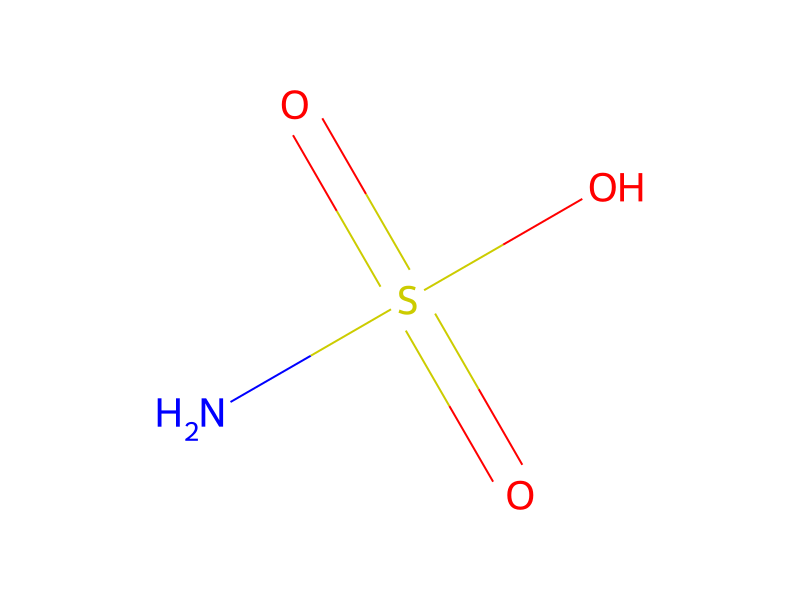
NS(=O)(=O)O
InChIKey
IIACRCGMVDHOTQ-UHFFFAOYSA-N
Summenformel
H3NO3S
Durchschnittliche Molmasse
97,1 g/mol
Monoisotopische Masse
96,98336413

Namen und Bezeichner

Bevorzugter Name
Sulfamic Acid
IUPAC
sulfamic acid
Lokaler Name
Sulfamidsure
Englischer Name
Sulfamic acid
Summenformel
H3NO3S
Molmasse
97.09

Namen und Synonyme

SULFAMIC ACID5329-14-6Amidosulfonic acidSulphamic acidAmidosulfuric acidAminosulfonic acidSulfamidic acidSulfaminic acidImidosulfonic acidJumboAminosulfuric acidKyselina sulfaminova
Weitere Namen anzeigen
sulfamicAminosulfonicSulphamic203-571-6BETZ 0254
Kyselina amidosulfonovaDTXSID60340059NFU33906QNSC-1871CHEBI:9330DTXCID4014005RefChem:6270226-218-8

Datenbank-Bezeichner

CAS
5329-14-6
PubChem CID
5987
DTXSID
DTXSID6034005
ChEBI
CHEBI:9330
UNII
9NFU33906Q
EC Number
226-218-8
Nikkaji
J43.594E

Eigenschaften

Berechnete StruktureigenschaftenWird ergänzt

XLogP
-1,6
Polarare Oberfläche (TPSA)
88,8 Ų
H-Brücken-Donoren
2
H-Brücken-Akzeptoren
4
Frei drehbare Bindungen
0
Schwere Atome
5
Formalladung
0
Komplexität
92

Experimentelle und physikochemische Eigenschaften

pH1N, pH=0.41; 0.75N, pH=0.5; 0.5N, pH=0.63; 0.25N, pH=0.87; 0.1N, pH=1.18; 0.05N, pH=1.41; 0.01N, pH=2.02
LogP0.10
OdorODORLESS
Density · 3 Einträge

2.15

Relative density (water = 1): 2.1

2.15 @25 °C

Color/Form · 3 Einträge

ORTHORHOMBIC CRYSTALS

WHITE CRYSTALLINE SOLID

Granular grade is off-white in color

Solubility · 6 Einträge

SPARINGLY SOL IN ALC, METHANOL; SLIGHTLY SOL IN ACETONE; INSOL IN ETHER; FREELY SOL IN NITROGENOUS BASES AND IN NITROGEN CONTAINING ORG SOLVENTS

INSOL IN CARBON DISULFIDE & CARBON TETRACHLORIDE

12.8 wt% in water at 0 °C; 17.57 wt% in water at 20 °C; 22.77 wt% in water at 40 °C; 0.1667 wt% in formamide at 25 °C; 0.0412 wt% in methanol at 25 °C; 0.0167 wt% in ethanol (2% benzene) at 25 °C; 0.0040 wt% in acetone at 25 °C; 0.0001 wt% in ether at 25 °C

water solubility = 1.47X10+5 mg/l @ 0 °C

147 mg/mL at 0 °C

Solubility in water at 20 °C: freely soluble

Sicherheit und Regulatorisches

Sicherheitsangaben dienen nur zur Orientierung und ersetzen weder das Sicherheitsdatenblatt (SDB) des Lieferanten noch geltende Vorschriften oder eine fachliche Bewertung.

GHS-Klassifizierung

GHS Classification · 6 Einträge

Warning

H315: Causes skin irritation [Warning Skin corrosion/irritation];H319: Causes serious eye irritation [Warning Serious eye damage/eye irritation];H412: Harmful to aquatic life with long lasting effects [Hazardous to the aquatic environment, long-term hazard]

P264, P264+P265, P273, P280, P302+P352, P305+P351+P338, P321, P332+P317, P337+P317, P362+P364, and P501 (click each P-code to see the statement)

This chemical does not meet GHS hazard criteria for 2.7% (104 of 3920) of reports.

Gefahrenhinweise

Regulatory Information · 5 Einträge

Chemical: Sulfamic acid

Sulfamic acid is listed on the EPA's Chemical Data Reporting (CDR) system. Manufacturers and importers of Sulfamic acid are required to report information about their production and use of this chemical to the EPA under the Toxic Substances Control Act (TSCA). (40 eCFR Part 711)

Status: Active Update: 28-10-2022 https://echa.europa.eu/registration-dossier/-/registered-dossier/14842;Status: Active Update: 11-03-2022 https://echa.europa.eu/registration-dossier/-/registered-dossier/22327

Sulfamic acid: HSNO Approval: HSR001549 Approved with controls

The New Jersey Worker and Community Right to Know Act requires public and private employers to provide information about hazardous substances at their workplaces. (N.J.S.A. 34:5A-1 et. seq.)

Other Safety InformationIMAP assessments - Sulfamic acid: Human health tier I assessment;IMAP assessments - Sulfamic acid: Environment tier I assessment
DOT LabelCorrosive
Fire Hazards · 3 Einträge

Excerpt from ERG Guide 154 [Substances - Toxic and/or Corrosive (Non-Combustible)]:;Non-combustible, substance itself does not burn but may decompose upon heating to produce corrosive and/or toxic fumes. Some are oxidizers and may ignite combustibles (wood, paper, oil, clothing, etc.). Corrosives in contact with metals may evolve flammable hydrogen gas. Containers may explode when heated. For electric vehicles or equipment, ERG Guide 147 (lithium ion or sodium ion batteries) or ERG Guide 138 (sodium batteries) should also be consulted. (ERG, 2024)

Chemie und Industrie

Pharmakologische Informationen

MeSH Pharmacological Classification · 2 Einträge

Pesticides used to destroy unwanted vegetation, especially various types of weeds, grasses (POACEAE), and woody plants. Some plants develop HERBICIDE RESISTANCE.

Substances used for the detection, identification, analysis, etc. of chemical, biological, or pathologic processes or conditions. Indicators are substances that change in physical appearance, e.g., color, at or approaching the endpoint of a chemical titration, e.g., on the passage between acidity and alkalinity. Reagents are substances used for the detection or determination of another substance by chemical or microscopical means, especially analysis. Types of reagents are precipitants, solvents, oxidizers, reducers, fluxes, and colorimetric reagents. (From Grant & Hackh's Chemical Dictionary, 5th ed, p301, p499)

Tissue LocationsKidney;Liver
Cellular LocationsCytoplasm;Extracellular

Verwendung und Herstellung

Uses · 5 Einträge

Used as a herbicide and chemical reagent; [ChemIDplus] Used as a herbicide (ammonium sulfamate) and to stabilize chlorine for swimming pools, cooling towers, and paper mills; used in electroplating (metal salts) and acid cleaning; [Merck Index] Used in photography (color bleach); [www.ci.tucson.az.us/arthazards/medium.html]

Acid and Alkali Cleaning of Metals [Category: Clean];Electroplating [Category: Plate];Pulp and Paper Processing [Category: Industry];Farming (Pesticides) [Category: Industry];Photographic Processing [Category: Other]

AS STANDARD IN ALKALIMETRY; IN ACID CLEANING; IN NITRITE REMOVAL; IN CHLORINE STABILIZATION FOR USE IN SWIMMING POOLS, COOLING TOWERS, PAPER MILLS

GAS-LIBERATING COMPOSITIONS; ORG SYNTHESIS; CATALYST FOR UREA-FORMALDEHYDE RESINS

CHEMICAL INTERMEDIATE FOR ITS SALTS; METAL CLEANING COMPONENT; WOOD PULP BLEACHING AGENT; ANALYTICAL REAGENT; AGENT IN DYING OF WOOL WITH ACID DYES; BACTERICIDE IN POOLS & PAPER MILLS

Impurities · 1 Eintrag

Zugehörige Reaktionen

497
Reaktionsaufzeichnung erstellen
Reaktionsgleichung von HRID 3425
HRID 3425als Eduktuspto-grants-1998_03
Reaktionsgleichung von HRID 3438
HRID 3438als Eduktuspto-grants-1998_03
Reaktionsgleichung von HRID 3442
HRID 3442als Eduktuspto-grants-1998_03
Reaktionsgleichung von HRID 3445
HRID 3445als Eduktuspto-grants-1998_03
Reaktionsgleichung von HRID 4252
HRID 4252als Eduktuspto-grants-1988_02
Reaktionsgleichung von HRID 5682
HRID 5682als Eduktuspto-grants-1993_09
Reaktionsgleichung von HRID 21678
HRID 21678als Eduktuspto-grants-1995_06
Reaktionsgleichung von HRID 34098
HRID 34098als Eduktuspto-grants-2008_09
Seite 1 von 63

Notizen zur Verbindung

Wird geladen…

Auf dieser SeiteGrundinformationenNamen und BezeichnerEigenschaftenSicherheit und RegulatorischesChemie und IndustrieZugehörige ReaktionenNotizen zur Verbindung
Weitere Aktionen
Neue NotizNeue ReaktionAnfrage stellen
Corrosivity · 1 Eintrag

H2SO4 (3wt%) and HCl (3wt%) are 2.6 and 4.2 times more corrosive, respectively, than a 3 wt% solution of sulfamic acid on 1010 steel. On the same scale, H2SO4 and HCl (3wt% solutions) are 1.5 and 6.7, respectively, times more corrosive on copper; 1.5 and 2.8 more corrosive on brass; 4.0 and 7.0 more corrosive on bronze; 0.6 and 5.3 more corrosive on aluminum.

Boiling PointDECOMP @ BOILING POINT
Decomposition · 2 Einträge

WHEN HEATED TO DECOMP, IT EMITS HIGHLY TOXIC FUMES OF /SULFUR OXIDES & HYDROGEN CHLORIDE/.

~205 °C

Melting Point · 3 Einträge

Melting point equals 205 °C

205 °C

205 °C

Heat of Combustion1.53x10+7 J/kmol
Physical Description · 5 Einträge

Sulfamic acid appears as a white crystalline solid. Density 2.1 g / cm3. Melting point 205 °C. Combustible. Irritates skin, eyes, and mucous membranes. Low toxicity. Used to make dyes and other chemicals.

Liquid; Liquid; Other Solid; Dry Powder; Other Solid; Large Crystals; CBI

White crystals; [CAMEO]

Solid

ODOURLESS COLOURLESS CRYSTALS OR POWDER.

Physikochemische Eigenschaften

Schmelzpunkt
215 · 215-225 °C (dec.) (lit.)
Siedepunkt
-520.47 °C · -520.47°C (estimate)
Dichte
2.151 g/cm3 · 2.151 g/cm3 at 25 °C
Dampfdruck
0.8 Pa · 0.8Pa at 20℃
Brechungsindex
1.553 · 1.553
storage temp.
30 °C · Store below +30°C.
Löslichkeit
213 g/L · water: soluble213g/L at 20°C
Aggregatzustand
Crystals or Crystalline Powder
pka
-8.53 · -8.53±0.27(Predicted)
Farbe
White
PH
1.2 · 1.2 (10g/l, H2O)
Geruch (Odor)
odorless
Wasserlöslichkeit
146.8 g/L · 146.8 g/L (20 ºC)
Merck
14 · 14,8921
Stabilität
Stable.
Major Application
environmentalfood and beveragesgeneral analyticalindustrial qcpharmaceutical
InChI
1S/H3NO3S/c1-5(2,3)4/h(H3,1,2,3,4)
InChIKey
IIACRCGMVDHOTQ-UHFFFAOYSA-N
SMILES
NS(O)(=O)=O
LogP
0 at · 0 at 20℃
CAS Datenbank
5329 · 5329-14-6(CAS DataBase Reference)
NIST chemische Informationen
Sulfamic acid(5329-14-6)
EPA chemische Informationen
Sulfamic acid (5329-14-6)

· Non-combustible, substance itself does not burn but may decompose upon heating to produce corrosive and/or toxic fumes.;· Some are oxidizers and may ignite combustibles (wood, paper, oil, clothing, etc.).;· Corrosives in contact with metals may evolve flammable hydrogen gas.;· Containers may explode when heated.;· For electric vehicles or equipment, GUIDE 147 (lithium ion or sodium ion batteries) or GUIDE 138 (sodium batteries) should also be consulted.

Combustible under specific conditions. Gives off irritating or toxic fumes (or gases) in a fire. Risk of explosion on contact with incompatible substances. See Chemical Dangers.

Health Hazards · 2 Einträge

Excerpt from ERG Guide 154 [Substances - Toxic and/or Corrosive (Non-Combustible)]:;TOXIC and/or CORROSIVE; inhalation, ingestion or skin contact with material may cause severe injury or death. Contact with molten substance may cause severe burns to skin and eyes. Avoid any skin contact. Fire may produce irritating, corrosive and/or toxic gases. Runoff from fire control or dilution water may be corrosive and/or toxic and cause environmental contamination. (ERG, 2024)

· TOXIC and/or CORROSIVE; inhalation, ingestion or skin contact with material may cause severe injury or death.;· Contact with molten substance may cause severe burns to skin and eyes.;· Avoid any skin contact.;· Fire may produce irritating, corrosive and/or toxic gases.;· Runoff from fire control or dilution water may be corrosive and/or toxic and cause environmental contamination.

Hazards Summary · 1 Eintrag

A skin and eye irritant; Molten substance may cause severe burns to the eyes and skin; [CAMEO] A strong acid; Slowly hydrolyzes to ammonium bisulfate in solution; [Merck Index] No active registrants; [NPIRS] Corrosive to the skin and eyes; Inhalation of aerosol can produce pulmonary edema; Nitrogen oxides and sulfur oxides are released when heated to decomposition; [ICSC] Moderately toxic by ingestion; Application of 0.5 ml. of a 4% solution into the eyes of a rabbit caused conjunctivitis, but no serious injury; [HSDB] Corrosive to skin and mucous membranes; Inhalation may induce chemical pneumonitis; [MSDSonline]

DOT ID and Guide2967 154
Reactive GroupAcids, Strong Non-oxidizing
UN ClassificationUN Hazard Class: 8; UN Pack Group: III
EPA Safer ChemicalChemical: Sulfamic acid; Green circle - The chemical has been verified to be of low concern based on experimental and modeled data.
FIFRA Requirements · 2 Einträge

As the federal pesticide law FIFRA directs, EPA is conducting a comprehensive review of older pesticides to consider their health and environmental effects and make decisions about their future use. Under this pesticide reregistration program, EPA examines health and safety data for pesticide active ingredients initially registered before November 1, 1984, and determines whether they are eligible for reregistration. In addition, all pesticides must meet the new safety standard of the Food Quality Protection Act of 1996. Pesticides for which EPA had not issued Registration Standards prior to the effective date of FIFRA, as amended in 1988, were divided into three lists based upon their potential for human exposure and other factors, with List B containing pesticides of greater concern and List D pesticides of less concern. Sulfamic acid is found on List D. Case No: 4085; Pesticide type: antimicrobial; Case Status: None of the active ingredients in the case are being supported for reregistration by their registrants. All are unsupported, or some are unsupported and some are cancelled. Cases described as "unsupported" generally are being processed for cancellation.; Active ingredient (AI): Sulfamic acid; AI Status: Registrants of the pesticide have not made or honored a commitment to seek reregistration, conduct the necessary studies, or pay the requisite fees, or they have asked EPA to cancel their product registrations. Unless some other interested party supports them, products containing the pesticide will be cancelled.

A tolerance is established for residues of sulfamate ion, expressed as sulfamic acid, from the postharvest application of the fungicide chlorosulfamic acid in or on asparagus, carrots, cauliflower, celery, potatoes, and radishes.

Reactivity AlertsKnown Catalytic Activity

Sicherheit und Schutzausrüstung

Fire Fighting · 2 Einträge

Excerpt from ERG Guide 154 [Substances - Toxic and/or Corrosive (Non-Combustible)]:;SMALL FIRE: Dry chemical, CO2 or water spray.;LARGE FIRE: Dry chemical, CO2, alcohol-resistant foam or water spray. If it can be done safely, move undamaged containers away from the area around the fire. Dike runoff from fire control for later disposal.;FIRE INVOLVING TANKS, RAIL TANK CARS OR HIGHWAY TANKS: Fight fire from maximum distance or use unmanned master stream devices or monitor nozzles. Do not get water inside containers. Cool containers with flooding quantities of water until well after fire is out. Withdraw immediately in case of rising sound from venting safety devices or discoloration of tank. ALWAYS stay away from tanks in direct contact with flames. (ERG, 2024)

Use water spray, foam, powder, carbon dioxide. In case of fire: keep drums, etc., cool by spraying with water.

First Aid Measures · 4 Einträge

Fresh air, rest. Seek medical attention if you feel unwell.

Rinse skin with plenty of water or shower. Refer for medical attention if skin irritation occurs.

Rinse with plenty of water for several minutes (remove contact lenses if easily possible). Refer immediately for medical attention.

Rinse mouth. Give one or two glasses of water to drink. Seek medical attention if you feel unwell.

Accidental Release Measures · 2 Einträge

· CALL 911. Then call emergency response telephone number on shipping paper. If shipping paper not available or no answer, refer to appropriate telephone number listed on the inside back cover.;· Keep unauthorized personnel away.;· Stay upwind, uphill and/or upstream.;· Ventilate closed spaces before entering, but only if properly trained and equipped.

· ELIMINATE all ignition sources (no smoking, flares, sparks or flames) from immediate area.;· Do not touch damaged containers or spilled material unless wearing appropriate protective clothing.;· Stop leak if you can do it without risk.;· Prevent entry into waterways, sewers, basements or confined areas.;· Absorb or cover with dry earth, sand or other non-combustible material and transfer to containers.;· DO NOT GET WATER INSIDE CONTAINERS.

First Aid · 2 Einträge

Excerpt from ERG Guide 154 [Substances - Toxic and/or Corrosive (Non-Combustible)]:;Refer to the "General First Aid" section. Specific First Aid: For corrosives, in case of contact, immediately flush skin or eyes with running water for at least 30 minutes. Additional flushing may be required. (ERG, 2024)

General First Aid:;· Call 911 or emergency medical service.;· Ensure that medical personnel are aware of the material(s) involved, take precautions to protect themselves and avoid contamination.;· Move victim to fresh air if it can be done safely.;· Administer oxygen if breathing is difficult.;· If victim is not breathing:;-- DO NOT perform mouth-to-mouth resuscitation; the victim may have ingested or inhaled the substance.;-- If equipped and pulse detected, wash face and mouth, then give artificial respiration using a proper respiratory medical device (bag-valve mask, pocket mask equipped with a one-way valve or other device).;-- If no pulse detected or no respiratory medical device available, provide continuous compressions. Conduct a pulse check every two minutes or monitor for any signs of spontaneous respirations.;· Remove and isolate contaminated clothing and shoes.;· For minor skin contact, avoid spreading material on unaffected skin.;· In case of contact with substance, remove immediately by flushing skin or eyes with running water for at least 20 minutes.;· For severe burns, immediate medical attention is required.;· Effects of exposure (inhalation, ingestion, or skin contact) to substance may be delayed.;· Keep victim calm and warm.;· Keep victim under observation.;· For further assistance, contact your local Poison Control Center.;· Note: Basic Life Support (BLS) and Advanced Life Support (ALS) should be done by trained professionals.;Specific First Aid:;· For corrosives, in case of contact, immediately flush skin or eyes with running water for at least 30 minutes. Additional flushing may be required.

Safe StorageStore only in original container. Separated from food and feedstuffs and incompatible materials. See Chemical Dangers. Dry. Store in an area without drain or sewer access.
Exposure Control and Personal Protection · 1 Eintrag

· Wear positive pressure self-contained breathing apparatus (SCBA).;· Wear chemical protective clothing that is specifically recommended by the manufacturer when there is NO RISK OF FIRE.;· Structural firefighters' protective clothing provides thermal protection but only limited chemical protection.

Fire Fighting Procedures · 1 Eintrag

If material on fire or involved in fire: Extinguish fire using agent suitable for type of surrounding fire. (Material itself does not burn or burns with difficulty.) Use dry chemical, dry sand, or carbon dioxide. Do not use water on material itself. If large quantities of combustibles are involved, use water in flooding quantities as spray and fog.

Cleanup MethodsWear eye protection, laboratory coat and nitrile rubber gloves. Clean up with dust pan and brush. May be flushed away to waste with at least 50 vol of water or mixed with sand and disposed or as normal refuse.
Nonfire Spill Response · 1 Eintrag

Excerpt from ERG Guide 154 [Substances - Toxic and/or Corrosive (Non-Combustible)]:;ELIMINATE all ignition sources (no smoking, flares, sparks or flames) from immediate area. Do not touch damaged containers or spilled material unless wearing appropriate protective clothing. Stop leak if you can do it without risk. Prevent entry into waterways, sewers, basements or confined areas. Absorb or cover with dry earth, sand or other non-combustible material and transfer to containers. DO NOT GET WATER INSIDE CONTAINERS. (ERG, 2024)

Disposal Methods · 2 Einträge

SRP: At the time of review, criteria for land treatment or burial (sanitary landfill) disposal practices are subject to significant revision. Prior to implementing land disposal of waste residue (including waste sludge), consult with environmental regulatory agencies for guidance on acceptable disposal practices.

Package Lots: Place in a separate labeled container for recycling or disposal by burning in a furnace equipped with an afterburner and scrubber. Small Quantities: Wear eye protection, laboratory coat and nitrile rubber gloves. Work in the fume hood. Sift slowly into a large container of cold water, with agitation. When dissolved, neutralize with sodium carbonate and pour into drain with at least 50 times its volume of water.

Spillage Disposal · 1 Eintrag

Personal protection: face shield. Do NOT let this chemical enter the environment. Sweep spilled substance into covered containers. If appropriate, moisten first to prevent dusting. Cautiously neutralize remainder. Then store and dispose of according to local regulations.

Preventive Measures · 3 Einträge

SRP: The scientific literature for the use of contact lenses in industry is conflicting. The benefit or detrimental effects of wearing contact lenses depend not only upon the substance, but also on factors including the form of the substance, characteristics and duration of the exposure, the uses of other eye protection equipment, and the hygiene of the lenses. However, there may be individual substances whose irritating or corrosive properties are such that the wearing of contact lenses would be harmful to the eye. In those specific cases, contact lenses should not be worn. In any event, the usual eye protection equipment should be worn even when contact lenses are in place.

If material not on fire and not involved in fire: Keep sparks, flames, and other sources of ignition away. Keep material out of water sources and sewers.

Personnel protection: Avoid breathing dusts, and fumes from burning material. Avoid bodily contact with the material. ... If contact with the material anticipated, wear appropriate chemical protective clothing.

Toxikologische Informationen

Adverse EffectsDermatotoxin - Skin burns.;Toxic Pneumonitis - Inflammation of the lungs induced by inhalation of metal fumes or toxic gases and vapors.
Exposure RoutesThe substance can be absorbed into the body by inhalation of its aerosol and by ingestion.
Signs and Symptoms · 4 Einträge

Cough. Sore throat.

Redness. Pain.

Redness. Pain. Burns.

Cough. Sore throat.

ICSC Environmental DataThe substance is harmful to aquatic organisms.
Human Toxicity Excerpts · 5 Einträge

SYMPTOMATOLOGY (...INGESTION OR SKIN CONTACT): 1. CORROSION OF MUCOUS MEMBRANES OF MOUTH, THROAT...ESOPHAGUS, WITH...PAIN & DYSPHAGIA. NECROTIC AREAS...GRAYISH WHITE BUT SOON...BLACKISH DISCOLORATION...& SOMETIMES SHRUNKEN OR WRINKLED TEXTURE. /ACID/

SYMPTOMATOLOGY.../INGESTION/: 2. EPIGASTRIC PAIN...MAY BE ASSOC WITH NAUSEA & VOMITING...INTENSE THIRST. 3. CIRCULATORY COLLAPSE...CLAMMY SKIN, WEAK & RAPID PULSE, SHALLOW RESP...SCANTY URINE. ...SHOCK IS OFTEN...CAUSE OF DEATH. 4. ASPHYXIAL DEATH DUE TO GLOTTIC EDEMA. /ACID/

SYMPTOMATOLOGY.../INGESTION/: 5. ULCERATION OF ALL MEMBRANES & TISSUES WITH WHICH ACID COMES IN CONTACT. ULCERATED AREAS OFTEN PERFORATE, LEADING TO MEDIASTINITIS & PERITONITIS. 6. LATE ESOPHAGEAL, GASTRIC & PYLORIC STRICTURES & STENOSIS...MAY REQUIRE...SURGICAL REPAIR, SHOULD BE ANTICIPATED. /ACID/

SYMPTOMATOLOGY.../INGESTION/: 6. ...PERMANENT SCARS MAY...APPEAR CORNEA, SKIN & OROPHARYNX. 7. UNCORRECTED CIRCULATORY COLLAPSE OF SEVERAL HR...MAY LEAD TO RENAL FAILURE & ISCHEMIC LESIONS IN LIVER & HEART. /ACID/

For more Human Toxicity Excerpts (Complete) data for SULFAMIC ACID (6 total), please visit the HSDB record page.

Artificial Pollution SourcesSUBSTANCE WHICH MIGRATES TO FOOD FROM PACKAGING MATERIALS.
Non-Human Toxicity Excerpts · 4 Einträge

ON RABBIT EYES APPLICATION OF 0.5 CC OF 4% SOLN IS REPORTED TO HAVE CAUSED MODERATE CONJUNCTIVITIS & EDEMA, BUT NO SERIOUS INJURY...

SOLN PRODUCE IRRITATION ON SC INJECTION IN RATS /AND/ ON THE CONJUNCTIVA OF RABBITS ... .

SOMEWHAT MORE TOXIC THAN AMMONIUM SALT /HERBICIDAL FORM/ TO MAMMALS...

Circulation and respiration were not greatly influenced after iv injection of 100 mg/kg in rats.

Regulatorische Informationen

Regulatory Information · 5 Einträge

Chemical: Sulfamic acid

Sulfamic acid is listed on the EPA's Chemical Data Reporting (CDR) system. Manufacturers and importers of Sulfamic acid are required to report information about their production and use of this chemical to the EPA under the Toxic Substances Control Act (TSCA). (40 eCFR Part 711)

Status: Active Update: 28-10-2022 https://echa.europa.eu/registration-dossier/-/registered-dossier/14842;Status: Active Update: 11-03-2022 https://echa.europa.eu/registration-dossier/-/registered-dossier/22327

Sulfamic acid: HSNO Approval: HSR001549 Approved with controls

The New Jersey Worker and Community Right to Know Act requires public and private employers to provide information about hazardous substances at their workplaces. (N.J.S.A. 34:5A-1 et. seq.)

FIFRA Requirements · 2 Einträge

As the federal pesticide law FIFRA directs, EPA is conducting a comprehensive review of older pesticides to consider their health and environmental effects and make decisions about their future use. Under this pesticide reregistration program, EPA examines health and safety data for pesticide active ingredients initially registered before November 1, 1984, and determines whether they are eligible for reregistration. In addition, all pesticides must meet the new safety standard of the Food Quality Protection Act of 1996. Pesticides for which EPA had not issued Registration Standards prior to the effective date of FIFRA, as amended in 1988, were divided into three lists based upon their potential for human exposure and other factors, with List B containing pesticides of greater concern and List D pesticides of less concern. Sulfamic acid is found on List D. Case No: 4085; Pesticide type: antimicrobial; Case Status: None of the active ingredients in the case are being supported for reregistration by their registrants. All are unsupported, or some are unsupported and some are cancelled. Cases described as "unsupported" generally are being processed for cancellation.; Active ingredient (AI): Sulfamic acid; AI Status: Registrants of the pesticide have not made or honored a commitment to seek reregistration, conduct the necessary studies, or pay the requisite fees, or they have asked EPA to cancel their product registrations. Unless some other interested party supports them, products containing the pesticide will be cancelled.

A tolerance is established for residues of sulfamate ion, expressed as sulfamic acid, from the postharvest application of the fungicide chlorosulfamic acid in or on asparagus, carrots, cauliflower, celery, potatoes, and radishes.

Sicherheitsdaten

wgk
1
tsca
TSCA listed
ridadr
UN 2967
hs_code
28111980
RTECS-Nr.
WO5950000
risk_code
36/38-52/53
Toxizität
MLD orally in rats: 1.6 g/kg (Ambrose)
hazard_code
Xi
safety_code
26-28-61-28A
hazard_class
8
packing_group
III
Speicherklasse
8A - Combustible corrosive hazardous materials
Giftige Stoffe Daten
5329-14-6(Hazardous Substances Data)
Hazard Classifications
Aquatic Chronic 3Eye Irrit. 2Skin Irrit. 2

Typical analysis, in 1981, of the E.I. du Pont de Nemours & Co. Inc products - Crystal grade: 0.2 wt% sulfates, 0.001 wt% iron, and 0.001 wt% insoluble matter; Granular grade: 3.5 wt% ammonium bisulfate, 3.5 wt% sulfuric acid, 0.1 wt% urea, 0.15 wt% magnesium, and 0.2 wt% sulfur trioxide

U.S. Imports · 2 Einträge

(1972) 2.39X10+9 G

(1975) 2.94X10+9 G

U.S. Production2023: 10,000,000 - <25,000,000 lb;2022: 10,000,000 - <25,000,000 lb;2021: 10,000,000 - <25,000,000 lb;2020: 10,000,000 - <25,000,000 lb
Consumer UsesAnti-scaling agent;Adsorbent;Cleaning agent;Not Known or Reasonably Ascertainable;pH regulating agent;Bleaching agent
Industry Uses · 1 Eintrag

pH regulating agent;Plating agent;Binder;Processing aids, specific to petroleum production;Anti-scaling agent;Chelating agent;Flocculating agent;Etching agent;Adsorbent;Flame retardant;Cleaning agent;Filler;Not Known or Reasonably Ascertainable;Emulsifier;Stabilizing agent

Methods of Manufacturing · 2 Einträge

REACTION OF UREA, SULFUR TRIOXIDE, AND SULFURIC ACID

OBTAINED FROM CHLOROSULFONIC ACID & AMMONIA, OR BY HEATING UREA WITH SULFURIC ACID.

Formulations/Preparations · 2 Einträge

99.5% Crystal or granular technical grades

Typical analysis in 1981 of the E.I. du Pont de Nemours & Co. Inc products: 99.7% Crystal grade, 92.2% Granular grade

Household ProductsInformation on 70 consumer products that contain Sulfamic acid in the following categories is provided:;• Auto Products;• Commercial / Institutional;• Home Maintenance;• Inside the Home
Use Classification · 2 Einträge

EPA Safer Chemical Functional Use Classes -> Processing Aids and Additives

Safer Chemical Classes -> Green circle - The chemical has been verified to be of low concern

General Manufacturing Information · 3 Einträge

All Other Basic Inorganic Chemical Manufacturing;Utilities;Wholesale and Retail Trade;Oil and Gas Drilling, Extraction, and Support activities;Primary Metal Manufacturing;Electrical Equipment, Appliance, and Component Manufacturing;Soap, Cleaning Compound, and Toilet Preparation Manufacturing;All Other Chemical Product and Preparation Manufacturing;Furniture and Related Product Manufacturing;Not Known or Reasonably Ascertainable;Paint and Coating Manufacturing;Textiles, apparel, and leather manufacturing;All Other Basic Organic Chemical Manufacturing;Other (requires additional information);Paper Manufacturing;Petrochemical Manufacturing;Miscellaneous Manufacturing

Sulfamic acid: ACTIVE

...ACID OR ITS AMMONIUM SALT...RECOMMENDED FOR FLAMEPROOFING FABRICS & WOOD. METAL SALTS...USED IN ELECTROPLATING. AMMONIUM SULFAMATE IS ALSO WIDELY USED AS WEED KILLER...

Anwendungen · 1 Eintrag

VerwendenSulfamic acid is widely used in electroplating, hard-water scale reremovers, acidic cleaning agent, chlorine stabilizers, sulfonating agents, denitrification agents, disinfectants, flame retardants, herbicides, artificial sweeteners and catalysts.Sulfamic acid is a precursor to sweet-tasting compounds. Reaction with cyclohexylamine followed by addition of NaOH gives C6H11NHSO3Na, sodium cyclamate.Sulfamic acid is a water-soluble, moderately strong acid. An intermediate between sulfuric acid and sulfamide, it can be used as a precursor to sweet-tasting compounds, a therapeutic drug component, an acidic cleaning agent, and a catalyst for esterification.

Vor- und nachgelagerte Produkte

Vorgelagerte Rohstoffe

Fuming sulfuric acidSchwefeldioxidHarnstoffSchwefeltrioxidAcetonoximSchwefelsure

Nachgelagerte Produkte

sodium nonylphenol polyoxyethylene ether sulfateNickelbis(sulfamidat)Disperse Red 153fatty alcohol ammonium sulfateAcesulfamDinatrium-4-amino-3-[(4-aminophenyl)azo]-5-hydroxy-6-(phenylazo)naphthalin-2,7-disulfonatTrioxysalenNatrium-4-(2,4-dihydroxyphenyl-azo)benzolsulfonatBensulfuron methylMethyl-2-[[3-[[(2,3-dihydro-2-oxo-1H-benzimidazol-5-yl)amino]carbonyl]-2-hydroxy-1-naphthyl]azo]benzoat6-Methyl-1,2,3-oxathiazin-4(3H)-on-2,2-dioxid, KaliumsalzBromoxynil (ISO)Sulfaminsäure, Monoammonium-SalzNatrium-5-chlor-2-(4-chlor-2-((((3,4-dichlorphenyl)amino)-carbonyl)amino)phenoxy)benzol-sulfonatnonylphenyl polyoxyethylene ether sulfate triethanolamineCobalt(2+)disulfamatVadimezanDirect Black 56Filth remover2-ChlorbenzonitrilIrsogladineNatriumcyclamatMelassenCleaning agentMETOSULAMDisperse Yellow 104
Ergänzende Hinweise · 1 Eintrag

DefinitionChEBI: Sulfamic acid is the simplest of the sulfamic acids consisting of a single sulfur atom covalently bound by single bonds to hydroxy and amino groups and by double bonds to two oxygen atoms. It is a strong acid, readily forming sulphamate salts, which is extremely soluble in water and normally exists as the zwitterion H3N+. SO3–.