
4-Hydroxy-3-methoxyzimtsure
3-(4-Hydroxy-3-Methoxyphenyl)Prop-2-Enoic Acid
Daten werden ergänzt – lade die Seite später neu, um den aktuellen Stand zu sehen
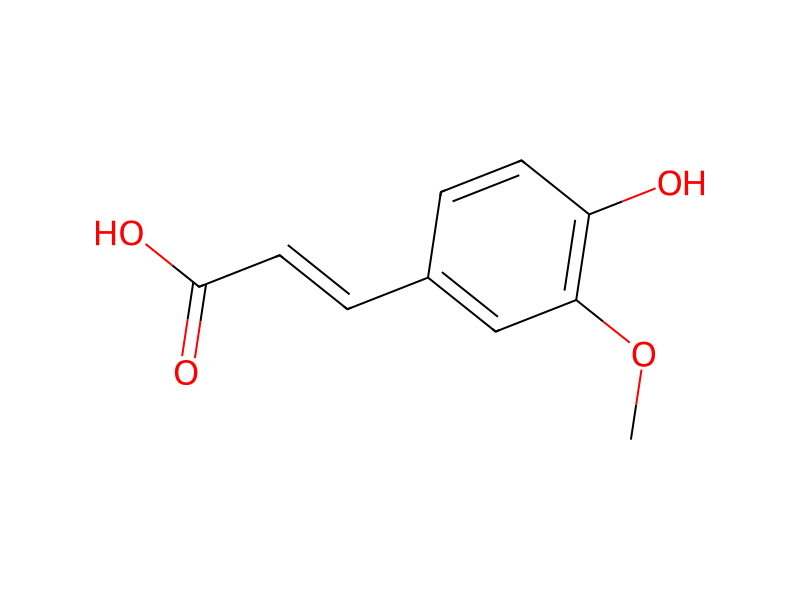
Grundinformationen
- CAS
1135-24-6- Standard-SMILES
COc1cc(C=CC(=O)O)ccc1O- InChIKey
KSEBMYQBYZTDHS-UHFFFAOYSA-N- Summenformel
- C10H10O4
- Durchschnittliche Molmasse
- 194,18 g/mol
- Monoisotopische Masse
- 194,0579088
Überblick
(E/Z)-ferulic acid has been reported in Camellia reticulata, Angelica gigas, and other organisms with data available.
Namen und Bezeichner
- Bevorzugter Name
- 3-(4-Hydroxy-3-Methoxyphenyl)Prop-2-Enoic Acid
- IUPAC
- 3-(4-hydroxy-3-methoxyphenyl)prop-2-enoic acid
- Lokaler Name
- 4-Hydroxy-3-methoxyzimtsure
- Englischer Name
- Ferulic Acid
- Summenformel
- C10H10O4
- Molmasse
- 194.18
Namen und Synonyme
3-(4-hydroxy-3-methoxyphenyl)prop-2-enoic acidRefChem:1066861(E/Z)-ferulic acid(2E)-3-(4-Hydroxy-3-methoxyphenyl)acrylic acidTrans-3-(4-hydroxy-3-methoxyphenyl)acrylic acid3-(4-hydroxy-3-methoxy-phenyl)prop-2-enoic acidferulic acid (trans-4-hydroxy-3-methoxycinnamic acid)EINECS 214-490-0CIS-FERULICACIDbmse000587DTXSID70892035ferulasaur
Weitere Namen anzeigen
Ferulate4-HYDROXY-3-METHOXYCINNAMIC ACIDFerulic3-METHOXY-4-HYDROXYCINNAMIC ACIDFERULLIC ACIDferulaic aciderulic AcidForulic acidFERULIC ACID pureTIMTEC-BB SBB000326
4-Hydroxy-3-methoxy cinnamic acidBBL010345AC-7965Ferulic acid CRStrans-Ferulic Acid (purified by sublimation)Spectrum_001256SpecPlus_000547Spectrum2_001394
Eigenschaften
Berechnete StruktureigenschaftenWird ergänzt
- XLogP
- 1,5
- Polarare Oberfläche (TPSA)
- 66,8 Ų
- H-Brücken-Donoren
- 2
- H-Brücken-Akzeptoren
- 4
- Frei drehbare Bindungen
- 3
- Schwere Atome
- 14
- Formalladung
- 0
- Komplexität
- 224
Experimentelle und physikochemische Eigenschaften
LogP1.87
Physikochemische Eigenschaften
- Schmelzpunkt
- 168 · 168-172 °C(lit.)
- Siedepunkt
- 250.62 °C · 250.62°C (rough estimate)
- Dichte
- 1.316 · 1.316(20.0000℃)
- Dampfdruck
- 0 Pa · 0Pa at 25℃
- Brechungsindex
- 1.5168 · 1.5168 (estimate)
- storage temp.
- 2 · 2-8°C
- Löslichkeit
- DMSO (Slightly), Methanol (Slightly)
- pka
- 4.58 · 4.58±0.10(Predicted)
- Aggregatzustand
- powder
- Farbe
- slightly yellow
- Wasserlöslichkeit
- soluble
- Kosmetik-Inhaltsstoffe Funktionen
- ANTIOXIDANTANTIMICROBIAL
Sicherheit und Regulatorisches
Sicherheitsangaben dienen nur zur Orientierung und ersetzen weder das Sicherheitsdatenblatt (SDB) des Lieferanten noch geltende Vorschriften oder eine fachliche Bewertung.
Sicherheitsdaten
- wgk
- 3
- tsca
- TSCA listed
- hs_code
- 29162090
- RTECS-Nr.
- UD3365500
- risk_code
- 36/37/38
- Toxizität
- mouse,LD,intraperitoneal,> 350mg/kg (350mg/kg),BEHAVIORAL: CHANGES IN MOTOR ACTIVITY (SPECIFIC ASSAY)BEHAVIORAL: ATAXIABEHAVIORAL: REGIDITY,Indian Journal of Pharmaceutical Sciences. Vol. 49, Pg. 77, 1987.
- hazard_code
- Xi
- safety_code
- 26-36-37/39
- hazard_class
- IRRITANT
- Giftige Stoffe Daten
- 1135-24-6(Hazardous Substances Data)
Chemie und Industrie
Anwendungen
BeschreibungFerulic acid is widely found in plants, especially in artichoke, eggplant and corn bran. In addition, it is also present in a variety of Chinese herbal medicines, such as angelica, dome, motherwort, snow ganoderma lucidum and so on.
HistoryFerulic acid was first isolated from the medicinal plants ferulic in 1866. The biologi_x005fcal activity of ferulic acid was not revealed until 1957 when the pioneering study of Preziosi P in Italy showed for the first time the efficacy of ferulic acid in regulating blood lipids and diuretic . In 1979, Lin Mao and others isolated ferulic acid from the Chinese medicine angelica and reported that ferulic acid had the inhibitory effect on platelet aggregation . Since then, more and more medicinal efficacy of ferulic acid has gradually been recognized.
Verwendenferulic acid is a plant-derived anti-oxidant and free-radical scavenger, it protects the skin against uVB-induced redness. When incorporated into formulas with ascorbic acid and tocopherol, ferulic acid can improve their stability and double the photoprotection capacities offered by the formulation. In clinical studies, ferulic acid exhibits good permeation capacities through the stratum corneum, which can be attributed to its lipophilic properties.
Vor- und nachgelagerte Produkte
Vorgelagerte Rohstoffe
Zugehörige Reaktionen
19


Notizen zur Verbindung
Wird geladen…