
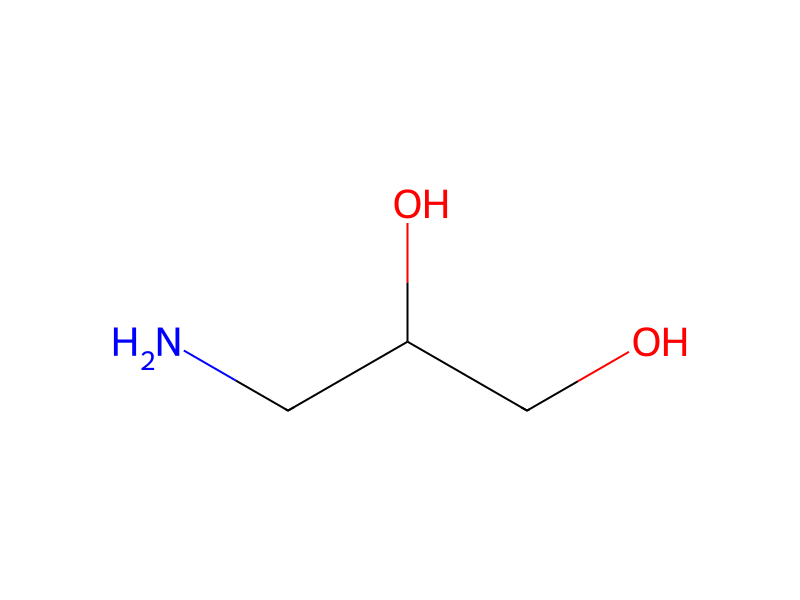
Grundinformationen
- Standard-SMILES
NCC(O)CO- InChIKey
KQIGMPWTAHJUMN-UHFFFAOYSA-N- Summenformel
- C3H9NO2
- Durchschnittliche Molmasse
- 91,11 g/mol
- Monoisotopische Masse
- 91,06332853
Überblick
structure given in first source; RN given refers to parent cpd
Namen und Bezeichner
- Bevorzugter Name
- 3-Amino-1,2-propanediol
- IUPAC
- 3-aminopropane-1,2-diol
- Lokaler Name
- 3-Aminopropan-1,2-diol
- Englischer Name
- 3-Amino-1,2-propanediol
- Summenformel
- C3H9NO2
- Molmasse
- 91.11
Namen und Synonyme
3-Amino-1,2-propanediol616-30-81-Aminoglycerol1,2-Propanediol, 3-amino-2,3-Dihydroxypropylamine1-AminopropanediolRH369P864XNSC-67381DTXSID30862294RefChem:92848DTXCID90811081210-475-8
Weitere Namen anzeigen
APD3-amino-1,2-propanediol (APD)3--1,2-
Aminopropanediol3-Aminopropane-1,2-diol1-Amino-2,3-propanediol2,3-Propandiol-1-amine3-Amino-1,2-propandiolisoserinolMFCD00008140(S)-(-)-3-Amino-1,2-propanediol
Datenbank-Bezeichner
- CAS
616-30-8- PubChem CID
- 73561
- DTXSID
DTXSID30862294- UNII
- RH369P864X
- EC Number
- 210-475-8
- Nikkaji
- J1.661F
Eigenschaften
Berechnete Struktureigenschaften
- XLogP
- -2
- Polarare Oberfläche (TPSA)
- 66,5 Ų
- H-Brücken-Donoren
- 3
- H-Brücken-Akzeptoren
- 3
- Frei drehbare Bindungen
- 2
- Schwere Atome
- 6
- Formalladung
- 0
- Komplexität
- 32
Experimentelle und physikochemische Eigenschaften
Food Contact SubstancesFCS -> FDA Inventory of Food Contact Substances Listed in 21 CFR
Physikochemische Eigenschaften
- Schmelzpunkt
- 55 · 55-57 °C
- Siedepunkt
- 264 · 264-265 °C739 mm Hg(lit.)
- Dichte
- 1.175 g/mL · 1.175 g/mL at 25 °C(lit.)
- Dampfdruck
- 1 hPa · <1 hPa (20 °C)
- Brechungsindex
- 20 · n20/D 1.492(lit.)
- Flammpunkt
- 230 °F · >230 °F
- storage temp.
- 30 °C · Store below +30°C.
- Löslichkeit
- 1000 g/l · >1000g/l soluble
- Aggregatzustand
- liquid (highly viscous)
- pka
- 12.11 · 12.11±0.35(Predicted)
- Farbe
- Clear colorless to pale yellow
- Wichte
- 1.175 · 1.175
- PH
- 11 · 11 (100g/l, H2O, 20℃)
- Wasserlöslichkeit
- soluble
- BRN
- 1719121 · 1719121
- Kosmetik-Inhaltsstoffe Funktionen
- BUFFERING
- InChI
- 1S/C3H9NO2/c4-1-3(6)2-5/h3,5-6H,1-2,4H2
- InChIKey
- KQIGMPWTAHJUMN-UHFFFAOYSA-N
- SMILES
- NCC(O)CO
- LogP
- -2.079 · -2.079 (est)
- CAS Datenbank
- 616 · 616-30-8(CAS DataBase Reference)
- NIST chemische Informationen
- 3 · 3-Amino-1,2-propanediol(616-30-8)
- EPA chemische Informationen
- 1 · 1,2-Propanediol, 3-amino- (616-30-8)
Sicherheit und Regulatorisches
GHS-Klassifizierung
GHS Classification
Danger
H314 (94%): Causes severe skin burns and eye damage [Danger Skin corrosion/irritation]
P260, P264, P264+P265, P280, P301+P330+P331, P302+P361+P354, P304+P340, P305+P354+P338, P316, P317, P321, P363, P405, and P501 (click each P-code to see the statement)
Aggregated GHS information provided per 184 reports by companies from 8 notifications to the ECHA C&L Inventory. Each notification may be associated with multiple companies.
Gefahrenhinweise
Regulatory Information
Chemical: 1,2-Propanediol, 3-amino-
Status: Active Update: 21-02-2023 https://echa.europa.eu/registration-dossier/-/registered-dossier/5186
1,2-Propanediol, 3-amino-: Does not have an individual approval but may be used as a component in a product covered by a group standard. It is not approved for use as a chemical in its own right.
Hazard Classes and CategoriesSkin Corr. 1B (94%)
Sicherheitsdaten
- F
- 10-21
- wgk
- 2
- tsca
- TSCA listed
- ridadr
- UN 2735 8/PG 2
- hs_code
- 29221980
- RTECS-Nr.
- TY2800000
- risk_code
- 34-36/37/38
- Toxizität
- LD50 orally in Rabbit: 7500 mg/kg
- hazard_code
- C,Xi
- hazard_note
- Corrosive
- safety_code
- 26-36/37/39-45-36
- hazard_class
- 8
- packing_group
- III
- Speicherklasse
- 8A - Combustible corrosive hazardous materials
- Hazard Classifications
- Skin Corr. 1B
Chemie und Industrie
Verwendung und Herstellung
General Manufacturing Information1,2-Propanediol, 3-amino-: ACTIVE
Anwendungen
Beschreibung3-Amino-1,2-propanediol (APD) is a calcium metabolism regulator useful in the treatment of Paget's disease, tumor-induced hypercalcemia and other bone disorders involving increased osteoclastic activity.
Verwenden3-Amino-1,2-propanediol is used in the preparation of iohexol, which is a X-CT non-ionic contrast medium. It acts as a starting material in the production of specialty materials.
VerwendenA chiral glycerol derivative, namely 3-amino-1,2-propanediol, was employed for as the hydrogen bond donor (HBD) in the design of a new deep eutectic solvent (DES) with choline chloride acting as the hydrogen bond acceptor (HBA). The novel mixture was characterized and unambiguously classified as a DES[4].
Darstellung
synthetische3-Amino-1,2-propanediol is synthesized by reacting 3-chloro-1,2-propanediol (CPD) with ammonia in alkaline environment by adding sodium hydroxide. Afterwards, the product undergoes a series of purification steps.
Vor- und nachgelagerte Produkte
Vorgelagerte Rohstoffe
Anbieter50 Anbieter
国药集团化学试剂有限公司86-21-63210123 · [email protected]
梯希爱(上海)化成工业发展有限公司021-67121386 · [email protected]
衢州润东化工有限公司0570-8789886 18892685668 · [email protected]
上海阿拉丁生化科技股份有限公司400-6206333 13167063860 · [email protected]
INTATRADE GmbH+49 3493/605464 · [email protected]
爱斯特(成都)生物制药股份有限公司+86-28-85122536 85324413 · [email protected]
北京安司莫森技术有限公司010-82954736 13391601435 · [email protected]
韶远科技(上海)有限公司021-50795510 4000665055 · [email protected]
科瑞迪化学400-821-5857 021-64326257 · [email protected]
Syntechem Co.,Ltd[email protected]
上海迈瑞尔生化科技有限公司4006356688 18621169109 · [email protected]
Wuhan EnTai Technology Development Co,.Ltd86-27-82330560 · [email protected]
阿法埃莎(中国)化学有限公司400-6106006 · [email protected]
上海德默医药科技有限公司400-021-7337 2355568890 · [email protected]
安耐吉化学&3A(安徽泽升科技股份有限公司)400-0056266 · [email protected]
浙江海洲制药有限公司0576-88221739 · [email protected]
上海瀚鸿科技股份有限公司021-54306202 13764082696 · [email protected]
山东昌元化学有限公司0531-15554118484 15554118484 · [email protected]
嘉兴市艾森化工有限公司0573-85285100 18627885956 · [email protected]
武汉丰泰威远科技有限公司027-87465837 19945049750 · [email protected]
孝感深远化工有限公司15527621225; 15527621225 · [email protected]
玛雅试剂+86 (573) 82222445 (0)18006601000 452520369 · [email protected]
四川库利南科技有限公司400-1166-196 18981987031 · [email protected]
上海耐士化工科技有限公司400-188-0725 +86 21 34310725 13611771617
天津希恩思生化科技有限公司400 638 7771 · [email protected]
武汉科美沃化工有限公司027-85736489 · [email protected]
南京维奥化工有限公司Please Send Email 18652950785 · [email protected]
Connect Chemicals GmbH+49 2102 2077 19 · [email protected]
武汉海正工贸发展有限公司027-8866 0053/88660577/88660578
上海思域化工科技有限公司86-21-34053660 · [email protected]
苏州思变化学技术有限公司0512-65617459 18915409046 · [email protected]
赛默飞世尔科技(中国)有限公司800-810-5118 · [email protected]
北京伊诺凯科技有限公司400-810-7969 010-59572699 · [email protected]
江苏艾康生物医药研发有限公司025-66113011 13913916777 · [email protected]
上海健超生物科技有限公司150-2103-5486 18017383231 · [email protected]
TCI AMERICA800-4238616 · [email protected]
TOKYO CHEMICAL INDUSTRY CO., LTD.03-36680489 · [email protected]
TCI Europe320-37350700 · [email protected]
上海贤鼎生物科技有限公司4009209199 · [email protected]
深圳康特腾科技有限公司86-0755-86635001 · [email protected]
越林试剂021-62960152 · [email protected]
上海昶衍化工科技有限公司021-20242659 18930833303 · [email protected]
苏州爱玛特生物科技有限公司0512-56316828 4008675858 · [email protected]
北京环宇世纪化学科技有限公司hysj_bj.com
湖北鑫源顺医药化工有限公司13971561712, 13995564702, 027-50664929 · [email protected]
上海湄水化工科技有限公司021-60549325 18616193163
上海将来实业股份有限公司400-0066400 13621662912 · [email protected]
安徽科迪达化工有限公司0554-2106669 · [email protected]
日照力德士化工有限公司010-51268198 · [email protected]
上海石洋化工有限公司021-56795766 · [email protected]
Zugehörige Reaktionen
354


Verknüpfte Notizen
Wird geladen…