
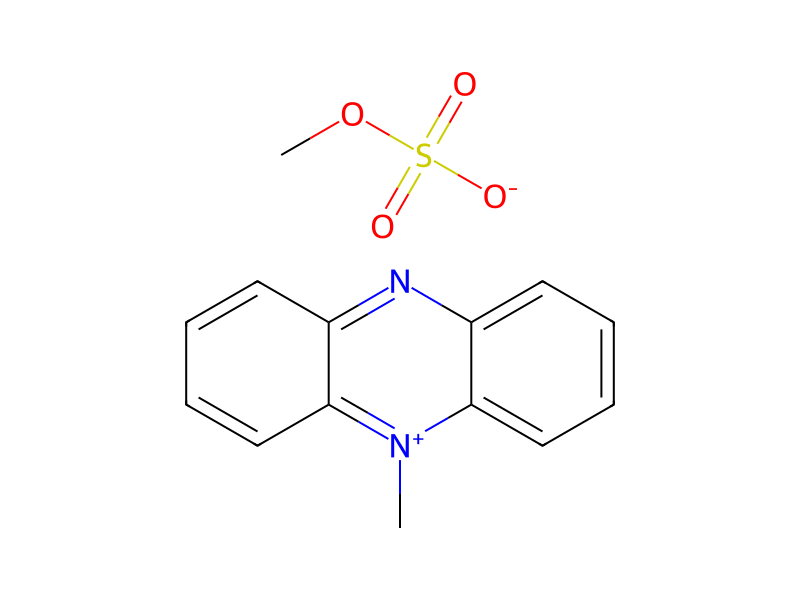
Grundinformationen
- Standard-SMILES
COS(=O)(=O)[O-].C[n+]1c2ccccc2nc2ccccc21- InChIKey
RXGJTUSBYWCRBK-UHFFFAOYSA-M- Summenformel
- C14H14N2O4S
- Durchschnittliche Molmasse
- 306,34 g/mol
- Monoisotopische Masse
- 306,06742793
Überblick
5-methylphenazinium methyl sulfate is an azaheterocycle sulfate salt and a member of phenazines.
Namen und Bezeichner
- Bevorzugter Name
- Phenazine Methosulfate
- IUPAC
- 5-methylphenazin-5-ium;methyl sulfate
- Lokaler Name
- 5-Methylphenaziniummethylsulfat
- Englischer Name
- Phenazine methosulfate
- Summenformel
- C14H14N2O4S
- Molmasse
- 306.34
Namen und Synonyme
Phenazine methosulfate299-11-65-Methylphenazinium methyl sulfateN-Methylphenazonium methosulfatePhenazine methosulphateMethylphenazonium methosulfate5-Methylphenazine methylsulfateN-Methylphenazinium methosulfateN-Methylphenazonium methosulphatePMS (pharmaceutical)Phenazinium, 5-methyl-, methyl sulfate5-Methyl phenazine, methyl sulfate salt
Weitere Namen anzeigen
PMSPHENAZINE METHYL SULFATEPhenazine methosuL5-MethylphenaziniumPhenazine methosulfaPhezine methosulfatePhenazine MethoshlphatePHENAZINE METHOLSULPHATE
J3GYQ3401YDTXSID1059783NSC-34661CHEBI:8055Methosulfate, PhenazineMethosulfate, Methylphenazonium5 Methylphenazinium Methyl SulfateMethyl Sulfate, 5-Methylphenazinium
Datenbank-Bezeichner
- CAS
299-11-6- PubChem CID
- 9285
- DTXSID
DTXSID1059783- ChEBI
CHEBI:8055- UNII
- J3GYQ3401Y
- EC Number
- 206-072-1
Eigenschaften
Berechnete Struktureigenschaften
- Polarare Oberfläche (TPSA)
- 91,6 Ų
- H-Brücken-Donoren
- 0
- H-Brücken-Akzeptoren
- 5
- Frei drehbare Bindungen
- 0
- Schwere Atome
- 21
- Formalladung
- 0
- Komplexität
- 297
Experimentelle und physikochemische Eigenschaften
Chemical ClassesNitrogen Compounds -> Other Aromatics (Nitrogen)
Physical DescriptionYellow to brown solid; [Merck Index] Yellow crystalline solid; [Sigma-Aldrich MSDS]
Physikochemische Eigenschaften
- Schmelzpunkt
- 158 · 158-160 °C (dec.)(lit.)
- Dichte
- 1.3395 · 1.3395 (rough estimate)
- Brechungsindex
- 1.693 · 1.6930 (estimate)
- storage temp.
- -20 °C · -20°C
- Löslichkeit
- 2 O: · H2O: 0.2 g/mL at 20 °C, clear, deep orange
- Aggregatzustand
- Crystalline Powder
- Farbe
- Dark yellow to brown or khaki
- Wasserlöslichkeit
- soluble in water (approximately 200 mg/ml).
- Merck
- 14 · 14,6109
- BRN
- 3898869 · 3898869
- Stabilität
- Stable. Incompatible with strong oxidizing agents.
- InChI
- InChI=1S/C13H11N2.CH4O4S/c1-15-12-8-4-2-6-10(12)14-11-7-3-5-9-13(11)15;1-5-6(2,3)4/h2-9H,1H3;1H3,(H,2,3,4)/q+1;/p-1
- InChIKey
- RXGJTUSBYWCRBK-UHFFFAOYSA-M
- SMILES
- C12C=CC=CC1=NC1=CC=CC=C1[N+]=2C.S([O-])(=O)(=O)OC
- CAS Datenbank
- 299 · 299-11-6(CAS DataBase Reference)
- EPA chemische Informationen
- 5 · Phenazinium, 5-methyl-, methyl sulfate (299-11-6)
Sicherheit und Regulatorisches
GHS-Klassifizierung
GHS Classification
Warning
H315 (100%): Causes skin irritation [Warning Skin corrosion/irritation]
P261, P264, P264+P265, P271, P280, P302+P352, P304+P340, P305+P351+P338, P319, P321, P332+P317, P337+P317, P362+P364, P403+P233, P405, and P501 (click each P-code to see the statement)
Aggregated GHS information provided per 47 reports by companies from 8 notifications to the ECHA C&L Inventory. Each notification may be associated with multiple companies.
Gefahrenhinweise
Regulatory InformationPhenazinium, 5-methyl-, methyl sulfate: Does not have an individual approval but may be used under an appropriate group standard
Hazards SummaryA moderate irritant; [Sigma-Aldrich MSDS]
Hazard Classes and CategoriesSkin Irrit. 2 (100%)
Sicherheitsdaten
- F
- 8
- wgk
- 3
- tsca
- TSCA listed
- ridadr
- 2811
- hs_code
- 29339900
- RTECS-Nr.
- SG1645000
- risk_code
- 36/37/38-68-46
- hazard_code
- Xi,Xn,T
- safety_code
- 26-36/37/39-53-45
- Speicherklasse
- 11 - Combustible Solids
Chemie und Industrie
Verwendung und Herstellung
UsesUsed as an electron carrier and to make succinic dehydrogenase; [Merck Index]
General Manufacturing InformationPhenazinium, 5-methyl-, methyl sulfate (1:1): INACTIVE
Anwendungen
BeschreibungPhenazine is a free radical generator. It has been used as an electron transfer reactant in cell viability assays. Phenazine (10 μM) induces ssDNA break formation in the presence of the reducing agent NADPH in a cell-free plasmid cleavage assay when used at a concentration of 10 μM. It induces oxidative DNA damage in an alkaline comet assay and apoptosis in A375 melanoma cells when used at a concentration of 10 μM. Phenazine (20 nM) oxidizes cysteine-containing proteins in HepG2 cells.
VerwendenPhenazine Methosulfate is used in tyrosine transaminase test and for enzymic determination of ethanol in blood by the colorimetric micromethod. Used with ascorbic acid to determine nitric oxide reductase activity. Since the reduced PMS is easily oxidized by oxygen, it is used in assays as an electron carrier between enzymes and oxygen, cytochrome c, indophenols, or tetrazolium salts. The reduced PMS is used as an electron donor to reduce cytochrome c or in photosynthetic experiments. Usage of PMS for detection of specific dehydrogenases has been reported.
Vor- und nachgelagerte Produkte
Vorgelagerte Rohstoffe
Anbieter50 Anbieter
国药集团化学试剂有限公司86-21-63210123 · [email protected]
北京华美互利生物化工010-56205725 · [email protected]
梯希爱(上海)化成工业发展有限公司021-67121386 · [email protected]
上海阿拉丁生化科技股份有限公司400-6206333 13167063860 · [email protected]
INTATRADE GmbH+49 3493/605464 · [email protected]
南京科朗科技有限公司025-58748998 18951874644 · [email protected]
上海如吉生物科技发展有限公司+86-21-65211385-8001 36031160 · [email protected]
上海宝博洛新材料科技有限公司15572878882; 15572878882 · [email protected]
南京胜凯医药科技有限公司025-86182925 17749516701 · [email protected]
科瑞迪化学400-821-5857 021-64326257 · [email protected]
上海迈瑞尔生化科技有限公司4006356688 18621169109 · [email protected]
大连美仑生物技术有限公司0411-62910999 13889544652 · [email protected]
阿法埃莎(中国)化学有限公司400-6106006 · [email protected]
安耐吉化学&3A(安徽泽升科技股份有限公司)400-0056266 · [email protected]
北京绿百草科技发展有限公司010-61136123 · [email protected]
上海瀚鸿科技股份有限公司021-54306202 13764082696 · [email protected]
上海景颜化工科技有限公司13817811078 · [email protected]
上海泰坦科技股份有限公司400-6009262 15618770481 · [email protected]
上海隆盛化工有限公司58099637 13585536065 · [email protected]
武汉赛沃尔化工有限公司027-85613400 18707177243 · [email protected]
武汉丰泰威远科技有限公司027-87465837 19945049750 · [email protected]
BOC Sciences1-631-485-4226; 16314854226 · [email protected]
湖北健楚生物医药有限公司027-65528353 13554206703
山东西亚化学有限公司13355009207 13355009207 · [email protected]
四川库利南科技有限公司400-1166-196 18981987031 · [email protected]
天津希恩思生化科技有限公司400 638 7771 · [email protected]
武汉科美沃化工有限公司027-85736489 · [email protected]
长沙钰腾新材料有限公司13487087296; 13487087296 · [email protected]
湖南汇百侍生物科技有限公司0731-85526065 13308475853 · [email protected]
斯百全化学(上海)有限公司021-021-021-67601398-809-809-809 15221380277 · [email protected]
北京泰亚杰科技有限公司021-33690831-8001 13552411790;18616022633 · [email protected]
上海源叶生物科技有限公司13636370518 · [email protected]
艾科试剂4008-755-333 18080918076 · [email protected]
上海思域化工科技有限公司86-21-34053660 · [email protected]
赛默飞世尔科技(中国)有限公司800-810-5118 · [email protected]
北京伊诺凯科技有限公司400-810-7969 010-59572699 · [email protected]
江苏艾康生物医药研发有限公司025-66113011 13913916777 · [email protected]
TCI AMERICA800-4238616 · [email protected]
TOKYO CHEMICAL INDUSTRY CO., LTD.03-36680489 · [email protected]
TCI Europe320-37350700 · [email protected]
上海贤鼎生物科技有限公司4009209199 · [email protected]
广州爱纯医药科技有限公司020-39119399 18927568969 · [email protected]
武汉五方伟业药化有限公司027-85838075
湖北威德利化学试剂有限公司186-02735115 18602735115 · [email protected]
重庆卡兰医药有限公司023-62879767 · [email protected]
上海将来实业股份有限公司021-61552785 · [email protected]
苏州乔纳森新材料科技有限公司0512-68312916,63926215 18912725070;18013709950 · [email protected]
上海石洋化工有限公司021-56795766 · [email protected]
苏州络森生物科技有限公司0512-87888687 13626191410 · [email protected]
湖南华腾制药有限公司400-8592883 · [email protected]
Ergänzende Hinweise
DefinitionChEBI: 5-methylphenazinium methyl sulfate is an azaheterocycle sulfate salt and a member of phenazines. It is used as an electron carrier in place of the flavine enzyme of Warburg in the hexosemonophosphate system and also in the preparation of succinic dehydrogenase. Green et al., J. Biol. Chem. 217, 551 (1955).
Zugehörige Reaktionen
6


Verknüpfte Notizen
Wird geladen…