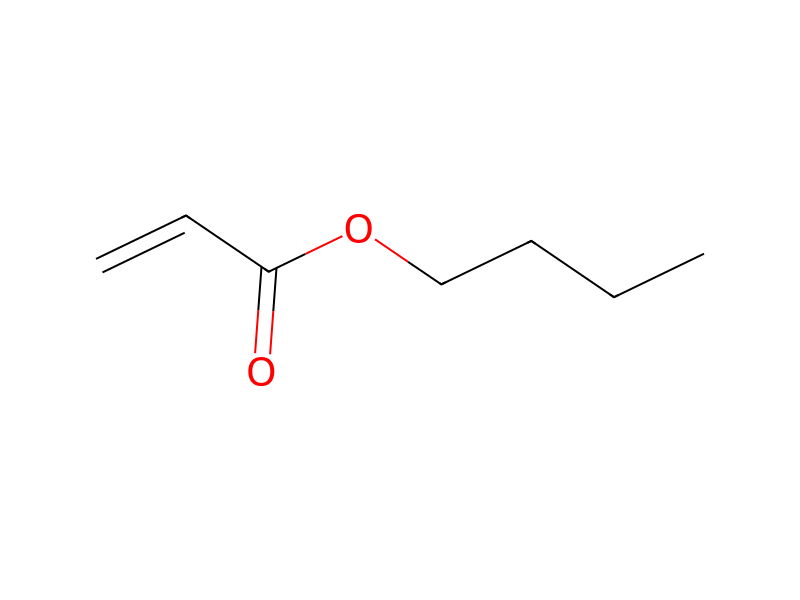
[C:1]([O:5][CH2:6][CH2:7][CH2:8][CH3:9])(=[O:4])[CH:2]=[CH2:3].[C:10]([O:14][CH2:15][CH:16]([CH2:21][CH3:22])[CH2:17][CH2:18][CH2:19][CH3:20])(=[O:13])[CH:11]=[CH2:12].C(S)CCCCCCCCCCC.C(OOC(=O)C1C=CC=CC=1)(=O)C1C=CC=CC=1>C1(C)C=CC=CC=1>[C:1]([O:5][CH2:6][CH2:7][CH2:8][CH3:9])(=[O:4])[CH:2]=[CH2:3].[C:10]([O:14][CH2:15][CH:16]([CH2:21][CH3:22])[CH2:17][CH2:18][CH2:19][CH3:20])(=[O:13])[CH:11]=[CH2:12]A 1 l reaction vessel equipped with a reflux condensor, stirrer, thermometer, and dropping funnel was charged with 75 g of n-butyl acrylate, 25 g of 2-ethylhexyl acrylate, 4 g of dodecylmercaptan, 1 g of benzoyl peroxide, and 200 g of toluene. The mixture was heated to 75-85° C. A mixture of 75 g of n-butyl acrylate, 25 g of 2-ethylhexyl acrylate, and 1 g of benzoyl peroxide was continuously dropped while stirring the mixture at this temperature to carry out the polymerization reaction for three hours. After the reaction, the solvent and low boiling point matters were removed by evaporation under reduced pressure, thereby obtaining an n-butyl acrylate/2-ethylhexyl acrylate copolymer. This copolymer is designated as “Copolymer (C-1)”.