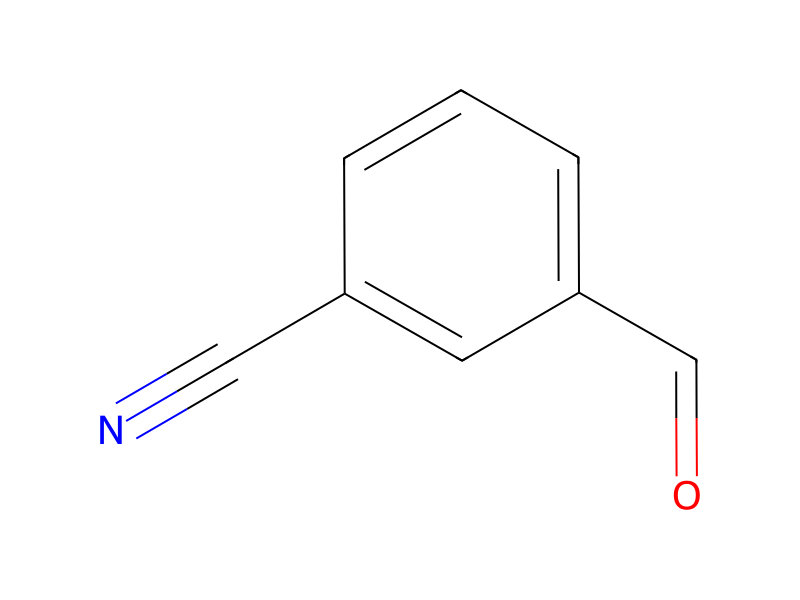
[Br-].[Cl:2][C:3]1[CH:4]=[CH:5][CH:6]=[C:7]2[C:11]=1[CH:10]([P+](C1C=CC=CC=1)(C1C=CC=CC=1)C1C=CC=CC=1)O[C:8]2=[O:31].[CH:32]([C:34]1[CH:35]=[C:36]([CH:39]=[CH:40][CH:41]=1)[C:37]#[N:38])=O.C(N(CC)CC)C.O.[NH2:50][NH2:51]>CN(C=O)C.CCO.O.C(Cl)Cl>[Cl:2][C:3]1[CH:4]=[CH:5][CH:6]=[C:7]2[C:11]=1[C:10]([CH2:32][C:34]1[CH:35]=[C:36]([CH:39]=[CH:40][CH:41]=1)[C:37]#[N:38])=[N:51][NH:50][C:8]2=[O:31](7-chloro-3-oxo-1,3-dihydroisobenzofuran-1-yl)triphenylphosphonium bromide (101) (10 g, 23.26 mmol) and 3-formylbenzonitrile (3.20 g, 24.43 mmol) were dissolved DCM (60 mL), to this was added triethylamine (4.22 mL, 30.24 mmol) and the reaction was stirred overnight. The reaction mixture was filtered to afford a white solid. To this was added water (40 mL), EtOH (40 mL) and DMF (4 mL). Hydrazine hydrate (11.65 g, 232.64 mmol) was added and the reaction was heated at reflux overnight. The reaction was cooled and the precipitate was collected by filtration, washed with EtOH (25 mL) and air dried to afford the desired material as a white solid (3.75 g, 54.5% yield), which was used without further purification; 1H NMR (400.132 MHz, DMSO) δ 4.66 (2H, s), 7.53-7.47 (2H, m), 7.68-7.66 (2H, m), 7.81 (1H, t), 7.97 (1H, d), 8.33 (1H, d), 12.55 (1H, s); m/z (LC-MS, ESI−), RT=2.04 (M−H 294).