Reaktionsgleichung

[Na].[CH:2]1[CH:7]=[CH:6][C:5]([NH:8][C:9]2[CH:14]=[CH:13][C:12]([N:15]=O)=[CH:11][CH:10]=2)=[CH:4][CH:3]=1.C1(NC2C=CC=CC=2)C=CC=CC=1.C1(C)C=CC=CC=1>O.C(O)CCC>[CH:2]1[CH:3]=[CH:4][C:5]([NH:8][C:9]2[CH:14]=[CH:13][C:12]([NH2:15])=[CH:11][CH:10]=2)=[CH:6][CH:7]=1Komponenten
Edukt 4


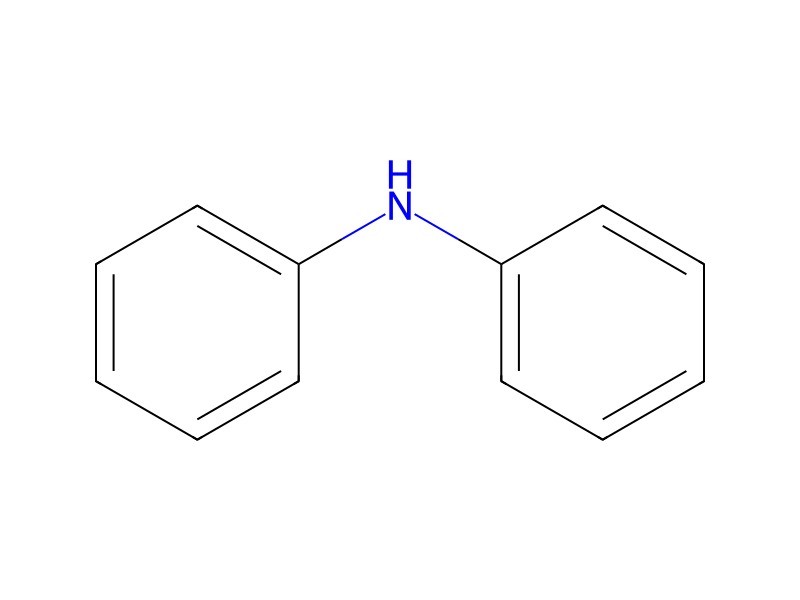

Produkt 1

Reagenzien, Katalysatoren, Lösungsmittel 2


Versuchsvorschrift
In this example the sodium salt of p-nitrosodiphenylamine was hydrogenated in a continuous manner over a fixed bed of catalyst. Diphenylamine (338 g, 2 mols) was converted to the sodium salt of p-nitrosodiphenylamine as in Example 2. A solution of approximately equal weights of toluene and 1-butanol was added to dilute the solution of the sodium salt to a concentration of about 13.5 wt. %, and enough water was added to dissolve all the inorganic salts present in the aqueous phase. The two phases were separated and simultaneously pumped into a tube reactor over a 0.4 wt. % palladium on charcoal catalyst at 125° C., 1000 psig hydrogen pressure at 1 liquid hourly space velocity based on total liquid. Thin layer chromatography indicated 100% conversion of p-nitrosodiphenylamine. Distillation of the residue after separation of the aqueous phase and removal of the organic solvents gave 95% p-aminodiphenylamine exclusive of losses from column hold-up.
Aufarbeitung
- additionwas added
- dissolutionto dissolve all the inorganic salts present in the aqueous phase
- customThe two phases were separated
- customsimultaneously pumped into a tube reactor over a 0.4 wt. % palladium on charcoal catalyst at 125° C.
- distillationDistillation of the residue
- customafter separation of the aqueous phase and removal of the organic solvents
Quellen und Nachweise
- ORD-Eintrag
- ord-287dbb840dd74a0595e17f15700a35c4
- Quelldatensatz
- uspto-grants-1982_01
- Patentnummer
- US04313002
Verknüpfte Notizen
Wird geladen…