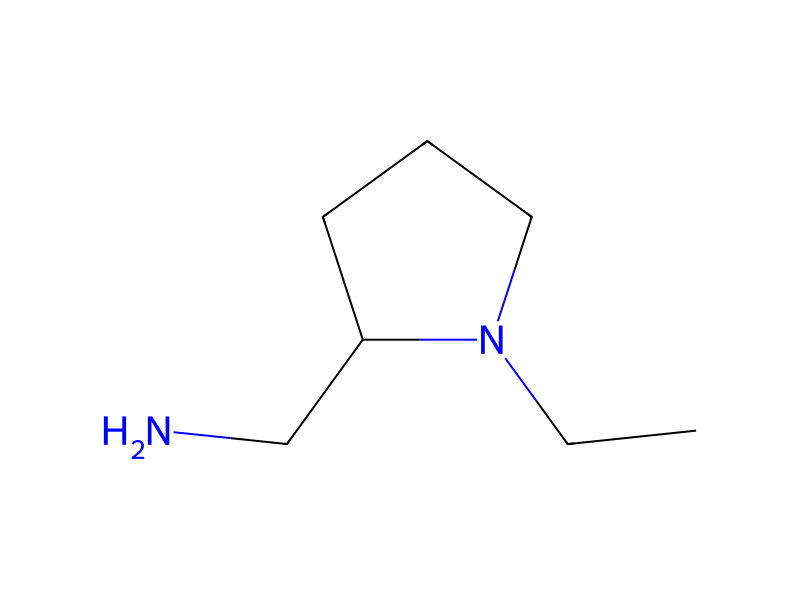
CO[C:3]([C:5]1[C:14]2[O:13][CH2:12][CH2:11][O:10][C:9]=2[C:8]([O:15][CH3:16])=[C:7]([S:17](=[O:20])(=[O:19])[NH2:18])[CH:6]=1)=[O:4].C(O)CO.[CH2:25]([N:27]1[CH2:31][CH2:30][CH2:29][CH:28]1[CH2:32][NH2:33])[CH3:26].O>C(O)(=O)C>[CH2:25]([N:27]1[CH2:31][CH2:30][CH2:29][CH:28]1[CH2:32][NH:33][C:3]([C:5]1[C:14]2[O:13][CH2:12][CH2:11][O:10][C:9]=2[C:8]([O:15][CH3:16])=[C:7]([S:17](=[O:19])(=[O:20])[NH2:18])[CH:6]=1)=[O:4])[CH3:26]150 g of methyl-8-methoxy-7-sulfamoyl-1,4-benzodioxane-5-carboxylate and 750 cm3 of ethylene glycol were introduced into a balloon flask. After dissolution, 127 g of 1-ethyl-2-aminomethylpyrrolidine was added and the mixture was heated at 50° C. The resulting solution was dissolved with 2 liters of water and acidified by means of 120 cm3 of acetic acid. The precipitate formed was dried off, washed with water and then dried. The precipitate was then redissolved in 915 cm3 of hot water. The solution was filtered and then the base was precipitated with ammonia. The precipitate was dried off, washed with water and then dried. 144 g of N-(1-ethyl-2-pyrrolidyl-methyl)-8-methoxy-7-sulfamoyl-1,4-benzodioxane-5-carboxamide was produced (M.P.: 110°-115° C.; yield: 73%).