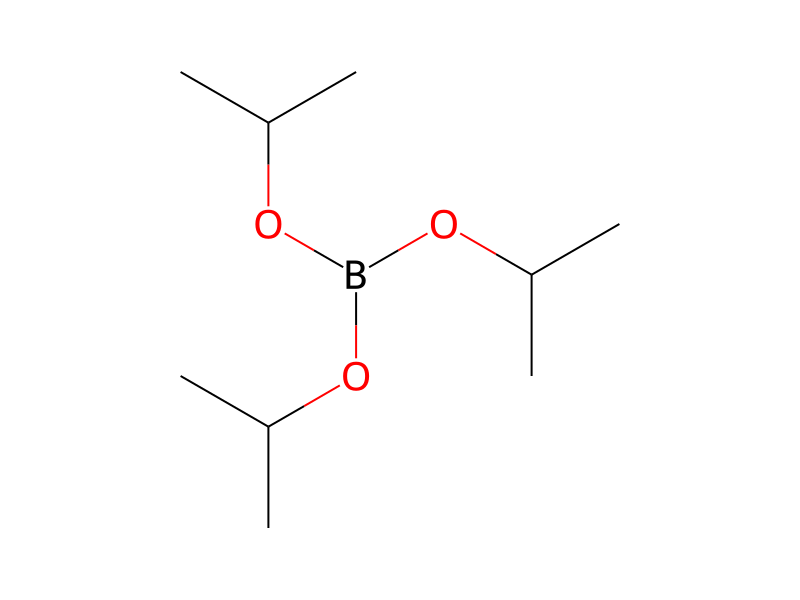
To a solution of 4-trifluoromethyl-benzoic acid 2,2-dimethyl-propyl ester (4.225 g, 16.23 mmol) in tetrahydrofuran (40 mL) was added triisopropylborate (9.00 mL, 39.0 mmol). The solution was cooled to −78° C. and lithium diisopropylamide (12.0 mL of a 2.0 M solution in tetrahydrofuran/heptane, 24.0 mmol) was added dropwise over 5 minutes. The red solution was stirred for 30 minutes, warmed to 0° C, and quenched by the slow addition of 1 N hydrochloric acid (50 mL). The mixture was allowed to warm to room temperature, stirred for 30 minutes and added to hexanes (200 mL). The layers were separated and the organic layer was washed successively with 2N hydrochloric acid (two times with 100 mL), water (100 mL), and brine (50 mL). The organic extracts were dried over magnesium sulfate, filtered, and concentrated to an oil. The crude product was crystallized from heptane (40 mL) to provide 2-(2,2-dimethyl -propoxycarbonyl)-5-trifluoromethyl-benzeneboronic acid (3.037 g, 62% yield) as a white solid: mp=159-160° C.; IR 3377 (br), 2963, 1703, 1371, 1308, 1171, 1131, 794, 709 cm−1; 1H NMR (400 MHz, DMSO/D2O) 67 8.05 (d, J=8.1 Hz, 1 H), 7.78 (d, J=8.3 Hz, 1H), 7.66 (s, 1H), 3.94 (s, 2H), 0.95 (s, 9H); 13C NMR (100 MHz DMSO/D20) 67 26.69, 31.69, 74.91, 125.29, 125.75, 128.30, 129.62, 131.98 (q, J=31.8 Hz), 136.28, 142.68, 166.90.