StartseiteMCPWorkbenchSkills
StartseiteWorkbenchBenachrichtigungenMein Bereich
llms.txt · MCP-AnleitungDatenschutz · Nutzungsbedingungen · Supportv1.8.3
  1. Startseite
  2. /Reaktion

Diisopropylethylamine → (R)-5-(6-cyclohexyl-1-(hydroxyamino)-1-oxohexan-3-yl)-N,N-dimethyl-1,2,4-oxadiazole-3-carboxamide

HRID 1279774
Drucken

Reaktionsgleichung

Reaktionsgleichung von HRID 1279774
[CH:1]1([CH2:7][CH2:8][CH2:9][C@@H:10]([C:15]2[O:19][N:18]=[C:17]([C:20]([N:22]([CH3:24])[CH3:23])=[O:21])[N:16]=2)[CH2:11][C:12](O)=[O:13])[CH2:6][CH2:5][CH2:4][CH2:3][CH2:2]1.C(N(CC)C(C)C)(C)C.F[P-](F)(F)(F)(F)F.[N:41]1([O:50]C(N(C)C)=[N+](C)C)C2N=CC=CC=2N=N1.Cl.NO>>[CH:1]1([CH2:7][CH2:8][CH2:9][C@@H:10]([C:15]2[O:19][N:18]=[C:17]([C:20]([N:22]([CH3:24])[CH3:23])=[O:21])[N:16]=2)[CH2:11][C:12]([NH:41][OH:50])=[O:13])[CH2:6][CH2:5][CH2:4][CH2:3][CH2:2]1
KomponentenVersuchsvorschriftAufarbeitungQuellen und NachweiseNotizen zur Reaktion

Komponenten

5

Edukt 4

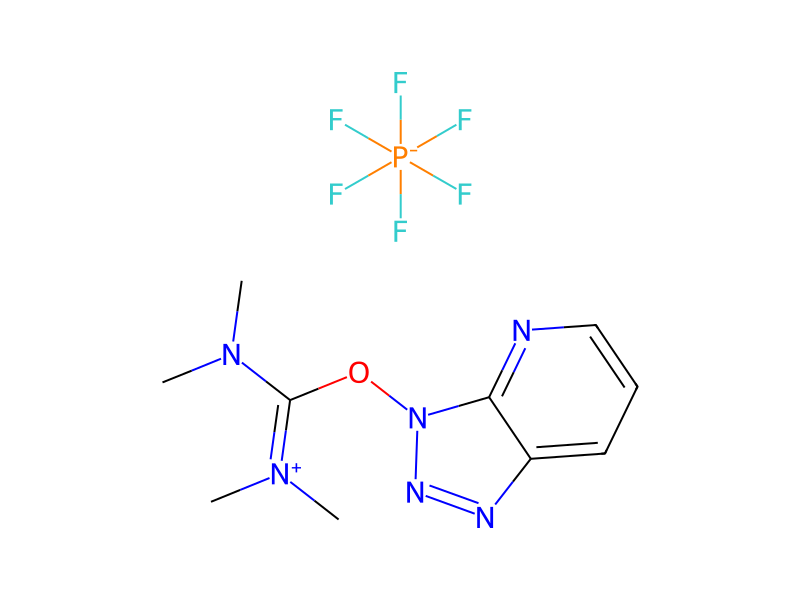
HCID 81531Diisopropylethylamine2×HCID 443297Hydroxyamine hydrochlorideHCID 9886157Methanaminium, N-((dimethylamino)(3H-1,2,3-triazolo(4,5-b)pyridin-3-yloxy)methylene)-N-methyl-, hexafluorophosphate(1-) (1:1)HCID 59909820(3R)-6-cyclohexyl-3-{3-[(dimethylamino)carbonyl]-1,2,4-oxadiazol-5-yl}hexanoic acid

Produkt 1

HCID 9924640
(R)-5-(6-cyclohexyl-1-(hydroxyamino)-1-oxohexan-3-yl)-N,N-dimethyl-1,2,4-oxadiazole-3-carboxamide

Versuchsvorschrift

A solution of (3R)-6-cyclohexyl-3-{3-[(dimethylamino)carbonyl]-1,2,4-oxadiazol-5-yl}hexanoic acid (Preparation 11) (60 mg, 0.18 mmol) and N,N-diisopropylethylamine (30 μl, 0.18 mmol) in N-N-dimethylformamide (3 ml) was treated with O-(7-azabenzotriazol-1-yl)-N,N,N′,N′-tetramethyluronium hexafluorophosphate (100 mg, 0.27 mmol) and the resulting mixture was stirred at room temperature under a nitrogen atmosphere for 1 hour. Further N,N-diisopropylethylamine (90 μl, 0.52 mmol) was then added, followed by hydroxylamine hydrochloride (35 mg, 0.52 mmol) and the mixture was stirred at room temperature for 18 hours. The mixture was partitioned between ethyl acetate and pH 7 aqueous buffer. The layers were separated and the aqueous phase extracted with ethyl acetate (×2). The combined organic layers were washed sequentially with aqueous citric acid solution (5% w/v) and brine, dried over anhydrous sodium sulphate, filtered and the solvent removed under reduced pressure. The residue was purified by column chromatography on silica gel eluting with a gradient system of dichloromethane:ethyl acetate (90:10 ) gradually changing to dichloromethane:ethyl acetate (50:50) then to dichloromethane: methanol (95:5). The residue was further purified by column chromatography on silica gel eluting with a gradient system of dichloromethane: methanol (99:1) gradually changing to dichloromethane:methanol (95:5) to afford the title compound as an oil which crystallised on standing (35 mg).

Aufarbeitung

  1. stirringthe mixture was stirred at room temperature for 18 hours
  2. customThe mixture was partitioned between ethyl acetate and pH 7 aqueous buffer
  3. customThe layers were separated
  4. extractionthe aqueous phase extracted with ethyl acetate (×2)
  5. washThe combined organic layers were washed sequentially with aqueous citric acid solution (5% w/v) and brine
  6. dry with materialdried over anhydrous sodium sulphate
  7. filtrationfiltered
  8. customthe solvent removed under reduced pressure
  9. customThe residue was purified by column chromatography on silica gel eluting with a gradient system of dichloromethane:ethyl acetate (90:10 )
  10. customThe residue was further purified by column chromatography on silica gel eluting with a gradient system of dichloromethane: methanol (99:1)

Quellen und Nachweise

ORD-Eintrag
ord-3ea2f5047760488b9bf6e23869185398
Quelldatensatz
uspto-grants-2002_09
DOI
10.6084/m9.figshare.5104873.v1
Patentnummer
US06448278B2

Notizen zur Reaktion

Auf dieser SeiteKomponentenVersuchsvorschriftAufarbeitungQuellen und NachweiseNotizen zur Reaktion