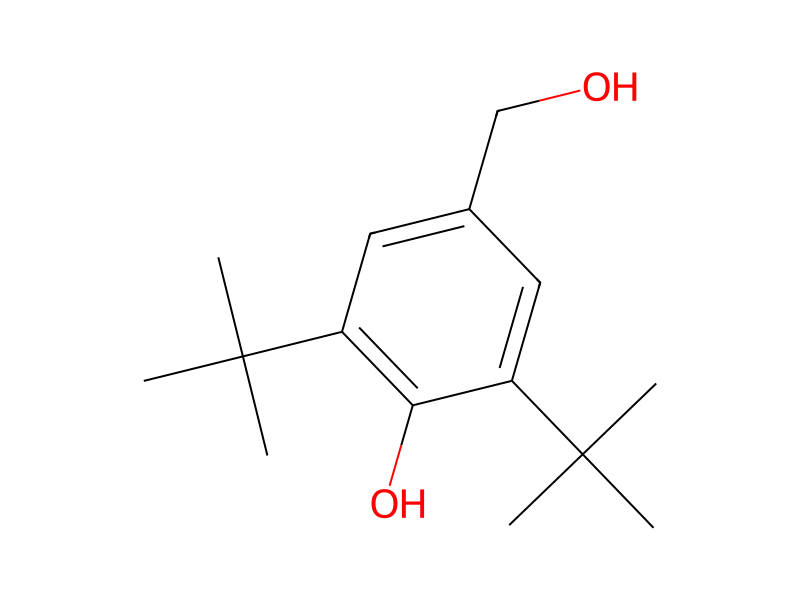
C([O-])(=O)C.[NH4+].C=O.[C:8]([C:12]1[CH:13]=[C:14]([CH:17]=[C:18]([C:21]([CH3:24])([CH3:23])[CH3:22])[C:19]=1[OH:20])[CH2:15][OH:16])([CH3:11])([CH3:10])[CH3:9]>O.C(O)(=O)C>[C:21]([C:18]1[CH:17]=[C:14]([CH:13]=[C:12]([C:8]([CH3:11])([CH3:10])[CH3:9])[C:19]=1[OH:20])[CH:15]=[O:16])([CH3:24])([CH3:23])[CH3:22]A 500 ml reaction flask fitted with a mechanical stirrer, heating mantle, thermometer and water-cooled condenser was charged with 100 ml of glacial acetic acid and 17 ml of water. To the stirred solution there were added 30.8 g (0.4 mole) of ammonium acetate, 48.7 g of 37% formalin (0.60 mole formaldehyde) and 11.8 g (0.05 mole) of 3,5-ditert.butyl-4-hydroxybenzyl alcohol. The reaction flask was equipped with a take-off head to remove the methanol which is present in commercially available formalin. The mixture was refluxed (100°-2°) for 2 hours. The cooled mixture was poured on a vacuum filter and the product cake was washed with water. After drying, there was obtained 8.0 g of crystalline 3,5-ditert.butyl-4-hydroxybenzaldehyde, m.p. 191°-93° (68.4%).