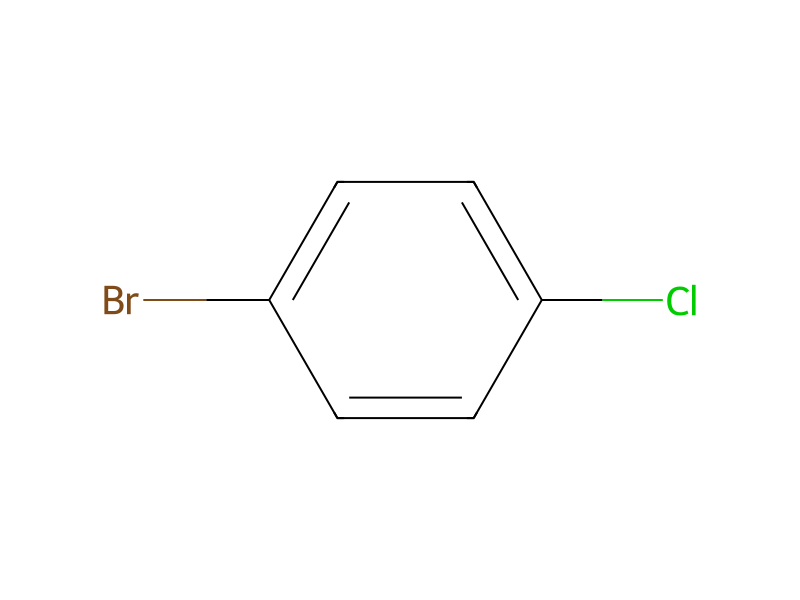
The Grignard reagent solution prepared, under nitrogen, from 1-bromo-4-chlorobenzene (38.3 g, 0.2 mol) and magnesium (4.867 g, 0.2 g atom) in 300 ml anhydrous diethyl ether, is filtered through a glass filter-stick by nitrogen pressure into a graduated feed-funnel, from which it is fed during 21/4 hours into a stirred solution of redistilled silicon tetrachloride (102 g, 0.6 mol) in 200 ml of dry ether. The solution is heated at reflux temperature an additional 2 hours, then cooled and filtered under nitrogen. If not protected from the air, the solution turns red and reduced yields are obtained. The ether and excess silicon chloride is concentrated in vacuum and the residue distilled in vacuum under nitrogen. 4-Chlorophenyl trichlorosilane (17 g, 35 percent yield), b.p. 84°-85° C/3.4 mm, nD27.5 1.5400, and bis(4-chlorophenyl) dichlorosilane (6.2 g, 20 percent yield), b.p. 146°-150° C/0.4 mm, m.p. 60°-61° C are obtained.