Reaktionsgleichung

[Cl:1][C:2]1[CH:7]=[C:6]([Cl:8])[CH:5]=[C:4]([Cl:9])[CH:3]=1.[Br:10][CH2:11][C:12](Br)=[O:13].[Cl-].[Al+3].[Cl-].[Cl-].O>C(OCC)(=O)C>[Br:10][CH2:11][C:12]([C:7]1[C:2]([Cl:1])=[CH:3][C:4]([Cl:9])=[CH:5][C:6]=1[Cl:8])=[O:13]Komponenten
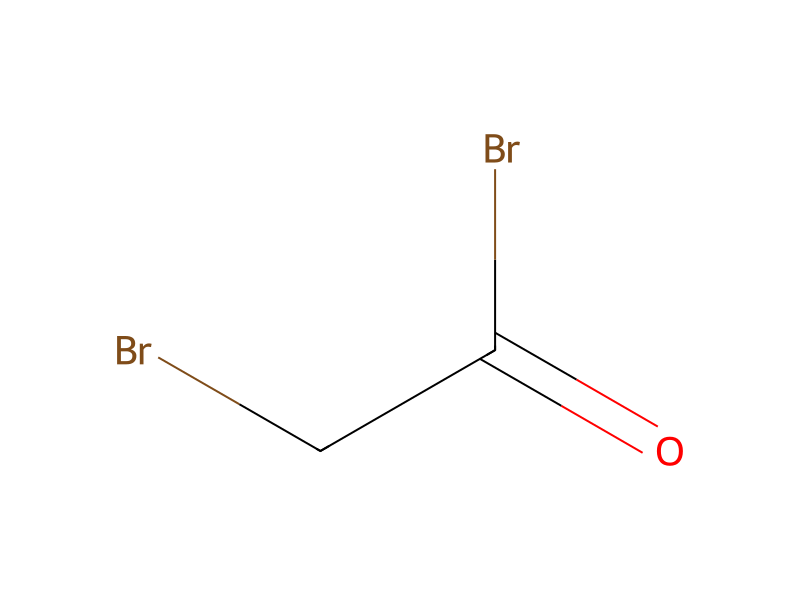
Edukt 4



Produkt 1

Reagenzien, Katalysatoren, Lösungsmittel 1

Reaktionsbedingungen
- Temperatur
- 80 °C
Versuchsvorschrift
A mixture of 1,3,5-trichlorobenzene (10.0 g, 55.1 mmol), 2-bromoacetyl bromide (5.0 mL, 57.8 mmol, 1.05 eq), and aluminum chloride (7.7 g, 57.8 mmol, 1.05 eq) was heated neat at 80° C. under argon for 17 h until a black precipitate is formed. The reaction was cooled to room temperature, and the resultant black mass was dissolved in ethyl acetate (500 mL). Water (200 mL) was added slowly at 0° C. to quench the reaction, and the biphasic layers were separated. The organic layer was then washed with water (2×150 mL) and brine (1×150 mL), dried (MgSO4), filtered, and evaporated in vacuo. Recrystallization from hexane gave 11.5 g (69.3%) of 2-bromo-1-(2,4,6-trichlorophenyl)ethanone as a fluffy white solid. 1H-NMR (DMSO-d6) δ 7.86 (s, 2H), 4.78 (s, 2H); Rf=0.28, 2% ethyl acetate-hexane.
Aufarbeitung
- customis formed
- temperatureThe reaction was cooled to room temperature
- customto quench
- customthe reaction
- customthe biphasic layers were separated
- washThe organic layer was then washed with water (2×150 mL) and brine (1×150 mL)
- dry with materialdried (MgSO4)
- filtrationfiltered
- customevaporated in vacuo
- customRecrystallization from hexane
Quellen und Nachweise
- ORD-Eintrag
- ord-1f51f824f8ed43009701d9111938ea26
- Quelldatensatz
- uspto-grants-2008_06
- Patentnummer
- US07384947B2
Verknüpfte Notizen
Wird geladen…