Boron trifluoride etherate → 3-(4-Chlorophenyl)-2,3-dihydro-1H-indole
Reaktionsgleichung

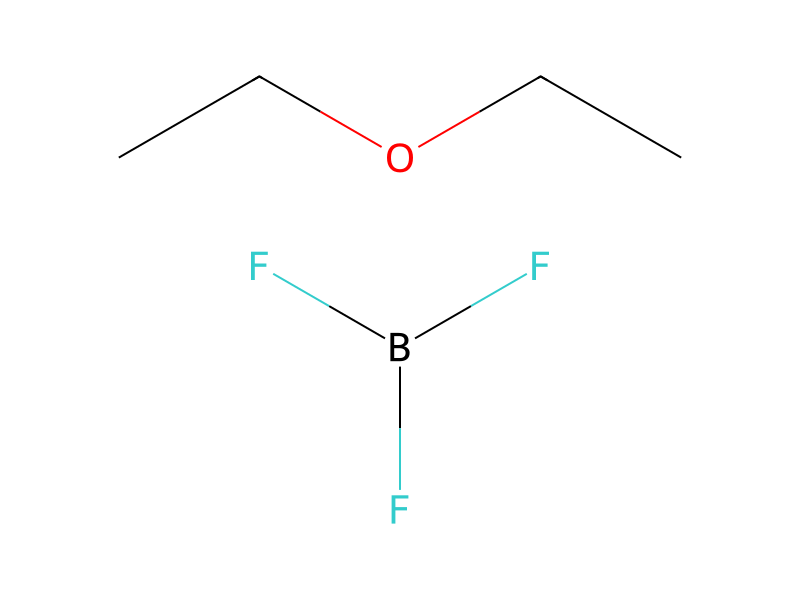
[Cl:1][C:2]1[CH:7]=[CH:6][C:5]([C:8]2[C:16]3[C:11](=[CH:12][CH:13]=[CH:14][CH:15]=3)[NH:10][CH:9]=2)=[CH:4][CH:3]=1.B(F)(F)F.CCOCC>[Zn].C(O)(=O)C>[Cl:1][C:2]1[CH:3]=[CH:4][C:5]([CH:8]2[C:16]3[C:11](=[CH:12][CH:13]=[CH:14][CH:15]=3)[NH:10][CH2:9]2)=[CH:6][CH:7]=1Komponenten
5
Edukt 2

Produkt 1

Reagenzien, Katalysatoren, Lösungsmittel 2


Versuchsvorschrift
Using the same procedure as detailed in Example 1 3.5 g of 3-p-chlorophenylindole, 35 ml of glacial acetic acid, 7 ml of boron trifluoride etherate and 7 g of zinc dust were reacted together and the product worked up as in Example 1. In this way 1.5 g of the desired 3-p-chlorophenylindoline was obtained as a yellow oil.
Aufarbeitung
- customwere reacted together
Quellen und Nachweise
- ORD-Eintrag
- ord-824c9da88642485a9f01eb1ef4e3af0e
- Quelldatensatz
- uspto-grants-1979_02
- Patentnummer
- US04138494
Notizen zur Reaktion
Wird geladen…