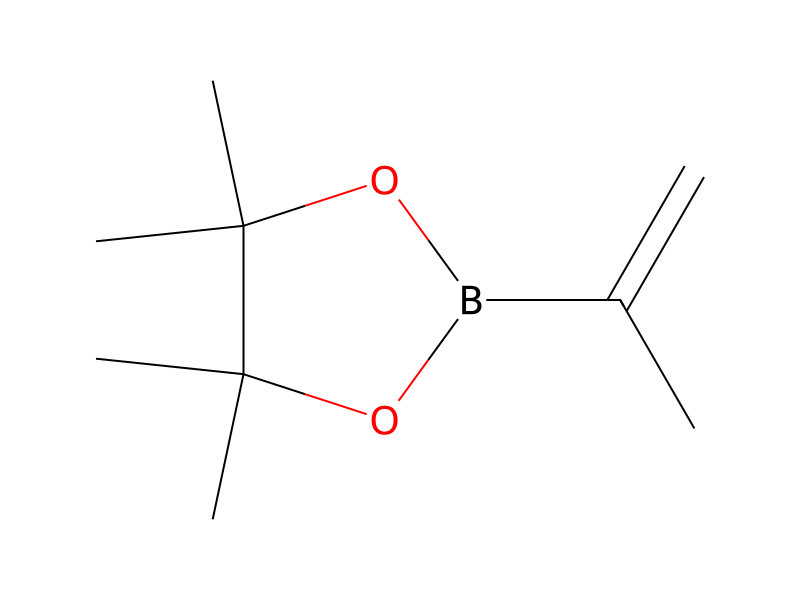
To a mixture of 1-bromo-3-fluoro-2-nitrobenzene (0.953 g, 4.33 mmol) in a 100 mL round-bottomed flask equipped with a magnetic stir bar and nitrogen inlet were added dioxane (17.3 mL), sodium carbonate (0.551 g, 5.20 mmol), water (4.33 mL), and 4,4,5,5-tetramethyl-2-(prop-1-en-2-yl)-1,3,2-dioxaborolane (0.977 mL, 5.20 mmol). To this mixture was added bis(triphenyl-phosphine)palladium(II)chloride (0.243 g, 0.347 mmol). The flask was evacuated and purged with nitrogen (3×) and then heated to 80° C. and stirred overnight. The reaction was cooled to room temperature, filtered through Celite®, and the pad was washed with ethyl acetate. The phases were separated and the organic phase was concentrated. Purification by flash column chromatography provided the title compound (0.590 g, 3.26 mmol, 75% yield) as a light yellow oil: 1H NMR (400 MHz, CDCl3) δ 7.48-7.36 (m, 1H), 7.21-7.06 (m, 2H), 5.23 (p, J=1.5 Hz, 1H), 5.05 (q, J=1.1 Hz, 1H), 2.09 (s, 3H); 13C NMR (101 MHz, CDCl3) δ 153.56 (d, JCF=257.5 Hz), 139.62, 139.60, 138.83, 131.48 (d, JCF=8.6 Hz), 124.47 (d, JCF=3.6 Hz), 117.60, 115.51 (d, JCF=19.1 Hz), 23.18.