Reaktionsgleichung

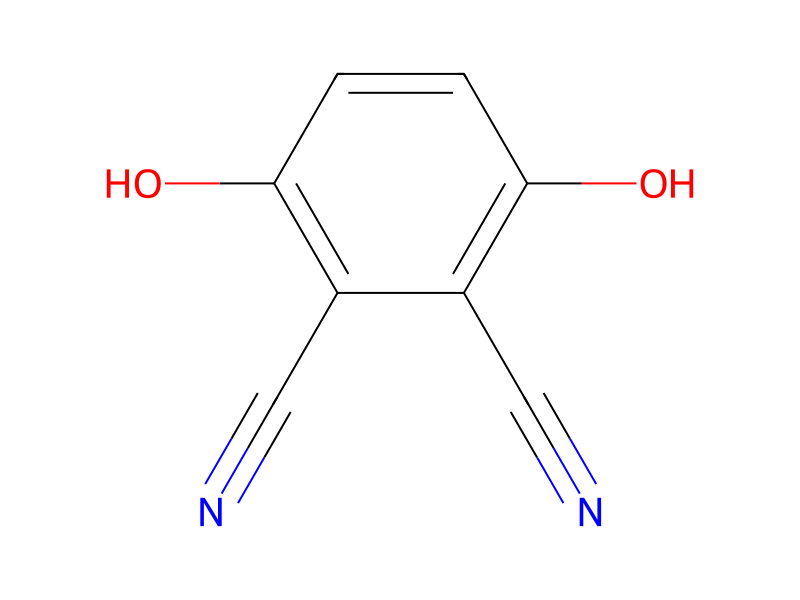
[C:1]([C:3]1[C:9]([C:10]#[N:11])=[C:8]([OH:12])[CH:7]=[CH:6][C:4]=1[OH:5])#[N:2].[OH-].[K+].[CH2:15](Br)[CH2:16][CH2:17][CH2:18][CH2:19][CH3:20].O>CO.CN(C)C=O>[C:1]([C:3]1[C:9]([C:10]#[N:11])=[C:8]([O:12][CH2:15][CH2:16][CH2:17][CH2:18][CH2:19][CH3:20])[CH:7]=[CH:6][C:4]=1[OH:5])#[N:2]Komponenten






Reaktionsbedingungen
- Temperatur
- 50 °C
Versuchsvorschrift
27 g (168.8 mM) of 2,3-dicyanohydroquinone and 22.2 g (337 mM) of 85%-potassium hydroxide were dissolved in a mixture solvent of 65 ml of methanol and 302 ml of dimethylformamide, followed by heating to 50° C. To the solution, 33.4 g (202.4 mM) of hexyl bromide were added dropwise in 25 minutes, followed by heating to 100° C. and stirring for 3 hours. The reaction mixture was poured into cold water and washed with ether. The water layer was acidified with 6N-hydrochloric acid to provide a pH value of 1, followed by precipitation of a crystal. The crystal was extracted with ether, and the ether layer was washed with 5%-sodium hydrogen-carbonate aqueous solution and further washed with water, followed by distilling-off of the solvent to obtain a crude product. The crude product was treated with activated carbon and recrystalized from methanol to obtain 13.1 g of 2,3-dicyano-4-hexyloxyphenol.
Aufarbeitung
- temperatureby heating to 100° C.
- washwashed with ether
- customto provide a pH value of 1
- customfollowed by precipitation of a crystal
- extractionThe crystal was extracted with ether
- washthe ether layer was washed with 5%-sodium hydrogen-carbonate aqueous solution
- washfurther washed with water
- customto obtain a crude product
- customrecrystalized from methanol
Quellen und Nachweise
- ORD-Eintrag
- ord-1ef0cb99e25d4ae5bf721947c31adc49
- Quelldatensatz
- uspto-grants-1993_06
- Patentnummer
- US05217643
Verknüpfte Notizen
Wird geladen…