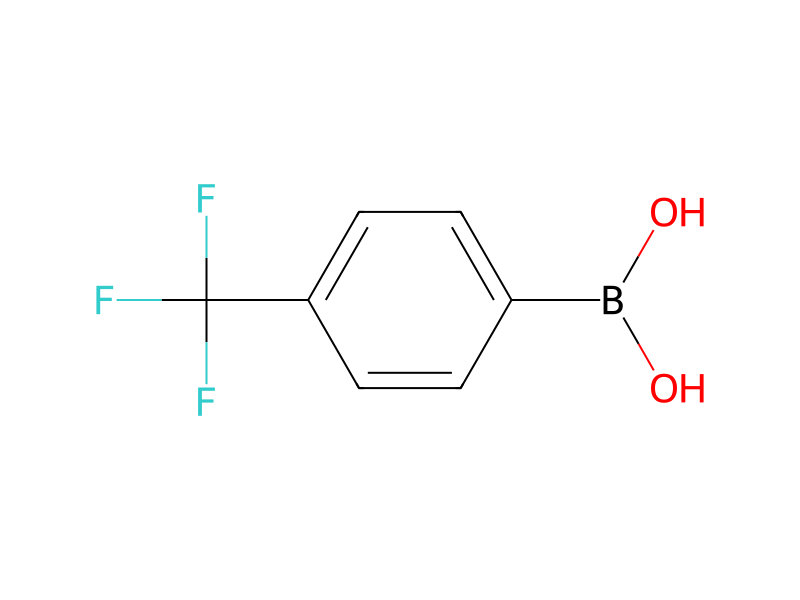
Br[C:2]1[CH:10]=[CH:9][CH:8]=[C:7]2[C:3]=1[CH2:4][CH2:5][C:6]2=[O:11].[F:12][C:13]([F:24])([F:23])[C:14]1[CH:19]=[CH:18][C:17](B(O)O)=[CH:16][CH:15]=1.C(=O)([O-])[O-].[Na+].[Na+].C1(P(C2C=CC=CC=2)C2C=CC=CC=2)C=CC=CC=1>C1(C)C=CC=CC=1.C([O-])(=O)C.[Pd+2].C([O-])(=O)C.O.C(O)C>[F:12][C:13]([F:24])([F:23])[C:14]1[CH:19]=[CH:18][C:17]([C:2]2[CH:10]=[CH:9][CH:8]=[C:7]3[C:3]=2[CH2:4][CH2:5][C:6]3=[O:11])=[CH:16][CH:15]=16.33 g (0.03 mol) of 4-bromo-1-indanone and 5.7 g (0.03 mol) of 4-trifluoromethylphenylboronic acid are suspended with 6.36 g (0.06 mol) of sodium carbonate in a mixture of 100 ml of toluene with 20 ml of ethanol and 20 ml of water. Under an argon atmosphere, 320 mg (1.42 mmol) of palladium(II) acetate and 787 mg (3 mmol) of triphenylphosphine are added, and the mixture is boiled under reflux for 5 h. After the reaction is complete, the ethanol content is evaporated off in vacuo, 50 ml of 0.5 N sodium hydroxide solution are added to the residue, and the mixture is stirred and filtered with suction through a clarifying layer. The organic phase of the filtrate is separated off, shaken 3× with 50 ml of water each time, shaken once with saturated brine, dried over sodium sulfate and concentrated in vacuo. The crude product is chromatographed on silica gel with n-heptane/ethyl acetate 3/1. 4-(4-Trifluoromethylphenyl)-1-indanone is obtained with a melting point of 75-78° C.