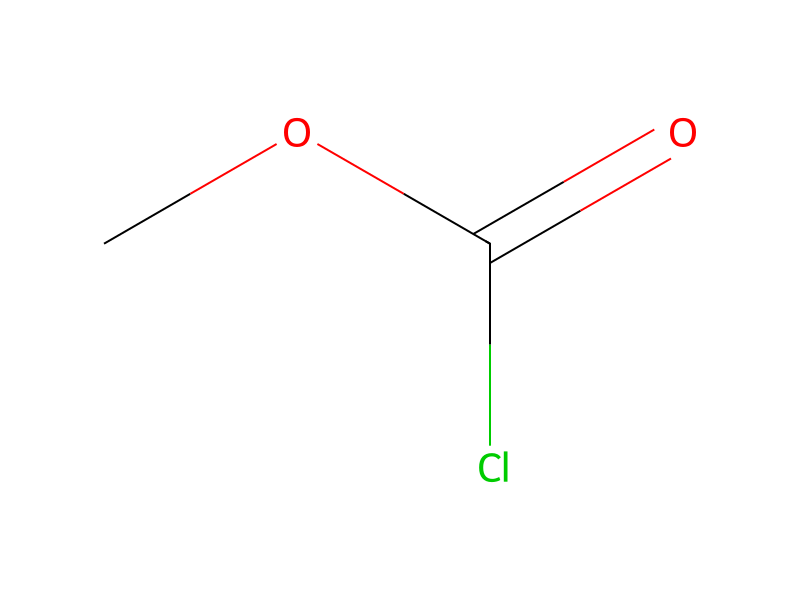
[Cl:1][C:2]1[CH:7]=[CH:6][C:5]([NH:8][C:9]([N:11]2[CH2:15][CH:14]([CH3:16])[C:13]([C:17]3[CH:22]=[CH:21][C:20]([Cl:23])=[CH:19][CH:18]=3)=[N:12]2)=[O:10])=[CH:4][CH:3]=1.C(NC(C)C)(C)C.C([Li])CCC.Cl[C:37]([O:39][CH3:40])=[O:38]>O1CCCC1.CCCCCC>[Cl:1][C:2]1[CH:3]=[CH:4][C:5]([NH:8][C:9]([N:11]2[CH2:15][C:14]([C:37]([O:39][CH3:40])=[O:38])([CH3:16])[C:13]([C:17]3[CH:18]=[CH:19][C:20]([Cl:23])=[CH:21][CH:22]=3)=[N:12]2)=[O:10])=[CH:6][CH:7]=1To 3.4 g of N,3-bis-(4-chlorophenyl)-4-methyl-4,5-dihydro-1H-pyrazole-1-carboxamide and 1.1 g of diisopropylamine dissolved in 20 ml of tetrahydrofuran and cooled in an acetone bath maintained at -20° C., was added 8.0 ml of a 2.7 molar solution of butyllithium in hexane. The resulting solution was stirred for 20 minutes and then cooled to -70° C. To this solution was added 0.9 ml of methyl chloroformate. The reaction was allowed to stir of 10 minutes and then allowed to warm to room temperature over 10 minutes. The reaction was quenched with 1.0 ml of acetic acid and the reaction mixture was partitioned between diethyl ether and water and the organic layer was dried over anhydrous magnesium sulfate. The resulting solution was filtered evaporated in vacuo to give 2.9 g of N,3-bis-(4-chlorophenyl)-4-carbomethoxy-4-methyl-4,5-dihydro-1H-pyrazole-1-carboxamide. NMR and IR data were consistent with the structure.