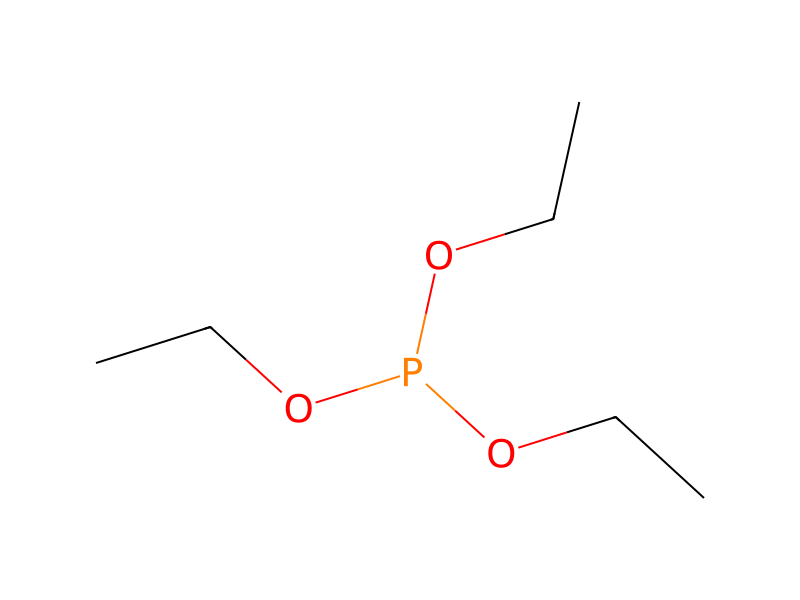
Triethyl phosphite → Donepezil
Reaktionsgleichung

Br[CH:2]1[CH2:10][C:9]2[C:4](=[CH:5][C:6]([O:13][CH3:14])=[C:7]([O:11][CH3:12])[CH:8]=2)[C:3]1=[O:15].P(OCC)(OCC)OCC.[CH2:26]([N:33]1[CH2:38][CH2:37][CH:36]([CH:39]=O)[CH2:35][CH2:34]1)[C:27]1[CH:32]=[CH:31][CH:30]=[CH:29][CH:28]=1.C([N-]C(C)C)(C)C.[Li+]>[Pd].O1CCCC1>[CH3:12][O:11][C:7]1[CH:8]=[C:9]2[CH2:10][CH:2]([CH2:39][CH:36]3[CH2:35][CH2:34][N:33]([CH2:26][C:27]4[CH:28]=[CH:29][CH:30]=[CH:31][CH:32]=4)[CH2:38][CH2:37]3)[C:3](=[O:15])[C:4]2=[CH:5][C:6]=1[O:13][CH3:14]Komponenten
7
Edukt 4


Produkt 1

Reagenzien, Katalysatoren, Lösungsmittel 2


Versuchsvorschrift
There are many processes as disclosed in the prior arts for producing donepezil of formula 1. U.S. Pat. No. 4,895,841 wherein substituted 1-indanone-2-phosphonate prepared from 2-bromo-5,6-dimethoxyindanone and triethyl phosphite, is treated with 1-benzylpiperidine-4-carboxaldehyde in the presence of a strong base, such as lithium diisopropylamide (LDA), followed by catalytic reduction using palladium on carbon in tetrahydrofuran (40 volumes) to yield donepezil with an overall yield of 50.8%. This process however suffers with few limitations i.e. it employs triphenylphosphonium methoxymethyl chloride, which is expensive and toxic and the overall yield of this process is quite low. (scheme 1).
Quellen und Nachweise
- ORD-Eintrag
- ord-a91868260619440cb738a37d927b78f0
- Quelldatensatz
- uspto-grants-2012_02
- Patentnummer
- US08124783B2
Notizen zur Reaktion
Wird geladen…