Reaktionsgleichung

[NH4+:1].[OH-].[Cl:3][C:4]1[CH:9]=[CH:8][C:7]([NH:10][N:11]=[C:12]2[C:16](=O)[O:15][C:14]([C:18]3[CH:23]=[CH:22][CH:21]=[CH:20][CH:19]=3)=[N:13]2)=[CH:6][C:5]=1[CH2:24][O:25][CH2:26][C:27]([F:33])([F:32])[C:28]([F:31])([F:30])[F:29]>O>[Cl:3][C:4]1[CH:9]=[CH:8][C:7]([N:10]2[C:14]([C:18]3[CH:23]=[CH:22][CH:21]=[CH:20][CH:19]=3)=[N:13][C:12]([C:16]([NH2:1])=[O:15])=[N:11]2)=[CH:6][C:5]=1[CH2:24][O:25][CH2:26][C:27]([F:32])([F:33])[C:28]([F:31])([F:30])[F:29]Komponenten
4
Edukt 2


Produkt 1
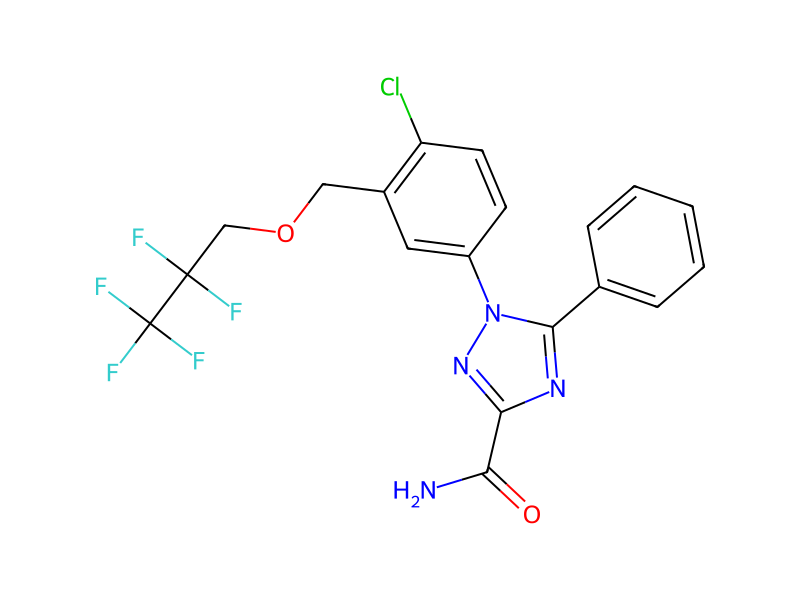
Reagenzien, Katalysatoren, Lösungsmittel 1

Reaktionsbedingungen
- Temperatur
- 80 °C
Versuchsvorschrift
A 29% ammonia aqueous solution (8.82 g, 150 mmol) was added to 100 g of water, and to the solution was added 2-phenyl-4,5-oxazoledione 4-[4-chloro-3-(2,2,3,3,3-pentafluoropropoxy)methylphenyl]hydrazone (39.7 g, purity: 97%, water content: 40%, 50 mmol). The mixture was vigorously stirred to produce a slurry. The slurry was heated to 80° C. in a water bath. In the course of the heating, the slurry abruptly changed its color, exhibiting an increase in the viscosity, at 65°-70° C.
Aufarbeitung
- customto produce a slurry
- temperaturean increase in the viscosity, at 65°-70° C.
Quellen und Nachweise
- ORD-Eintrag
- ord-b2a9fd777acf499687b4271b2c5eaa04
- Quelldatensatz
- uspto-grants-1995_07
- Patentnummer
- US05434268
Verknüpfte Notizen
Wird geladen…