Bromide ion → 2-(Trifluoromethyl)benzhydryl bromide
Reaktionsgleichung

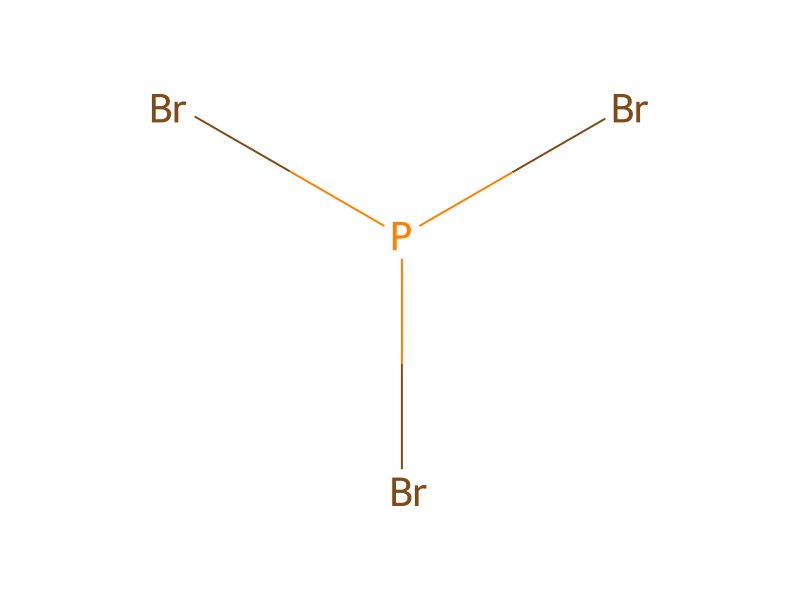
[F:1][C:2]([F:18])([F:17])[C:3]1[CH:16]=[CH:15][CH:14]=[CH:13][C:4]=1[CH:5](O)[C:6]1[CH:11]=[CH:10][CH:9]=[CH:8][CH:7]=1.P(Br)(Br)[Br:20].[Br-]>C(OCC)C>[F:1][C:2]([F:18])([F:17])[C:3]1[CH:16]=[CH:15][CH:14]=[CH:13][C:4]=1[CH:5]([Br:20])[C:6]1[CH:11]=[CH:10][CH:9]=[CH:8][CH:7]=1Komponenten
5
Edukt 3


Produkt 1

Reagenzien, Katalysatoren, Lösungsmittel 1

Versuchsvorschrift
2-(Trifluoromethyl)benzhydrol (20.2 g, 79.9 mmol) was dissolved in ethyl ether (195 mL), and cooled in an ice-H2O bath, under N2. To the resulting solution was added, dropwise, a solution of PBr3 (3.80 mL, 40.0 mmol) in ethyl ether (95 mL). After addition was complete, the reaction mixture was brought to room temperature and stirred for 16 hours. The reaction mixture was cooled in an ice-H2O bath and quenched with H2O (200 mL). The aqueous layer was extracted with ethyl ether (2×200 mL). The combined organic extracts were dried (MgSO4), filtered, and concentrated to dryness at low heat to give a quantitative yield of product bromide as a pale yellow oil. 300 MHz 1H NMR (CDCl3): δ6.69 (s, 1H, (Ph)2CH. MS: 235 (M+ -Br).
Aufarbeitung
- temperaturecooled in an ice-H2O bath, under N2
- additionTo the resulting solution was added
- additionAfter addition
- customwas brought to room temperature
- temperatureThe reaction mixture was cooled in an ice-H2O bath
- customquenched with H2O (200 mL)
- extractionThe aqueous layer was extracted with ethyl ether (2×200 mL)
- dry with materialThe combined organic extracts were dried (MgSO4)
- filtrationfiltered
- concentrationconcentrated to dryness
- temperatureat low heat
Quellen und Nachweise
- ORD-Eintrag
- ord-d6bbe4e9d4cb47f2a44983397c5c7d8f
- Quelldatensatz
- uspto-grants-1996_04
- Patentnummer
- US05508273
Notizen zur Reaktion
Wird geladen…