StartseiteMCPWorkbenchSkills
StartseiteWorkbenchBenachrichtigungenMein Bereich
llms.txt · MCP-AnleitungDatenschutz · Nutzungsbedingungen · Supportv1.8.0
  1. Startseite
  2. /Reaktion

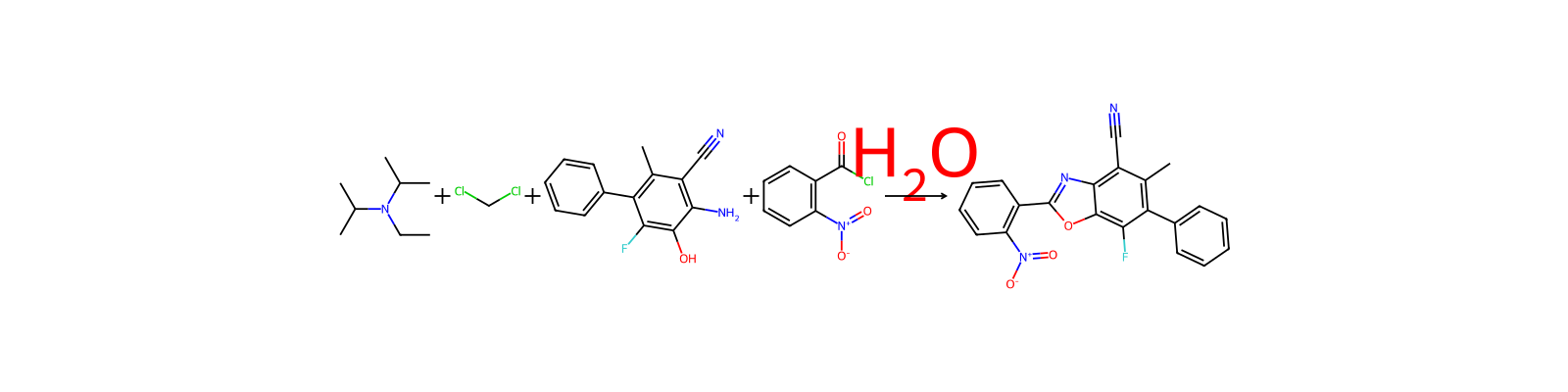
Dichloromethane → 7-Fluoro-5-methyl-2-(2-nitrophenyl)-6-phenyl-1,3-benzoxazole-4-carbonitrile

HRID 17501
Notizen
Druckvorschau

Reaktionsgleichung

Reaktionsgleichung von HRID 17501
C(N(C(C)C)CC)(C)C.ClCCl.[NH2:13][C:14]1[C:19]([OH:20])=[C:18]([F:21])[C:17]([C:22]2[CH:27]=[CH:26][CH:25]=[CH:24][CH:23]=2)=[C:16]([CH3:28])[C:15]=1[C:29]#[N:30].[N+:31]([C:34]1[CH:42]=[CH:41][CH:40]=[CH:39][C:35]=1[C:36](Cl)=O)([O-:33])=[O:32]>O>[F:21][C:18]1[C:17]([C:22]2[CH:27]=[CH:26][CH:25]=[CH:24][CH:23]=2)=[C:16]([CH3:28])[C:15]([C:29]#[N:30])=[C:14]2[C:19]=1[O:20][C:36]([C:35]1[CH:39]=[CH:40][CH:41]=[CH:42][C:34]=1[N+:31]([O-:33])=[O:32])=[N:13]2
KomponentenVersuchsvorschriftAufarbeitungQuellen und NachweiseNotizen zur Reaktion

Komponenten

6

Edukt 4

HCID 6344DichloromethaneHCID 118752-Nitrobenzoyl chlorideHCID 81531DiisopropylethylamineHCID 860974464-Amino-3-cyano-6-fluoro-5-hydroxy-2-methylbiphenyl

Produkt 1

HCID 685846847-Fluoro-5-methyl-2-(2-nitrophenyl)-6-phenyl-1,3-benzoxazole-4-carbonitrileAusbeute 77,1 %

Reagenzien, Katalysatoren, Lösungsmittel 1

HCID 962WaterLösungsmittel

Versuchsvorschrift

Diisopropylethylamine (523 μl, 3 mmol) was added to a dichloromethane (10 ml) solution of 4-amino-6-fluoro-5-hydroxy-2-methyl-biphenyl-3-carbonitrile (I-41) (485 mg, 2.0 mmol), and after cooling with ice, 2-nitrobenzoyl chloride (408 mg, 2.2 mmol) was added, followed by stirring at the same temperature for 1 hour. With cooling with ice, water was added, followed by extraction with ethyl acetate. The organic layer was washed with saturated brine, dried over anhydrous sodium sulfate, then the solvent was evaporated away under reduced pressure. In xylene (30 ml) in the presence of a catalytic amount of p-tosylic acid, the resulting residue was heated under reflux for 16 hours with a Dean-Stark device. After cooling, the solvent was evaporated away, and the resulting residue was dissolved in chloroform, washed with saturated sodium bicarbonate water, then dried over anhydrous sodium sulfate, and the solvent was evaporated away under reduced pressure. The resulting residue was subjected to silica gel column chromatography. Elution with chloroform gave the entitled compound (576 mg, 77%) as a colorless solid.

Aufarbeitung

  1. additionwas added
  2. additionwas added
  3. extractionfollowed by extraction with ethyl acetate
  4. washThe organic layer was washed with saturated brine
  5. dry with materialdried over anhydrous sodium sulfate
  6. customthe solvent was evaporated away under reduced pressure
  7. temperatureIn xylene (30 ml) in the presence of a catalytic amount of p-tosylic acid, the resulting residue was heated
  8. temperatureunder reflux for 16 hours with a Dean-Stark device
  9. temperatureAfter cooling
  10. customthe solvent was evaporated away
  11. dissolutionthe resulting residue was dissolved in chloroform
  12. washwashed with saturated sodium bicarbonate water
  13. dry with materialdried over anhydrous sodium sulfate
  14. customthe solvent was evaporated away under reduced pressure
  15. washElution with chloroform

Quellen und Nachweise

ORD-Eintrag
ord-48515c7a5c3e475f82295d54c4acffe1
Quelldatensatz
uspto-grants-2010_06
DOI
10.6084/m9.figshare.5104873.v1
Patentnummer
US07737166B2

Notizen zur Reaktion

Wird geladen…

Auf dieser SeiteKomponentenVersuchsvorschriftAufarbeitungQuellen und NachweiseNotizen zur Reaktion