StartseiteMCPWorkbenchSkills
StartseiteWorkbenchBenachrichtigungenMein Bereich
llms.txt · MCP-AnleitungDatenschutz · Nutzungsbedingungen · Supportv1.8.0
  1. Startseite
  2. /Reaktion

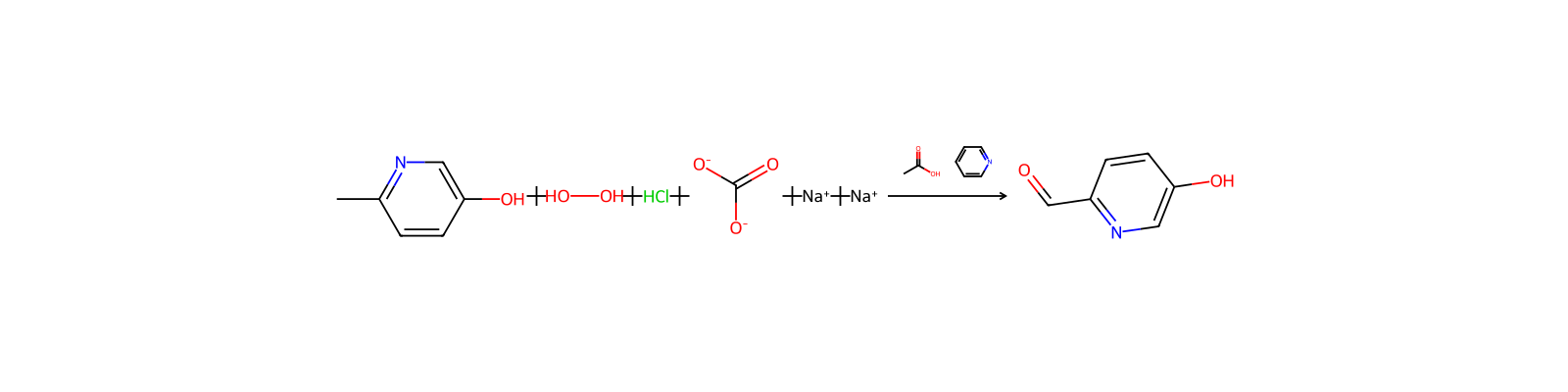
Hydrochloric Acid → 5-Hydroxy-2-pyridinecarboxaldehyde

HRID 1819
Notizen
Druckvorschau

Reaktionsgleichung

Reaktionsgleichung von HRID 1819
[OH:1][C:2]1[CH:3]=[CH:4][C:5]([CH3:8])=[N:6][CH:7]=1.OO.Cl.C(=O)([O-])[O-:13].[Na+].[Na+]>C(O)(=O)C.N1C=CC=CC=1>[CH:8]([C:5]1[CH:4]=[CH:3][C:2]([OH:1])=[CH:7][N:6]=1)=[O:13]
KomponentenReaktionsbedingungenVersuchsvorschriftAufarbeitungQuellen und NachweiseNotizen zur Reaktion

Komponenten

7

Edukt 4

HCID 313Hydrochloric AcidHCID 784Hydrogen Peroxide2×HCID 10340Sodium CarbonateHCID 142752-Methyl-5-hydroxypyridine

Produkt 1

HCID 2783895-Hydroxy-2-pyridinecarboxaldehydeAusbeute 32 %

Reagenzien, Katalysatoren, Lösungsmittel 2

HCID 176
Acetic Acid
Lösungsmittel
HCID 1049PyridineLösungsmittel

Reaktionsbedingungen

Temperatur
120 °C

Versuchsvorschrift

To a stirred solution of 21.8 g of 5-hydroxy-2-picoline (0.2 mol) in 200 mL of glacial acetic acid was added 18 mL of 30% hydrogen peroxide (0.159 mol) in one portion. The mixture was heated in an oil bath at 80°-85° C. with stirring for 3 h. Then another 18 mL of hydrogen peroxide was added and the mixture was stirred for 3 h at the same temperature. Excess solvent was removed in vacuo followed by the addition of acetone, which caused the pyridine N-oxide to crystallize. Without further purification, 200 mL of acetic anhydride was added to the solid and the mixture was heated at 120° C. with stirring in an oil bath for 2 h. After cooling to room temperature, excess acetic anhydride was removed by high vacuum distillation. The oily material was again oxidized with 30% hydrogen peroxide twice and rearranged with acetic anhydride following the same procedure and amounts depicted above. The black oily material obtained was hydrolyzed with 200 mL of 1N HCl (0.2 mol) at room temperature for 3 weeks (hydrolysis at higher temperature may be harmful to the pyridine nucleus). The mixture was neutralized with anhydrous sodium carbonate, indicated by litmus paper and then extracted three times with 300 mL of diethylether. The combined ether extracts were dried (MgSO4), filtered and evaporated to leave a solid material in a small mount of oil. The pure product (7.8 g, 32%) was obtained by filtering the solid, followed by washing it with a small amount of ether. It is yellow in color and shows a sharp melting point at 186°-187° C. 1H NMR (d6 -DMSO) d: 11.i0 (br. s, 1H, OH); 9.87 (s, 1H, CHO); 8.35 (d, J=2Hz, 1H); 7.58 (d, J=9 Hz, 1H); 7.35 (d of d, J=2Hz, 9Hz, 1H).

Aufarbeitung

  1. temperatureThe mixture was heated in an oil bath at 80°-85° C.
  2. stirringthe mixture was stirred for 3 h at the same temperature
  3. customExcess solvent was removed in vacuo
  4. additionfollowed by the addition of acetone, which
  5. customto crystallize
  6. customWithout further purification, 200 mL of acetic anhydride
  7. additionwas added to the solid
  8. stirringwith stirring in an oil bath for 2 h
  9. temperatureAfter cooling to room temperature
  10. customexcess acetic anhydride was removed by high vacuum distillation
  11. customThe black oily material obtained
  12. custom(hydrolysis at higher temperature
  13. extractionextracted three times with 300 mL of diethylether
  14. dry with materialThe combined ether extracts were dried (MgSO4)
  15. filtrationfiltered
  16. customevaporated
  17. customto leave a solid material in a small mount of oil

Quellen und Nachweise

ORD-Eintrag
ord-99c88818328441daaf858d5d4bfeac19
Quelldatensatz
uspto-grants-1998_03
DOI
10.6084/m9.figshare.5104873.v1
Patentnummer
US05726314

Notizen zur Reaktion

Wird geladen…

Auf dieser SeiteKomponentenReaktionsbedingungenVersuchsvorschriftAufarbeitungQuellen und NachweiseNotizen zur Reaktion


