Reaktionsgleichung

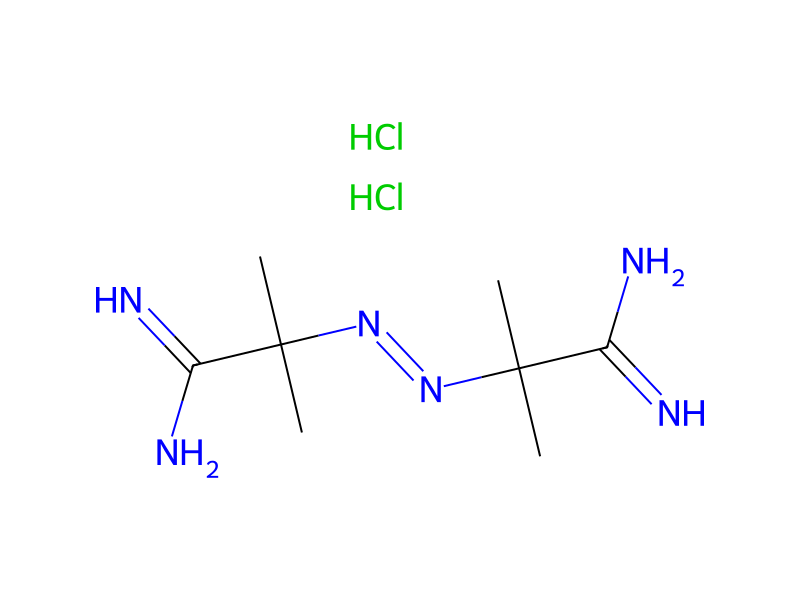
[CH3:1][N:2]([CH3:11])[CH2:3][CH2:4][CH2:5][NH:6][C:7](=[O:10])[CH:8]=[CH2:9].[C:12]([NH2:16])(=[O:15])[CH:13]=[CH2:14].Cl.Cl.N(C(C(=N)N)(C)C)=NC(C(=N)N)(C)C.Cl>O.C(O)C.C(O)(C)C>[CH3:11][N:2]([CH3:1])[CH2:3][CH2:4][CH2:5][NH:6][C:7](=[O:10])[CH:8]=[CH2:9].[C:12]([NH2:16])(=[O:15])[CH:13]=[CH2:14]Komponenten
Edukt 4



Produkt 1

Reagenzien, Katalysatoren, Lösungsmittel 3



Versuchsvorschrift
A solution of N-[3-(dimethylamino)propyl]acrylamide (30.0 g) and acrylamide (13.6 g) in deionized water (40 mL) and ethanol (40 mL) was heated to 60° C. under a nitrogen atmosphere. When the solution reached 60° C., 2,2′-azobis(2-amidinopropane) dihydrochloride (2.2 g of a 20 percent aqueous solution) was added. Heating was continued for 18 hours under a nitrogen atmosphere. After cooling to room temperature, the reaction solution was dissolved in isopropanol (150 mL), and concentrated HCl (31.5 g) was added with stirring. The solution was decanted from the precipitated polymer. The polymer was suspended in isopropanol (500 mL), stirred for at least 15 minutes, and allowed to settle. After decanting, the polymer was similarly washed an additional 3 times with isopropanol. The washed polymer was dried in a forced-air oven at 70° C. to afford 68.2 g.
Aufarbeitung
- customreached 60° C.
- temperatureHeating
- customThe solution was decanted from the precipitated polymer
- stirringstirred for at least 15 minutes
- customAfter decanting
- washthe polymer was similarly washed an additional 3 times with isopropanol
- customThe washed polymer was dried in a forced-air oven at 70° C.
- customto afford 68.2 g
Quellen und Nachweise
- ORD-Eintrag
- ord-65039d2b41984a25b40d593c1977cd1f
- Quelldatensatz
- uspto-grants-2006_05
- Patentnummer
- US07048917B1
Verknüpfte Notizen
Wird geladen…