Reaktionsgleichung

[N+:1]([C:4]1[CH:11]=[CH:10][C:7](C=O)=[CH:6][CH:5]=1)([O-])=O.[C:12](O[BH-](OC(=O)C)OC(=O)C)(=O)C.[Na+].C(O)(=O)C.[NH2:30][C:31]1[CH:39]=[C:38]2[C:34]([CH:35]=[N:36][NH:37]2)=[CH:33][CH:32]=1>ClCCl>[NH2:30][C:31]1[CH:39]=[CH:38][C:34]([CH2:35][NH:36][N:37]2[C:5]3[CH:6]=[CH:7][CH:10]=[CH:11][C:4]=3[N:1]=[CH:12]2)=[CH:33][CH:32]=1Komponenten
Edukt 4


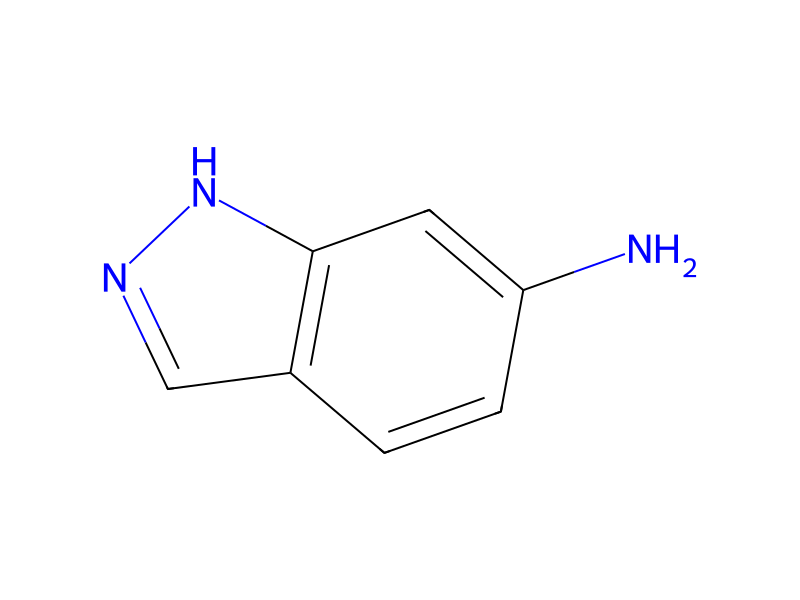

Produkt 1

Reagenzien, Katalysatoren, Lösungsmittel 1

Versuchsvorschrift
To the solution of 0.145 g (0.98 mmol) of 4-nitrobenzaldehyde in 3 ml of dichloromethane was added 0.31 g (1.47 mmol) of sodium triacetoxyborohydride, 0.6 ml (0.98 mmol) of acetic acid and 0.13 g (0.98 mmol) of 6-aminoindazole. After stirring the mixture overnight at room temperature, the solvent was evaporated. The resulting residue was dissolved in 10 ml of ethanol, 20 mg of 10% palladium on carbon was added and stirred under hydrogen atmosphere overnight. The catalyst was filtered off through celite. After evaporation of the solvent the residue was purified by HPLC and lyophilized to yield 0.2 g (86%) of the title compound. 1H-NMR (CDCl3) δ: 4.12 (2H, br), 6.50-6.70 (5H, m), 7.52 (1H, d), 7.86-7.94 (2H, m), 8.18 (1H, br), 8.29 (1H, br).
Aufarbeitung
- customthe solvent was evaporated
- dissolutionThe resulting residue was dissolved in 10 ml of ethanol
- addition20 mg of 10% palladium on carbon was added
- stirringstirred under hydrogen atmosphere overnight
- filtrationThe catalyst was filtered off through celite
- customAfter evaporation of the solvent the residue
- customwas purified by HPLC
Quellen und Nachweise
- ORD-Eintrag
- ord-e3caf4afabd54e539ab301437c037bbb
- Quelldatensatz
- uspto-grants-2010_06
- Patentnummer
- US07745443B2
Verknüpfte Notizen
Wird geladen…