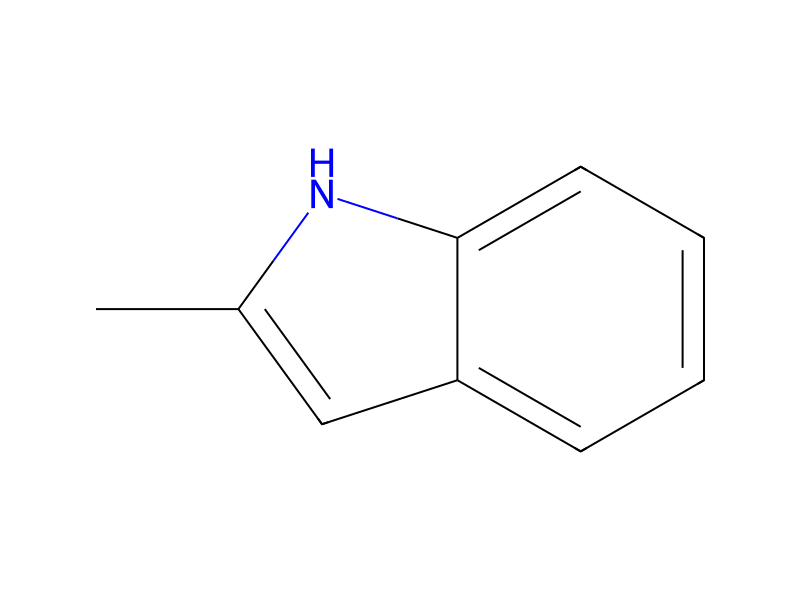
To a stirred solution of 2-methylindole (1 g) in diethylether (76 ml) under nitrogen was added a 1.6M solution of n-butyllithium in hexane (14.3 ml) slowly dropwise via syringe. Potassium tert-butoxide (1.711 g) was then added, producing a bright yellow mixture. After stirring at room temperature under nitrogen for 50 min., the mixture was cooled to -78° C., whereupon 3-bromo-2-methylpropene (1.54 ml) was added dropwise via syringe, giving a red-orange solution. The reaction mixture was stirred at -780° C. for 2 h, then quenched with water (10 ml). After warming to room temperature, water (150 ml) and 1N HCl (1 ml) was added to neutralize the reaction mixture. The mixture was extracted with ethyl acetate (250 ml), and the organic layer was washed with brine (100 ml) and dried with sodium sulfate. The solvent was removed under reduced pressure, and the crude residue was purified by flash chromatography (4-ethyl acetate/hexane) to afford 2-(2-methyl-1-butene-4-yl) indole (664 mg. 47%) as a waxy yellow solid.