Reaktionsgleichung

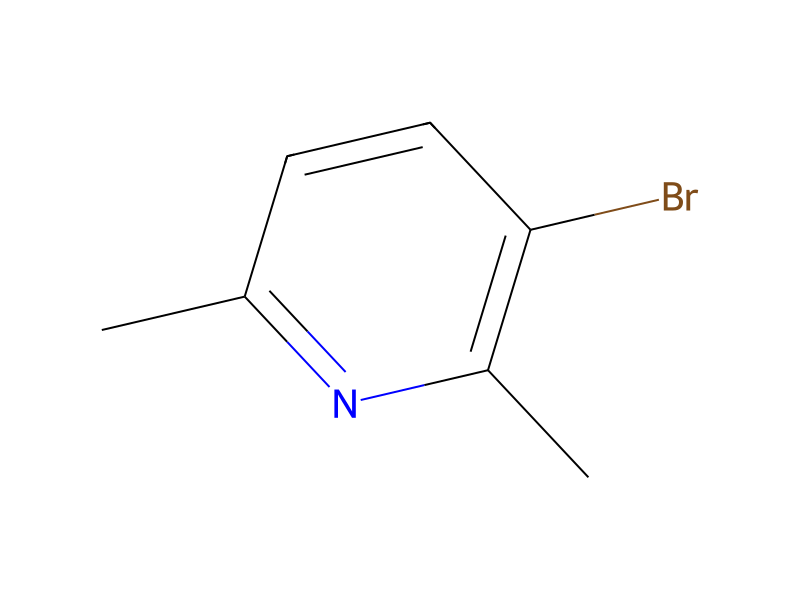
Br[C:2]1[C:3]([CH3:9])=[N:4][C:5]([CH3:8])=[CH:6][CH:7]=1.C([Li])CCC.C(O[B:19]1[O:23][C:22]([CH3:25])([CH3:24])[C:21]([CH3:27])([CH3:26])[O:20]1)(C)C>CCOCC>[CH3:9][C:3]1[C:2]([B:19]2[O:23][C:22]([CH3:25])([CH3:24])[C:21]([CH3:27])([CH3:26])[O:20]2)=[CH:7][CH:6]=[C:5]([CH3:8])[N:4]=1Komponenten
Edukt 3


Produkt 1

Reagenzien, Katalysatoren, Lösungsmittel 1

Reaktionsbedingungen
- Temperatur
- -78 °C
Versuchsvorschrift
A solution of 3-bromo-2,6-dimethylpyridine (5.10 g, 27.4 mmol) in anhydrous ether (160 ml) cooled to −78° C. under a nitrogen atmosphere was treated dropwise with n-butyl lithium (4.1 ml, 10 M in hexane) and stirred at −78° C. for 45 minutes. 2-isopropoxy-4,4,5,5-tetramethyl-[1,3,2]dioxaborolane (10.2 g, 54.8 mmol) in 20 ml of ether was added dropwise at −78° C. and stirred at −78° C. for 3 hours. The mixture was quenched with 10 ml of isopropanol, and allowed to warm to room temperature. 150 ml of saturated aqueous NaCl solution was added. The aqueous phase was separated and extracted with dichloromethane (100 ml×6). The combined organic phases were dried and concentrated to provide the title compound as light brown oil (6.29 g, 98.4%). 1H NMR (300 MHz, CDCl3) δ ppm 7.92 (d, J=7.46 Hz, 1H) 6.96 (d, J=7.80 Hz, 1H) 2.73 (s, 3H) 2.53 (s, 3H) 1.34 (s, 12H). MS: (M+H)+=234.
Aufarbeitung
- stirringstirred at −78° C. for 3 hours
- customThe mixture was quenched with 10 ml of isopropanol
- temperatureto warm to room temperature
- addition150 ml of saturated aqueous NaCl solution was added
- customThe aqueous phase was separated
- extractionextracted with dichloromethane (100 ml×6)
- customThe combined organic phases were dried
- concentrationconcentrated
Quellen und Nachweise
- ORD-Eintrag
- ord-33be2ff30d6648a5b259ecfbf949ed3f
- Quelldatensatz
- uspto-grants-2013_11
- Patentnummer
- US08592467B2
Verknüpfte Notizen
Wird geladen…