StartseiteMCPWorkbenchSkills
StartseiteWorkbenchBenachrichtigungenMein Bereich
llms.txt · MCP-AnleitungDatenschutz · Nutzungsbedingungen · Supportv1.8.2
  1. Startseite
  2. /Reaktion

Sodium Hydroxide → 8-(4-Bromo-2-fluoro-phenylamino)-imidazo[1,5-a]pyridine-7-carboxylic acid ((S)-2-hydroxy-propoxy)-amide

HRID 2067025
Drucken

Reaktionsgleichung

Reaktionsgleichung von HRID 2067025
CO[C:3]([C:5]1[CH:10]=[CH:9][N:8]2[CH:11]=[N:12][CH:13]=[C:7]2[C:6]=1[NH:14][C:15]1[CH:20]=[CH:19][C:18]([Br:21])=[CH:17][C:16]=1[F:22])=[O:4].[OH-].[Na+].CCN=C=NCCCN(C)C.C1C=CC2N(O)N=NC=2C=1.Cl.[NH2:47][O:48][CH2:49][C@@H:50]([OH:52])[CH3:51]>O.C(#N)C.C(O)=O>[OH:52][C@@H:50]([CH3:51])[CH2:49][O:48][NH:47][C:3]([C:5]1[CH:10]=[CH:9][N:8]2[CH:11]=[N:12][CH:13]=[C:7]2[C:6]=1[NH:14][C:15]1[CH:20]=[CH:19][C:18]([Br:21])=[CH:17][C:16]=1[F:22])=[O:4]
KomponentenReaktionsbedingungenVersuchsvorschriftAufarbeitungQuellen und NachweiseNotizen zur Reaktion

Komponenten

9

Edukt 5

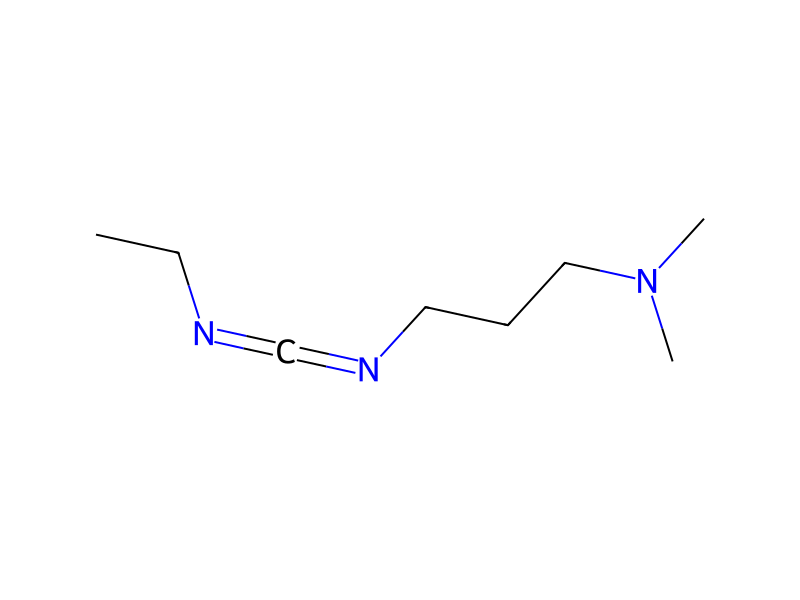
HCID 14798Sodium HydroxideHCID 159081-Ethyl-3-(3'-dimethylaminopropyl)carbodiimideHCID 757711-HydroxybenzotriazoleHCID 595651888-(4-Bromo-2-fluoro-phenylamino)-imidazo[1,5-a]pyridine-7-carboxylic acid methyl esterHCID 86637725(S)-1-aminooxypropan-2-ol hydrochloride

Produkt 1

HCID 44137363
8-(4-Bromo-2-fluoro-phenylamino)-imidazo[1,5-a]pyridine-7-carboxylic acid ((S)-2-hydroxy-propoxy)-amide
Ausbeute 26,4 %

Reagenzien, Katalysatoren, Lösungsmittel 3

HCID 284Formic AcidLösungsmittelHCID 962WaterLösungsmittelHCID 6342AcetonitrileLösungsmittel

Reaktionsbedingungen

Temperatur
65 °C

Versuchsvorschrift

To a solution of 8-(4-bromo-2-fluoro-phenylamino)-imidazo[1,5-a]pyridine-7-carboxylic acid methyl ester (587 mg, 1.61 mmol) in IMS (20 mL) was added a 1.0 M aqueous solution of sodium hydroxide (1.7 mL, 1.7 mmol). The reaction mixture was heated at 65° C. for 2 hours and then cooled to room temperature and concentrated in vacuo. The resulting residue was azeotroped with toluene, and then suspended in dioxane (15 mL). EDCI (614 mg, 3.2 mmol) and HOBt (432 mg, 3.2 mmol) were then added before the reaction mixture was stirred for 30 min at room temperature. (S)-1-Aminooxy-propan-2-ol hydrochloride (408 mg, 3.20 mmol) and N-N-diisopropylethylamine (1.1 mL, 6.44 mmol) were then added sequentially before the reaction mixture was stirred for 18 hours at room temperature. The reaction mixture was then concentrated under reduced pressure. The resultant residue was taken up in ethyl acetate, then washed with water followed by a saturated aqueous solution of sodium bicarbonate and brine, dried (Na2SO4), filtered and concentrated in vacuo. The resultant residue was subjected to flash chromatography (Si-PPC, gradient 0% to 10%, methanol in dichloromethane). The appropriate fractions were combined and concentrated to give a residue that was subjected to HPLC (Gemini 5 micron C18 250×21.20 mm column, 0.1% formic acid, acetonitrile in water, gradient 5% to 85%, ramp time 20 minutes) to afford the title compound as a pale yellow solid (180 mg, 26%). LCMS (method A): RT=6.55 min, [M+H]+=423/425. 1H NMR (CDCl3): 10.46 (1H, s), 8.75 (1H, s), 7.99 (1H, s), 7.39 (1H, d, J=7.36 Hz), 7.32 (1H, dd, J=9.31, 2.15 Hz), 7.28 (1H, d, J=8.83 Hz), 7.12 (1H, t, J=8.38 Hz), 6.63 (1H, s), 6.46 (1H, d, J=7.33 Hz), 4.10-4.01 (1H, m), 3.93 (1H, dd, J=11.43, 2.28 Hz), 3.70 (1H, t, J=10.42 Hz), 1.14 (3H, d, J=6.47 Hz).


Aufarbeitung

  1. temperaturecooled to room temperature
  2. concentrationconcentrated in vacuo
  3. customThe resulting residue was azeotroped with toluene
  4. stirringwas stirred for 18 hours at room temperature
  5. concentrationThe reaction mixture was then concentrated under reduced pressure
  6. washwashed with water
  7. dry with materialdried (Na2SO4)
  8. filtrationfiltered
  9. concentrationconcentrated in vacuo
  10. concentrationconcentrated
  11. customto give a residue that

Quellen und Nachweise

ORD-Eintrag
ord-73d40bfe073f45fab53b7d06fd7042f6
Quelldatensatz
uspto-grants-2012_10
DOI
10.6084/m9.figshare.5104873.v1
Patentnummer
US08293763B2

Notizen zur Reaktion

Auf dieser SeiteKomponentenReaktionsbedingungenVersuchsvorschriftAufarbeitungQuellen und NachweiseNotizen zur Reaktion